

By Suman Munshi,Kolkata
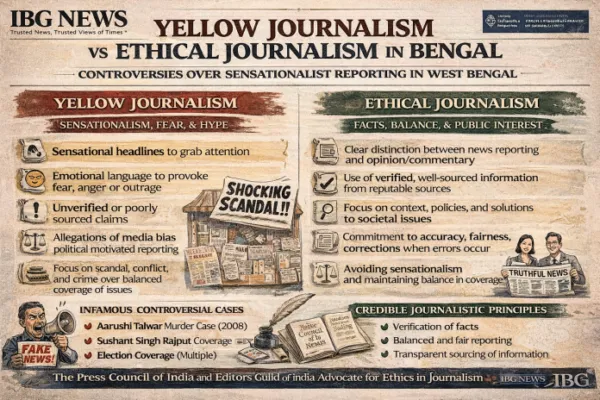
The term "yellow journalism" refers to a style of news reporting that emphasizes sensationalism, exaggeration, and emotionally charged narratives rather than balanced, fact-checked journalism . Although the phrase originated in the late nineteenth century, debates about sensational media practices remain relevant today in many parts of the world, including India.
In recent years, discussions about media credibility have intensified in West Bengal, where political polarization and the rapid growth of television and digital news platforms have led critics and analysts to question the quality of public discourse.
The term "yellow journalism" emerged in the United States during the rivalry between newspaper publishers Joseph Pulitzer and William Randolph Hearst in the 1890s. Their newspapers often competed by publishing dramatic headlines, exaggerated stories, and emotionally charged reporting designed to attract readers.
Historians frequently cite sensational newspaper coverage of the Spanish-American War as a defining moment in the rise of yellow journalism, when exaggerated reports helped shape public opinion.
While modern journalism standards have evolved significantly since then, media scholars argue that similar patterns of sensationalism occasionally appear in contemporary news environments.
Several controversies in India and internationally illustrate how sensational reporting can distort facts and influence public perception.
One of the most widely cited examples in India involved coverage of the Aarushi Talwar murder case in 2008.
Sections of the media speculated extensively about the private lives of the victim's parents before official investigations concluded.
The intense speculation led to accusations of "trial by media," where narratives were shaped through unverified claims and leaks.
Years later, courts criticized aspects of the investigation and media coverage for contributing to public confusion about the case.
Another widely debated case occurred following the death of actor Sushant Singh Rajput in 2020.
Several television channels devoted continuous coverage to the case, focusing on conspiracy theories and dramatic narratives rather than verified developments in the investigation.
Media watchdog groups and journalists argued that the reporting blurred the line between news coverage and entertainment, prompting debate about ethical journalism practices.
Election seasons often intensify concerns about sensational reporting.
In politically competitive regions such as West Bengal, critics sometimes accuse sections of television and digital media of amplifying dramatic political confrontations while giving less attention to policy issues such as healthcare, education, or economic development.
Supporters of these outlets argue that competitive political environments naturally produce dramatic news events, while critics say sensational framing can distort the public understanding of complex issues.
West Bengal has historically been one of India's most vibrant media markets, with strong traditions of print journalism and political commentary.
However, analysts point to several trends that have fueled debate about sensational reporting:
The state's competitive politics-particularly between parties such as the All India Trinamool Congress, Bharatiya Janata Party, and the Communist Party of India (Marxist)-often produce intense media narratives.
Critics say some outlets may adopt strongly partisan tones.
The expansion of continuous television news and online platforms has dramatically increased the speed of news reporting.
Media scholars note that the pressure to break stories quickly can sometimes lead to incomplete verification or exaggerated headlines.
Information spreads rapidly through digital platforms, where headlines and clips may circulate widely without full context.
This environment can amplify sensational narratives far beyond traditional news audiences.
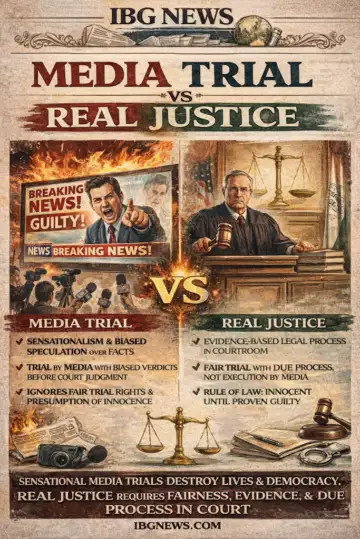 What is Media Trial
To maintain credibility, Indian journalism operates within ethical frameworks supported by institutions such as the Press Council of India and the Editors Guild of India.
These organizations emphasize key principles including:
Media scholars argue that strong editorial standards and media literacy among audiences are essential to counter sensationalism.
The question of sensational reporting is not unique to West Bengal or India. Across the world, journalists face increasing pressure from competition, political polarization, and the economics of digital media.
For readers and viewers, the challenge lies in distinguishing between verified reporting and emotionally driven narratives.
As media platforms evolve and audiences become more digitally connected, the demand for credible, fact-based journalism remains central to maintaining public trust in democratic societies.
Over the past 25 years, West Bengal has witnessed several high-profile criminal, political, and financial cases that received intense television and newspaper coverage, sometimes leading to accusations of "media trials."
The term generally refers to situations where public opinion about guilt or responsibility appears to be shaped through extensive media coverage before judicial proceedings conclude.
Below is a chronological list of major controversies in West Bengal between 2000 and 2025 that generated large-scale media debate and were frequently described as media trials.
The case became one of the first major television-driven controversies in Kolkata's modern media era.
The case became one of India's largest financial scandals linked to regional media networks.
Investigations were later handled by the Central Bureau of Investigation.
The case involved multiple leaders of the All India Trinamool Congress.
The case triggered discussions about hospital security, women's safety, and institutional accountability.
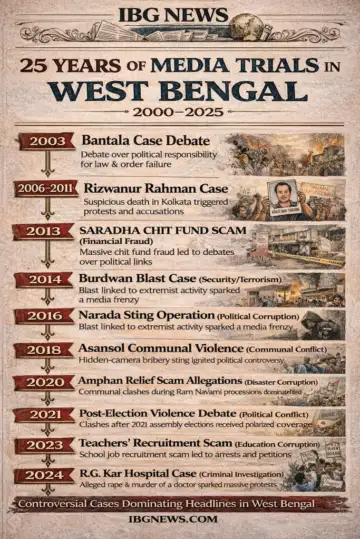
| Year | Case | Category |
|---|---|---|
| 2003 | Bantala case debate | Law & order |
| 2006-2011 | Rizwanur Rahman case | Suspicious death |
| 2013 | Saradha chit fund scam | Financial fraud |
| 2014 | Burdwan blast | Security / terrorism |
| 2016 | Narada sting operation | Political corruption |
| 2018 | Asansol communal violence | Communal conflict |
| 2020 | Amphan relief scam allegations | Disaster corruption |
| 2021 | Post-poll violence coverage | Political conflict |
| 2023 | Teachers recruitment scam | Education corruption |
| 2024 | RG Kar hospital case | Criminal investigation |
Legal experts and media scholars frequently note that media coverage can both expose wrongdoing and risk influencing public perception before courts complete investigations.
Institutions such as the Press Council of India emphasize the importance of:
Balancing press freedom and judicial fairness remains a continuing challenge in India's evolving media landscape.