

After a pathbreaking 2025, 2026 has already kicked off on a high note. January saw two new-age tech listings materialise, the year's first unicorn, and a clutch of IPO filings.
The scale underpinning this momentum is hard to ignore. India enters 2026 with 127 unicorns, 147 soonicorns, 60+ minicorns, 58 listed new-age tech ventures and over 2 Lakh DPIIT-registered startups.
Together, these moves signal that the world's third-largest startup ecosystem is ready to set the agenda for India's next growth chapter. But momentum does not mean smooth sailing. The past month threw up uncomfortable reminders of what comes with scale.
The fraud allegations engulfing beleaguered real-money gaming giant WinZO and the intensifying debate over gig worker welfare raised questions of trust, governance, and accountability.
And then there's the quiet, deeper shift underway. With sustained government and institutional push, the ecosystem appears to be stretching beyond its familiar consumer-facing playbook to deeptech and other frontier technologies. Deepinder Goyal's decision to step away from the day-to-day operations at Eternal to pursue riskier new ventures is emblematic of this mood.
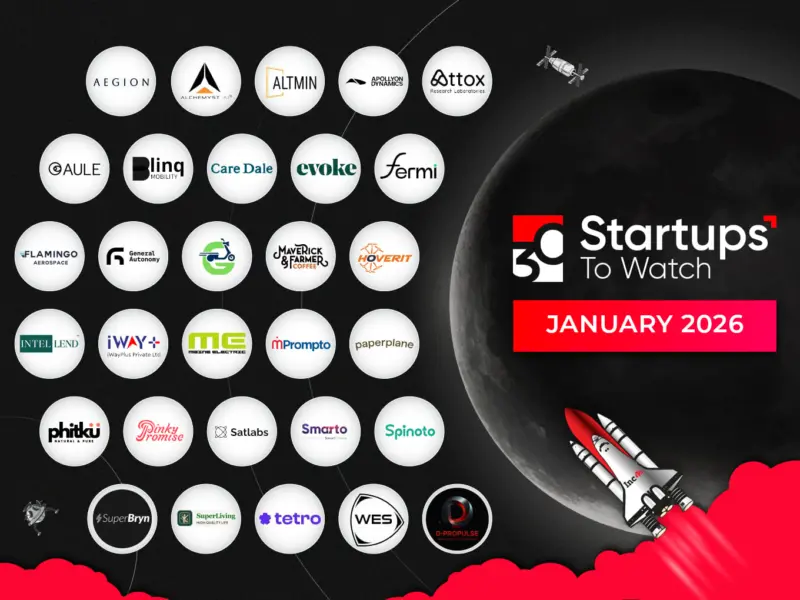
Against this backdrop, we are back with Inc42's flagship "30 Startups To Watch" series. In line with the broader mood, the 67th edition of the series features startups from sectors that seem to be the flavour of the season - AI, defence tech, manufacturing and semiconductors. Joining the list are also consumer brands that continue to bring forth deeper innovations.
Without further ado, here are the hottest early stage ventures that caught our eye in January.
Editor's Note: The list below is not a ranking but rather a window into startups that caught our eye last month.
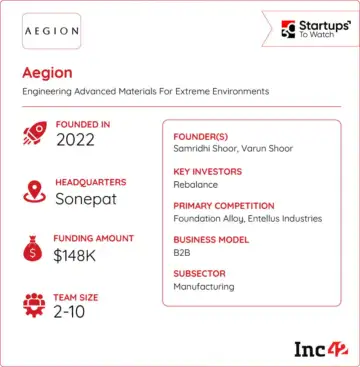
Aegion | Engineering Advanced Materials For Extreme Environments
Despite a strong government push to build India's manufacturing capabilities, the country remains heavily dependent on imports for aerospace and defence-grade materials and components, especially those requiring tight tolerances and advanced metallurgy. Long lead times, export controls and high costs make this a strategic vulnerability.
To address this gap, Saizal Shoor, Samridhi Shoor and Varun Dev Shoor founded manufacturing-focussed startup Aegion in 2022.
The startup is building domestic manufacturing capability for critical components, leveraging in-house engineering and materials science expertise to supply parts used in aerospace systems, defence platforms, energy equipment and space-adjacent applications.
Aegion has developed a closed-loop titanium recycling process that reclaims titanium, nickel and rare-earth metals from aerospace scrap using a hydrogen-assisted metallothermic method. This process produces low-oxygen, high-purity metal feedstock suitable for additive manufacturing, powder metallurgy and ingot casting, while preserving alloy chemistry and performance.
Using these materials, the startup manufactures titanium superalloys, nickel superalloys and superalloy powders for the defence, aerospace and energy sectors.
Unlike conventional machine shops, Aegion operates at the intersection of advanced materials and precision manufacturing. Its focus on indigenous production aligns closely with India's defence indigenisation and aerospace localisation push. Backed by Rebalance, the startup is targeting India's advanced materials market, projected to grow to around $21.5 Bn by 2030.
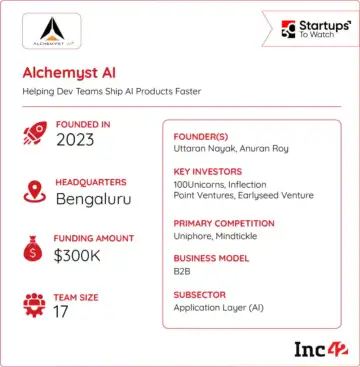
Alchemyst AI | Helping Dev Teams Ship AI Products Faster
Enterprises often struggle to build and integrate GenAI applications and intelligent agent systems at scale due to platform fragmentation, slow development cycles and the complexity of managing memory and context.
Founded in 2023 by Uttaran Nayak and Anuran Roy, Alchemyst AI is building infrastructure software to accelerate AI application development and deployment.
The startup offers a neural memory and data layer for AI-native and LLM-powered applications, enabling development teams to ship AI agents faster. Its platform supports context retention, observability and tooling integration, simplifying how generative AI products are built and scaled.
Unlike single-purpose AI tools, Alchemyst AI focusses on the core infrastructure layer for multi-agent and LLM systems.
This approach aims to reduce development friction for enterprises and lower dependence on generic LLM stacks.
Backed by Inflection Point Ventures, 100Unicorns and EarlySeed Ventures, the startup is tapping into the rapid adoption of GenAI (expected to become a $5.4 Bn opportunity by 2033) across enterprise workflows. These are driving demand for robust infrastructure that can support memory, context and observability at scale.
Altmin | Next-Gen Battery Materials
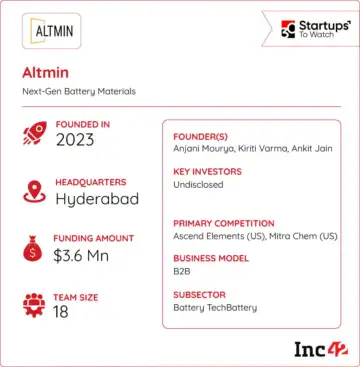
To reduce India's dependence on foreign-dominated mineral supply chains, Anjani Sri Mourya Sunkavalli founded the cell-engineering-focused startup Altmin in 2023.
The Hyderabad-based startup manufactures lithium iron phosphate (LFP) cathode active materials for lithium-ion batteries and specialises in refining spodumene ore into battery-grade lithium. It is also developing LMFP cell chemistry, which uses lithium manganese ferrophosphate in the cathode to deliver higher energy density and improved safety, while supplying sustainable battery-grade lithium carbonate.
Beyond manufacturing, Altmin is working to strengthen India's lithium supply chain by integrating upstream with mining and refining partners in South America.
The startup has partnered with the International Advanced Research Centre for Powder Metallurgy and New Materials (ARCI) to develop high-performance materials and processes for niche markets. It is also setting up India's first cathode giga factory in Telangana, with a planned capacity of over 8 GWh and annual production of more than 30,000 metric tonnes of battery-grade lithium carbonate.
In December, Altmin signed an MoU with Singareni Collieries Company and the Government of Telangana to build the INR 2,250 Cr facility. India's lithium-ion battery cathode market is projected to grow to over $3.2 Bn by 2030.
Apollyon Dynamics | Developing Advanced UAV Systems
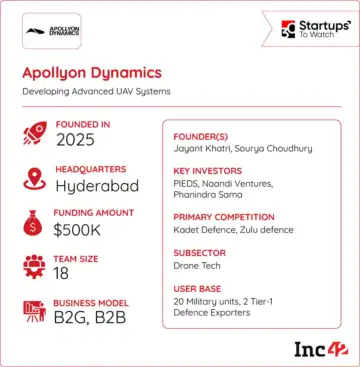
Growing conflicts across the globe have accelerated the Centre's push to indigenise defence technology supply chains, reduce import dependence and strengthen national security. This shift has also opened up the Indian defence market to new-age tech companies.
Looking to capitalise on this rapid expansion, BITS Hyderabad students Jayant Khatri and Sourya Choudhury founded dronetech startup Apolloyn Dynamics in 2025.
Incubated in on-campus hostel rooms, the startup is developing three kamikaze drones for defence applications.
Its flagship drone, Ahuti, is designed for low-altitude, high-velocity penetration in short-range tactical scenarios. Pralaya focusses on higher payload delivery to support frontline logistics resilience, while Abhyas is a smaller, long-endurance intelligence-gathering drone with a real-time encrypted data link.
One of the startup's key milestones so far is securing a contract from the Indian Army to build and deploy India's first mobile drone lab. Now operational in Jammu, it can produce over 100 first-person-view (FPV) drones every month, enabling rapid assembly, repair and deployment just kilometres from active combat zones. It operates in the country's military and tactical drone (UAV) market is projected to nearly double from $1.9 Bn in 2025 to around $5 Bn by 2033.
Attox Research Labs | Developing Advanced Diagnostic Tools
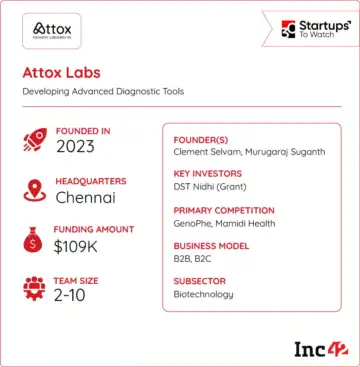
Traditional diagnostics rely heavily on large, centralised laboratories, long turnaround times and costly reagents and infrastructure, limiting timely and precise health insights, especially in point-of-care settings.
Founded in 2023 by Clement D and Suganth Murugaraj, Attox Research Laboratories (Attox Labs) is a biotech and medical diagnostics startup building next-generation diagnostic tools to address these gaps.
Based in Chennai, the startup is developing advanced diagnostic instruments that combine printed electrodes, nano-engineered materials such as graphene and carbon nanotubes, and AI-powered bioanalysis to deliver health data seamlessly.
Its product portfolio includes smart diagnostic devices for real-time bioanalysis, modular point-of-care systems and adaptive biosensors capable of analysing minerals, hormones and other biological markers with greater speed and sensitivity than conventional lab tests.
By combining deep materials engineering with AI-enabled diagnostics, Attox Labs aims to deliver laboratory-grade precision in decentralised, point-of-care environments. While in the early stage, the startup aims to capture India's point-of-care diagnostics market, expected to grow to around $1.2 Bn by 2033.
Aule Space | Building Robotic Workforce For In-Orbit Satellites
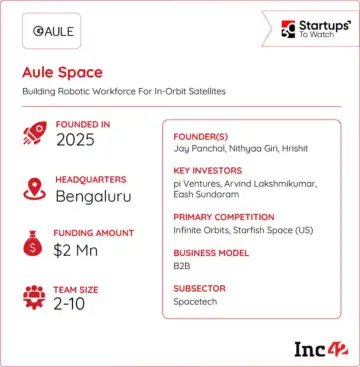 As satellite launches increase, many spacecraft are retired once they run out of fuel, despite their systems remaining fully functional. This strands billions of dollars in space assets and adds to orbital debris, a growing risk for space operations.
Bengaluru-based Aule Space is addressing this challenge by building autonomous servicing satellites equipped with docking systems that can approach, attach to and service spacecraft in orbit.
Founded in 2024 by Jay Panchal, Nithyaa Giri, and Hrishit Tambi, the startup's technology enables life extension of high-value satellites, close-range inspection of space assets and safe decommissioning of non-functional spacecraft.
Its systems combine AI-driven guidance, navigation and control with satellite-agnostic docking mechanisms to perform autonomous rendezvous, proximity operations and docking (RPOD) across geostationary and other orbits.
By focussing on non-cooperative docking, Aule aims to build one of the lightest and most cost-efficient fleets of service satellites, targeting a key gap in the global space economy where routine in-orbit maintenance infrastructure remains limited.
With autonomous docking recently demonstrated by Indian space missions and launch costs declining globally, in-orbit servicing is moving from concept to commercial reality. The on-orbit satellite servicing market was valued at $2.7-3 Bn in 2024 and is expected to reach around $8 Bn by 2034.
Blinq Mobility | Sustainable Mobility Solutions For Dense Urban Environments
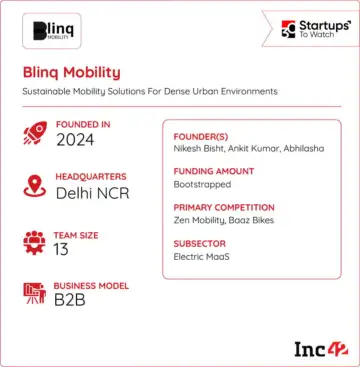
Although EVs are widely seen as the future of mobility, adoption in India remains constrained by long charging times, high upfront costs and low operational uptime. These challenges are most acute in high-utilisation segments such as ride-hailing, last-mile delivery and fleet transport, where downtime directly impacts economics.
Founded in 2024 by Nikesh Bisht, Ankit Kumar, Abhilasha Marmat, Sushmita Patil and Yashdeep Singh, Blinq Mobility is building sustainable mobility solutions for dense urban environments.
The Gurugram-based startup is developing purpose-built, lightweight EVs centred around a fast battery-swapping architecture.
Depleted batteries can be replaced with fully charged ones in minutes, eliminating long plug-in charging cycles and maximising vehicle availability for commercial operators.
Unlike conventional EV makers that retrofit charging systems into existing vehicle platforms, Blinq's modular vehicles are engineered from the ground up with battery swapping at the core. This design reduces idle time, lowers the total cost of ownership and improves uptime. As fleet electrification gains momentum, Blinq is targeting India's growing micro-mobility market, which is projected to expand from $2.2-2.5 Bn in 2024 to $8-8.3 Bn by 2033.
CareDale | Dermatologist-Backed Shower Filters
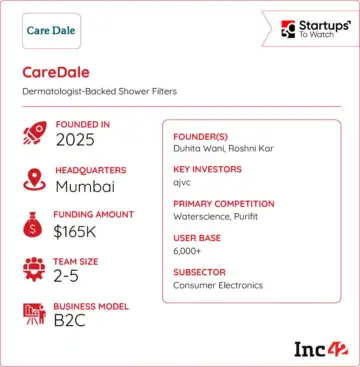
After moving across multiple cities, ex-Accenture executive and IIT Kharagpur alum Duhita Wani began facing severe hair fall, acne and other skin issues caused by inconsistent water quality.
Partnering with college mate Roshni Kar, she discovered that most tap and shower filters in the market were not designed to effectively tackle hard water.
Many existing solutions rely on low-cost, generic filtration that offer only temporary or cosmetic fixes. This insight pushed the duo to incorporate Care Dale in 2025. The startup develops tap and shower water filters powered by CareTec, its proprietary advanced filtration technology. Designed to neutralise hard-water minerals and chlorine, CareTec helps protect hair and skin from dryness, hair fall, acne and irritation. The founders consulted over 100 dermatologists and iterated extensively before launching their first set of products.
Sold primarily through online channels, Care Dale has reached more than 6,000 households across India. Backed by ajvc, the startup is targeting India's growing water purifier market, expected to cross $7 Bn by 2032, and plans to expand its product portfolio with filtration solutions focussed on long-term efficacy and care.
D-Propulse | Unlocking Future Of High-Speed Transit
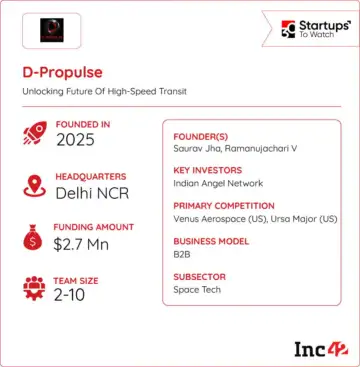
India remains heavily dependent on legacy propulsion technologies for high-speed defence platforms, resulting in systems that are large, expensive and difficult to scale. This comes at a time when global defence is shifting from radar stealth towards speed-based deterrence.
Founded in 2025 by defence expert Saurav Jha and former DRDO scientist V Ramanujachari, D-Propulse is developing indigenous rotating detonation engine-based propulsion systems for high-supersonic and hypersonic platforms.
Unlike conventional jet engines, rotating detonation engines have no moving parts, are mechanically simpler, easier to manufacture and deliver thermal efficiency gains of over 25%.
This allows for smaller engines with higher output.
As integrated air and missile defence systems reduce the effectiveness of radar stealth, speed is emerging as a critical strategic advantage. While interest in rotating detonation propulsion in India is still nascent, D-Propulse is positioning itself at the intersection of national security, cost efficiency and next-generation aerospace systems.
The startup claims to have achieved a meaningful technology readiness level in air-breathing rotating detonation engine combustors and is advancing towards flight-capable demonstrators, with early engagements underway with the Indian military. The opportunity aligns with India's electric propulsion systems market, projected to grow from $25.98 Mn in 2024 to $196.36 Mn by 2033.
Evoke | Providing High-Impact Hair Transplant Solution
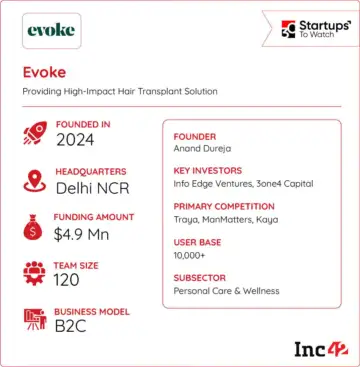
Access to quality preventive healthcare and wellness services remains uneven in India, with many patients increasingly seeking personalised clinics that offer care continuity and transparent treatment experiences.
Founded in 2023 by former Urban Company and OYO CXO Anand Dureja, Evoke Haircare provides hair restoration and skin treatment services through specialised clinics. Its haircare offerings include hair transplants, PRP therapy, low-level laser therapy and other non-invasive treatments. In skincare, the startup offers solutions such as acne scar treatment, wrinkle reduction, microneedling and chemical peels.
Evoke claims to use advanced medical technologies delivered by trained professionals, while also offering structured aftercare support to improve treatment outcomes.
The startup operates in a competitive landscape alongside players such as Traya, ManMatters and Kaya
Rising disposable incomes and increasing awareness around appearance-led wellness are driving demand for medical aesthetics and haircare services in India. Evoke is targeting this growing opportunity within the Indian medical aesthetics market, which was valued at around $598 Mn in 2024 and is projected to reach approximately $1.27 Bn by 2033.
Fermi | Edtech Gets An AI Tweak
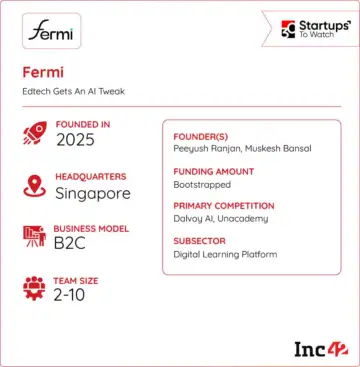
Despite widespread AI adoption in edtech, most platforms still rely on answer-generating chatbots that prioritise speed over understanding. This often weakens conceptual learning, limits teachers' role and gives educators little visibility into how students think or where they struggle.
To address this, Cult.fit founder Mukesh Bansal and former Google senior executive Peeyush Ranjan launched AI-based edtech startup Fermi in January.
Based in Singapore, Fermi is an AI-first learning platform focussed on STEM education for school students. In India, it offers after-school coaching for Classes 9-12, beginning with physics, chemistry and mathematics, while in the US it targets Advanced Placement STEM courses.
Unlike conventional AI tutors, Fermi guides students through the problem-solving process without revealing answers upfront, encouraging conceptual understanding.
The platform is stylus-first, allowing students to write on tablets to replicate pen-and-paper learning, while providing teachers with analytics to personalise instruction.
Following a three-month pilot with 79 students, Fermi has launched fully and plans to expand globally, add subjects such as biology for NEET, and introduce courses in engineering, accounting and data science. While currently free, a paid rollout is planned, with external fundraising to follow once stronger traction is achieved. Both founders are also partners at early stage venture firm Meraki Labs, which is backing Fermi with advisory support and initial capital.
Flamingo Aerospace | Building End-To-End Aviation Ecosystem
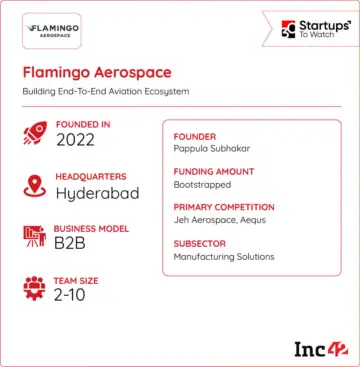
Aiming to build an indigenous aviation and aerospace ecosystem in India beyond aircraft assembly, former Mapprr founder Pappula Subhakar set up Flamingo Aerospace in 2022.
Based in Hyderabad, the startup focusses on aerospace manufacturing, avionics systems development, flight simulation technology, aviation material recycling and operational support for aircraft components and systems.
Its emphasis on precision engineering and localised production is aimed at reducing manufacturing and operating costs.
Flamingo Aerospace is positioning itself to develop fully Made-in-India aircraft platforms while strengthening the end-to-end aerospace supply chain. Beyond building its own aircraft, the company is investing in assembly, maintenance, repair, and overhaul (MRO) capabilities, seeking to move beyond being a parts supplier.
In late January, the startup conducted a demonstration flight at Begumpet Airport in Hyderabad and signed a partnership with United Aircraft Corporation to supply and codevelop aircraft. The collaboration is expected to enhance Flamingo's technical capabilities and manufacturing infrastructure.
Flamingo is targeting both domestic and global aviation markets as demand rises across commercial aircraft manufacturing and aerospace components, a market projected to reach $54-$61 Bn by the early-to-mid 2030s.
General Autonomy | Building Affordable Robots For Everyday Chores
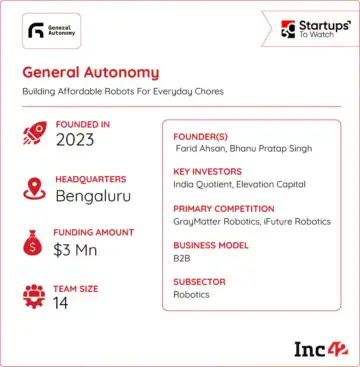
Founded in 2023 by ShareChat cofounders Farid Ahsan and Bhanu Pratap Singh, Bengaluru-based General Autonomy is building autonomous and semi-autonomous robots for everyday and industrial use cases.
The startup is developing a range of robotics platforms, including humanoid robots and versatile utility robots, that use AI and ML to perform tasks such as inspection, safety operations, logistics support and human-robot collaboration. Early public demonstrations have showcased autonomous systems designed to operate reliably in unstructured and dynamic environments.
General Autonomy's focus on building affordable, homegrown autonomous AI agents sets it apart from robotics players that rely on bespoke industrial systems or imported hardware. Its robots are engineered for contextual adaptability and broader commercial deployment across sectors such as safety, logistics and infrastructure inspection.
Backed by Elevation Capital and India Quotient, the startup has built multiple prototypes spanning humanoid and utility platforms, and is preparing to scale production and begin commercial sales.
The opportunity aligns with the rapid expansion of the AI-enabled home robotics and service robots market, which is expected to grow from $17-$18 Bn in 2025 to over $70 Bn by 2033.
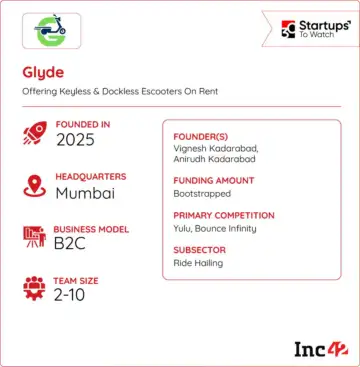
Glyde | Offering Keyless & Dockless Escooters On Rent
Millions of urban commuters struggle with daily short trips of two to five kilometres, with few reliable options between transit hubs and final destinations. Existing services are often unreliable, surge-priced or poorly suited for frequent, short-distance travel.
Founded in 2025 by Vignesh Kadarabad and his brother Anirudh Kadarabad, Glyde is a dockless escooter rental platform built to address last-mile mobility challenges in Indian cities.
Through its mobile app, users can locate and unlock electric scooters on demand, ride for short distances and park them in designated zones. The model offers a fast, affordable alternative to autos, cabs and overcrowded public transport.
By combining electric mobility with app-enabled convenience, Glyde aims to make everyday urban travel quicker, cleaner and more dependable, while reducing traffic congestion and emissions.
The platform has initially set its eyes on tier I city commuters, including working professionals and university students seeking low-cost, short-distance travel options that complement public transport.
Glyde is tapping into India's growing EV two-wheeler rental market, which is projected to reach nearly $478 Mn by 2034.
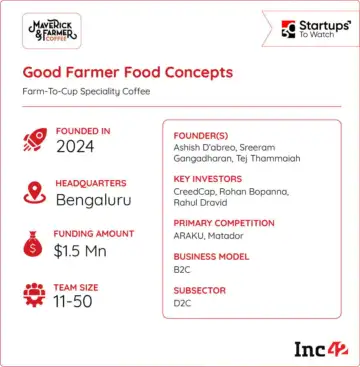
Good Farmer Food Concepts | Farm-To-Cup Speciality Coffee
India's premium coffee and casual dining market has largely been shaped by global chains, leaving limited room for homegrown brands that combine origin-led sourcing, product quality and community-driven café experiences.
Founded in 2024 by Ashish D'abreo, Sreeram Gangadharan and Tej Thammaiah, Good Farmer Foods is building a homegrown alternative in this space.
Based in Bengaluru, the startup operates multiple consumer brands across specialty coffee, cafés, retail and quick-service dining.
Its flagship brand, Maverick & Farmer Coffee, follows a farm-to-cup model, sourcing beans from its 140-acre estate in Pollibetta, Coorg, roasting them locally and selling through cafés, B2B partnerships and D2C channels.
It also runs Square Burgers & Co, a fast-casual burger brand focused on clean ingredients and affordability.
Good Farmer Foods operates seven cafés across Bengaluru and Goa and supplies coffee to enterprise and hospitality clients. Its products are also sold via its own online platform. As demand grows for premium yet local food and beverage brands, the startup is targeting India's speciality and artisan coffee market, expected to nearly double from $2.9-$3 Bn in 2024-25 to $6.2-6.5 Bn by 2030-31.
HoverIt | Mission-Grade UAVs For Defence & High-Value Operations
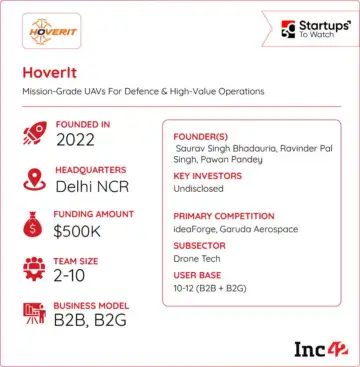
As India accelerates efforts to indigenise defence and aerospace manufacturing, unmanned aerial systems (UAS) have emerged as a strategic priority for surveillance, reconnaissance and tactical operations. However, a large share of mission-grade drone hardware continues to be imported, creating dependencies around cost, supply chains and operational readiness.
Founded in 2022 by former Kalaari Capital partner Ravinder Pal Singh, commercial pilot Saurav Singh and Kawa Tech founder Pawan Pandey, HoverIt is building indigenously designed and manufactured UAV platforms for defence and strategic enterprise use cases.
The startup focusses on mission-ready drones and autonomous aerial systems rather than consumer or hobbyist products, with in-house capabilities spanning airframes, propulsion, avionics, autonomy software and payload integration.
HoverIt's platforms are optimised for intelligence, surveillance and reconnaissance (ISR) missions, prioritising reliability, endurance and compliance with defence requirements. Operating out of the Uttar Pradesh Defence Industrial Corridor, the company is closely aligned with India's defence manufacturing and procurement ecosystem.
With deep experience across aviation and unmanned systems design, testing and deployment, the founding team brings a practical understanding of mission-critical operations. HoverIt is targeting long-term defence programmes as India's defence UAV and autonomous aerospace systems market grows from $1.9 Bn in 2025 to around $5 Bn by 2033.
Intellend | AI-Powered Lending For India's MSMEs
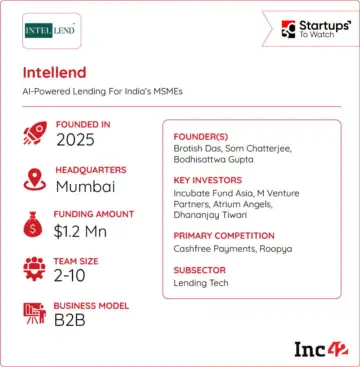
India's cash-starved MSMEs face a credit shortfall of more than $500 Bn. Over half of these small businesses still can't access formal loans, forcing many to rely on costly, informal borrowing. Mumbai-based Intellend is trying to fix this.
Founded in 2025 by former Quantbox Research CRO Brotish Das, ex-121 Mapping Business Solutions CEO Som Chatterjee and ex-Standard Chartered executive Bodhisattwa Gupta, Intellend partners directly with merchant platforms and financial institutions to deliver affordable credit right when it's needed in a risk-balanced manner.
Intellend is building a full-stack lending-as-a-service (LaaS) platform designed for digital merchants. It enables seamless, embedded credit access for underserved MSMEs using advanced data analytics, AI-driven underwriting, and technology-led risk assessment.
The startup claims to have already integrated its lending workflows with multiple merchant ecosystems, enabling it to collectively serve over 1 Lakh merchants.
With a focus on short-term financing solutions featuring fixed or flexible repayment options, the startup claims its edge lies in offering a frictionless loan experience with minimal documentation and faster disbursements. Simultaneously, its tech stack helps merchant platforms deepen engagement and retention.
The fintech startup is eyeing a share of the broader Indian embedded finance market, which is projected to cross $30 Bn by FY30.
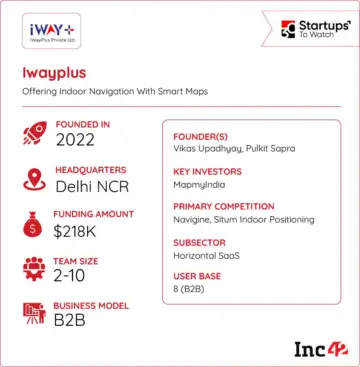
Iwayplus | Offering Indoor Navigation With Smart Maps
As large indoor environments such as hospitals, airports, malls and campuses scale up, traditional static signage and fragmented wayfinding systems fail to enable efficient navigation, crowd insights or real-time positioning. This creates a blind spot in digital mapping, where GPS signals do not work reliably.
Founded in 2022 by Vikas Upadhyay and Pulkit Sapra, and incubated at IIT Delhi's Assistech Lab, Iwayplus builds indoor mapping, positioning and navigation solutions for complex enclosed spaces.
Its technology stack combines detailed 2D and 3D maps, real-time positioning signatures and location-based services, supported by hardware such as Bluetooth beacons and sensors. These capabilities enable wayfinding, asset tracking and crowd management across large indoor facilities.
Unlike traditional outdoor mapping platforms, Iwayplus focusses on indoor geolocation, providing geocoded floor plans and navigation where GPS falls short.
The startup claims to have mapped eight large indoor facilities for clients, including AIIMS and Ashoka University.
Iwayplus made revenues of INR 76 Lakh in FY25. In January 2026, listed geospatial firm MapmyIndia acquired a 6% stake in the startup for INR 2 Cr. The company operates at the intersection of geospatial intelligence and embedded digital services, a market projected to grow from $5.7 Bn in 2024 to around $28-$30 Bn by 2029-30.
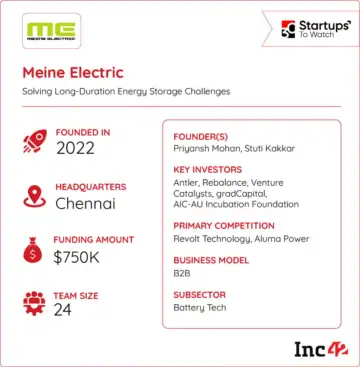
Meine Electric | Solving Long-Duration Energy Storage Challenges
As renewable energy penetration accelerates across India and APAC, long-duration energy storage (LDES) has emerged as a key bottleneck. While lithium-ion batteries work for short bursts, they struggle to economically deliver the 16-24 hours of storage needed for round-the-clock renewable power, exposing grids to intermittency.
Founded in 2023 by metal-air technologist Priyansh Mohan and ex-BCG consultant Stuti Kakkar, Meine Electric is building iron-air LDES systems designed for affordable, multi-hour storage.
The startup claims its batteries can be fully charged in eight hours and deliver 16-24 hours of storage at a levelised cost of under $0.05/kWh.
Using abundant materials such as iron, air and water, Meine Electric relies on a reversible rusting process to store and release electricity, making the technology scalable and sustainable. Its systems are built for integration with solar-heavy grids, C&I deployments and off-grid use cases.
Operating from a 5,000 sq ft facility in Chennai, the startup holds four granted patents and seven international filings. Meine Electric is targeting India's grid energy storage market, projected to grow from $9 Mn in 2024 to about $250 Mn by 2033.
mPrompto | Intelligent Co-Pilot Between Brands & Customers

In a crowded digital landscape, many brands struggle to convert visitor interest into confident purchase decisions. While shoppers often know what they want, hesitation and drop-offs lead to high traffic but weak conversion outcomes.
Founded in 2023 by Rediff founding team member Sumit Rajwade and Ketan Kasabe, mPrompto is building an AI-powered customer engagement platform designed to address this gap. The platform helps brands understand why customers hesitate and guides them towards informed decisions in real time.
Instead of relying on static analytics, mPrompto uses machine learning and behaviour-driven AI to interpret user intent and deliver context-aware nudges on brand websites. Acting as a customer co-pilot, it learns continuously from on-site behaviour and offers personalised, privacy-first prompts that feel assistive rather than intrusive.
The platform integrates seamlessly with existing digital properties through a plug-and-play setup. Early case studies show improvements in key metrics such as add-to-cart and cart-to-checkout conversion rates.
mPrompto operates within the fast-growing AI-assisted conversational and prompt-powered tools market, which is expected to expand from $6.95 Bn in 2025 to about $40.87 Bn by 2030. By focusing on decision logic over click tracking, mPrompto aims to become a critical engagement layer for modern digital commerce.
paperplane | Offering Curated Hotels In Great Neighbourhoods
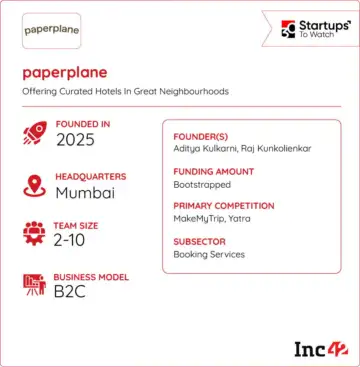
As Indian travellers increasingly seek personalised, cost-efficient leisure experiences, niche, membership-led travel models are emerging as alternatives to mainstream OTAs.
Founded in 2025 by ex-Stoa cofounders Aditya Kulkarni and Raj Kunkolienkar, Paperplane is a travel club and booking platform offering wholesale hotel pricing and curated vacation planning for Indian travellers. The startup operates on a membership model, giving users access to hotel rates that are typically 10-50% lower than prices on platforms like Booking.com, Agoda or MakeMyTrip.
Members pay INR 10,000 for a two-year subscription, which Paperplane claims most users recover on their first booking, with potential savings of INR 30,000-50,000 per trip.
Alongside discounted stays, the platform offers concierge-style travel planning, early booking credits and access to offbeat holiday experiences, positioning itself as a community-driven alternative to transactional OTAs.
Paperplane has partnered with over 3,000 properties in India and globally, including The Leela, ITC, JW Marriott, Novotel and The Postcard Hotel. As India's hotel market is projected to reach about $22.41 Bn by 2030, the startup is targeting value-conscious "global Indians" looking to avoid overpaying for hotels while still accessing premium experiences.
phitku | Alum Crystal Roll-On Deodorant
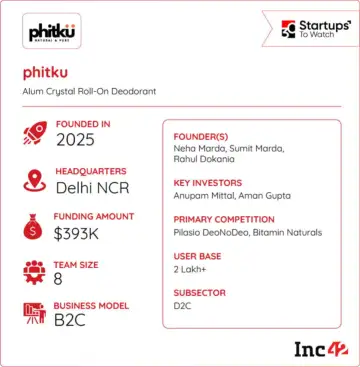
As awareness around clean beauty and skin-safe personal care grows, consumers are increasingly questioning deodorants that rely on synthetic fragrances and harsh chemicals to mask body odour rather than address it at the source.
Founded in 2025 by Neha Marda Agrawal, Sumit Marda and Rahul Dokania, Phitku is building a clean personal care brand in the alum-based natural deodorant category. Its flagship product is a 100% natural alum crystal roll-on deodorant, offered in variants such as Natural, Aloe Vera and Turmeric. The products are free from alcohol, artificial fragrances and harsh additives, and are dermatologically tested for use across skin types.
Phitku positions itself as a skin-friendly alternative to conventional deodorants by leveraging alum (phitkari) to neutralise odour-causing bacteria instead of masking smell. By combining traditional ingredients with modern product design, the brand aims to deliver effective, chemical-free freshness and underarm care.
The startup gained national visibility after appearing on Shark Tank India Season 5, where it secured investment from boAt cofounder Aman Gupta and Shaadi.com founder Anupam Mittal.
As India's roll-on deodorant segment is projected to grow to around $793.4 Mn by 2033, Phitku is targeting a fast-expanding market for natural, toxin-free personal care solutions.
Pinky Promise | Judgement-free Consultation With Gynaecologist
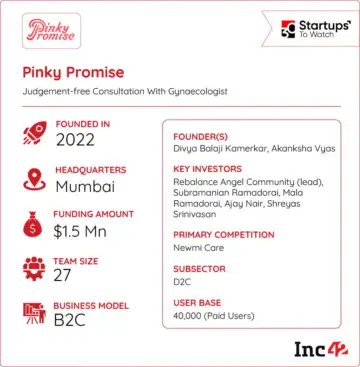
Access to timely, judgement-free women's healthcare remains a major gap in India, with many women facing stigma, long waits and limited privacy when seeking help for reproductive, menstrual or hormonal concerns. Traditional clinics often fall short on convenience and affordability.
Founded in 2022 by Divya Balaji Kamerkar, Pinky Promise is building an AI-assisted women's health platform that offers instant, confidential and low-cost access to qualified gynaecologists. Through its app, users can describe symptoms at any time, after which an AI-led assessment helps triage concerns before connecting them with licensed doctors.
Consultations on the platform start at INR 99, with additional support for follow-ups, second opinions, lab test coordination and personalised care plans.
Pinky Promise addresses a wide range of issues, including menstrual health, fertility, infections and hormonal disorders, combining AI-driven symptom analysis with real clinician support.
By reducing barriers around cost, privacy and access, the startup aims to make women's healthcare more inclusive across income groups and geographies. Pinky Promise claims to have served over 3.5 Lakh users since its inception and is targeting India's fast-growing telemedicine market, which is expected to reach around $20 Bn by 2033.
Satlabs Space Systems | Enhancing Real-Time Communication Between Orbit And Earth
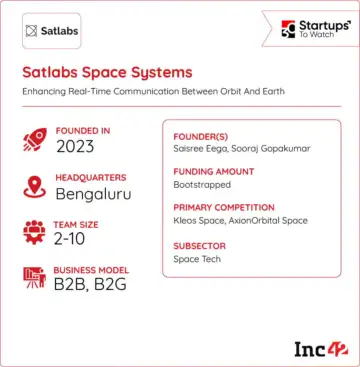
As satellite constellations scale globally, one persistent bottleneck remains real-time connectivity. Most satellites can downlink data only when passing over ground stations, creating latency, limiting responsiveness and reducing the value of time-sensitive data.
Founded in 2023 by Saisree Eega and Sooraj Gopakumar, Satlabs Space Systems is building a global data relay satellite network to enable 24×7 connectivity and real-time access to space assets. Instead of waiting for ground-station windows, satellite operators can connect to Satlabs' network to task and re-task spacecraft dynamically and access data continuously.
The Bengaluru-based startup is developing a software-defined space network that uses inter-satellite links, intelligent routing software and a single API interface.
Crucially, its system is designed to work with existing satellites without requiring proprietary transponders, making it broadly compatible and easier to adopt.
By democratising access to real-time command and data relay infrastructure - a capability typically reserved for large space agencies - Satlabs aims to unlock new use cases across Earth observation, communications and responsive space missions. The startup is building at the intersection of India's growing earth observation and satellite imagery market, which is projected to reach about $1.83 Bn by 2032.
Smarto Cabs | Bringing All-Electric Rides To Smaller Indian Cities
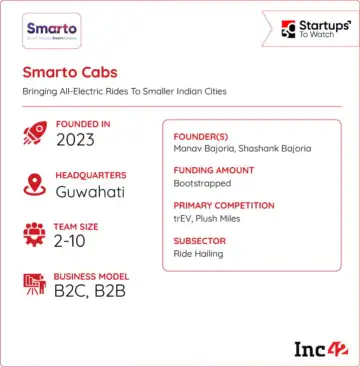
Adoption of electric vehicles remains fragmented in tier II and III Indian cities, leaving consumers and businesses with limited green mobility options.
Founded in 2022 by Manav and Shashank Bajoria, Smarto Cabs operates an all-electric fleet offering airport transfers, city rides, outstation trips and hourly rentals - all with flat, surge-free pricing and simple booking via WhatsApp or phone.
Unlike traditional taxis, Smarto combines sustainability with convenience, delivering predictable fares, comfortable rides and a scalable platform.
The startup also serves corporate clients and event organisers, extending its reach to B2B use cases such as employee transport and event logistics.
With India's electric mobility ecosystem expanding rapidly, government incentives driving EV adoption and rising environmental awareness among commuters, Smarto is targeting a market hungry for cleaner, quieter and reliable transport solutions.
The startup is positioned in India's local taxi and EV cab services segment, projected to grow from $20.6 Bn in 2025 to around $30.65 Bn by 2030. By providing a customer-friendly and sustainable alternative, Smarto aims to bridge the gap in urban mobility and make green transport practical across smaller Indian cities.
Spinoto | Roadside Assistance In 15-Mins
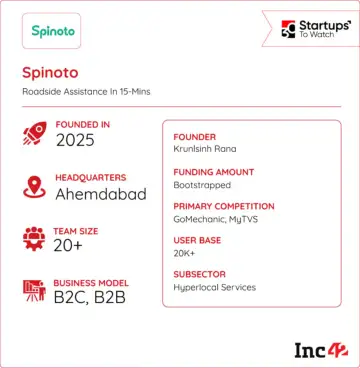
A vehicle breakdown can create a stressful moment for an owner. Long waiting hours, fragmented roadside assistance, unclear pricing, and uncertainty about mechanic quality can turn a small issue into an all-day disruption. These inefficiencies become even worse when it comes to electric vehicles (EVs).
Enter Spinoto, a platform trying to make roadside help as easy as ordering food online.
Founded in 2025 by Krunalsinh Rana, Spinoto is building an on-demand service platform that promises to dispatch a trained mechanic to a customer's location within 15 minutes.
Users can currently book a technician for issues such as breakdown assistance, routine servicing, minor maintenance and basic EV diagnostics
Spinoto operates through a network of dark stores that are stocked with commonly required spare parts and tools. When a service request is raised on the app, the system pre-assesses the issue, maps required parts and assigns the nearest mechanic. This ensures that the technician arrives equipped to resolve the problem on-site, without delays for diagnosis or part sourcing.
The startup is currently operational in Ahmedabad, where it is focussed on improving response times, technician readiness and supply availability. Spinoto plans to expand to other tier I cities, including Mumbai, Bengaluru, Delhi and Hyderabad, in a phased manner.
Over time, Spinoto aims to evolve into a broader vehicle ownership services ecosystem, rather than remaining a standalone repair platform.
The startup is vying for a piece of India's broader automotive service market, which is projected to become a $81.8 Bn opportunity by 2035.
SuperBryn | Helping Enterprises Evaluate VoiceAI Failures
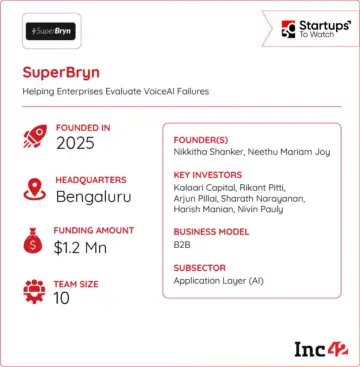
Many enterprise voice AI systems work well in controlled demos, but fail when deployed at scale in real-world conditions. This production gap - caused by accents, background noise, complex conversations and unpredictable use cases - leads to silent failures that organisations struggle to detect, analyse and fix.
Founded in 2025 by Nikkitha Shanker and Dr Neethu Mariam Joy, SuperBryn is addressing this gap by building a reliability infrastructure that enables enterprises to evaluate, observe and understand why voice agents fail in production and how to fix them.
SuperBryn's tools generate real-data test scenarios, monitor every call in live environments across speech-to-text, LLMs and text-to-speech pipelines and trace failures to their root causes.
It is also building future capabilities, which will enable continuous and automated improvement without human intervention.
As voice AI deployments grow rapidly in enterprises worldwide, reliability has emerged as the biggest bottleneck to scaling adoption. SuperBryn's focus on production-grade evaluation aligns with the urgent needs of critical sectors, where failures can have compliance or safety implications.
With its tech stack, SuperBryn is eyeing a piece of India's growing conversational AI market, projected to reach $17 Bn by 2030.
SuperLiving | Personalised Wellness Tailored For India
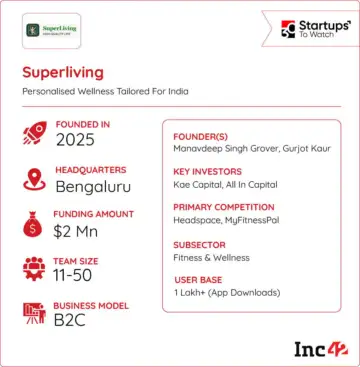
Millions of Indians in Tier II and Tier III cities face fatigue, poor sleep, gut issues, joint pain, and low energy. These issues are generally brushed off as not severe enough for a doctor, but can be disruptive enough to affect daily life.
Founded in 2025 by Manavdeep Singh Grover and Gurjot Kaur, SuperLiving is an AI-powered preventive lifestyle platform that provides personalised guidance across nutrition, movement, sleep, stress, and daily habits.
The platform combines bite-sized courses, snackable micro-content, and a 24×7 AI companion to help users build daily wellness habits without needing gyms, expensive ingredients, or extra free time.
It collects 115+ lifestyle parameters from user behaviour to continually refine personalisation, ensuring recommendations are practical, context-aware, and effective for everyday life. Courses are priced accessibly between INR 99-250, making preventive lifestyle guidance affordable and culturally relevant for Bharat.
The app has demonstrated some early traction, with 73% of paying users coming from tier II+ cities, validating its focus beyond metro audiences.
Backed by investors like Kae Capital, the startup is trying to carve a niche within India's broader digital health market, which is projected to grow to $106.97 Bn by 2033.
Tetro | Marketplace For Pre-Loved iPhones
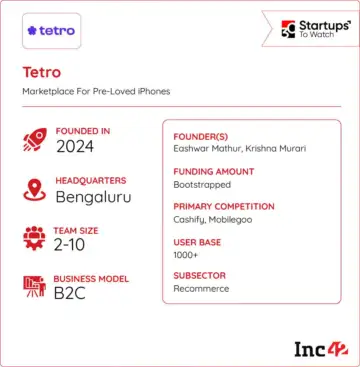
As India's smartphone market matures, demand for affordable premium devices is accelerating the growth of the pre-owned smartphone segment. Yet, the category remains fragmented and trust-deficient, with buyers wary of inconsistent quality, unclear warranties and unreliable battery performance.
Founded in 2024 by Eashwar Mathur and Krishna Murari, Tetro is building a quality-assured marketplace focussed exclusively on premium pre-owned iPhones. Unlike informal resellers and unverified listings, Tetro offers rigorous multi-point inspections, certified battery health reports and official warranty coverage, giving buyers near-new purchase confidence at significantly lower prices.
Every device undergoes a standardised inspection and refurbishment process before being listed, with clear disclosures on condition and performance.
Sold via a D2C channel, Tetro backs its products with return policies and post-purchase servicing.
By formalising the pre-owned iPhone ecosystem around trust and transparency, Tetro taps into rising demand from value-conscious consumers priced out of flagship Apple devices. The opportunity is expanding rapidly, with India's pre-owned and refurbished smartphone market forecast to grow from $1.75 Bn in 2025 to around $5.9 Bn by 2034.
Wankel Energy Systems | Clean Power From Industrial Steam Waste
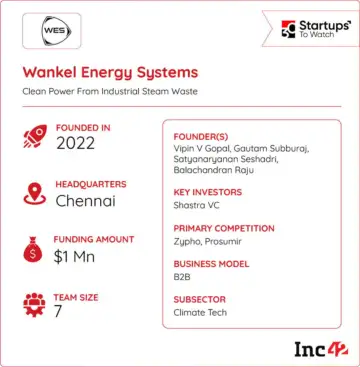
From food and dairy to chemicals, textiles and pharmaceuticals, steam powers India's process industries, but a large portion of this energy is lost at pressure-reducing valves (PRVs), where excess steam pressure is simply dissipated.
Founded in 2022 by Balachandran Raju, Gautam Subburaj, Vipin V Gopal and Satyanarayanan Seshadri, Wankel Energy Systems (WES) is building deeptech solutions to capture this wasted energy. Incubated at IIT Madras, the startup developed Phoenix, a patented rotary steam expander that converts excess steam pressure into clean electricity without requiring changes to existing plant infrastructure.
Unlike conventional turbines, Phoenix is compact, operates with saturated steam under variable loads, and achieves over 80% efficiency. Each unit can generate up to 160 kW, typically paying back within 6-24 months while reducing over 180 tonnes of CO₂ emissions annually.
Backed by government grants and $1 Mn in pre-seed funding from Shastra VC, WES has iterated through three technology generations and holds three patents in India and the US.
As industrial energy costs rise and decarbonisation pressures increase, Wankel is targeting India's overlooked energy efficiency gap. The startup is positioned in the waste heat recovery systems market, projected to grow from $2.12 Bn in 2024 to around $4.07 Bn by 2033, creating a scalable opportunity for clean industrial power.
[With inputs from Venu Rathore]
Edited by Shishir Parasher