
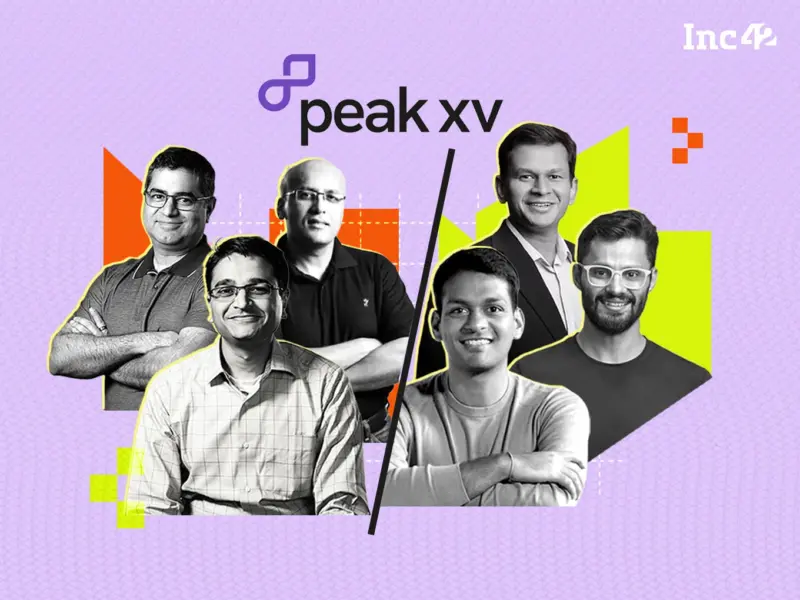

Ashish Agrawal was the centre of attention at an industry event hosted by Peak XV in December 2025.
Fresh off taking Groww to the IPO milestone, Agrawal was in the thick of it on the night - founders, other investors, representatives of industry bodies and law firms huddling around him, more than any other partner from the firm.
It showed that Agrawal had well and truly become a vital cog in the Peak XV machine.
All that changed in a matter of weeks.
"I remember celebrating Ashish's breakthrough performance (Groww IPO exit), which put Peak XV right there at the top of India's VC industry in terms of exits. It was the most successful exit by any VC fund in India," a partner working with a marquee global VC firm told Inc42.
Like much of the startup ecosystem, the VC world was stunned by what had happened at Peak XV Partners with the exits of its three partners - managing directors Ashish Agrawal, Ishaan Mittal and Tejeshwi Sharma. It is part of an exodus from the major VC fund that began close to two years ago.
"There was not much chatter or shock in investor groups on WhatsApp around this. While this may look like an unprecedented turn of events for the outside world, nothing about these exits was so shocking," an early stage venture fund founder said.
According to him, storied firms such as Peak XV Partners, which carry the global legacy of Sequoia Capital and have a portfolio of 400 companies, are bound to see partner churn, especially around the time of successful exits and an upcoming fundsraise. The Peak XV portfolio included 50+ unicorns and 36 IPOs as of December 2025, the firm says on its website.
"These large funds are pretty much the corporates with power concentration centres and whenever any event tries to disturb that power balance, whether it may be the matter of economics or power, the exits follow," another VC industry insider said.
Inc42 spoke to over a dozen VCs - partners and principals at large funds - and founders of Peak XV's portfolio companies to understand the pattern of why one of the largest VC funds in the country has seen at least half of its partners leave the firm in the last 12-18 months.
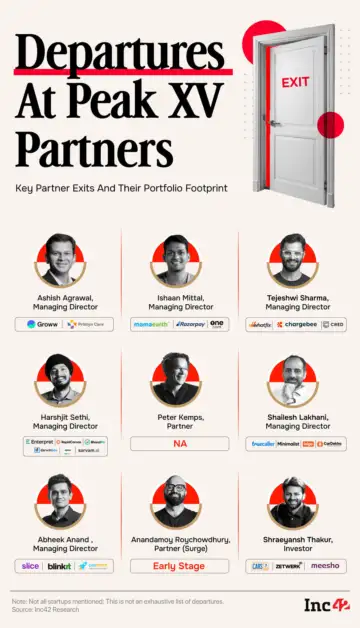
Apart from Agrawal, Sharma and Mittal's departures, the investment firm has seen the exits of partners like Pieter Kemps, Shailesh Lakhani, Abheek Anand, Shraeyansh Thakur, and Anandamoy Roychowdhury.
Sources at Peak XV Partners told us that nearly 50 employees have also quit their jobs across marketing, product and advisory roles.
"Ajay Gore, who was the operating partner at Peak XV until sometime ago, is doing his own startup. Prachi Pawar was another VP who left in 2024. There have been exits at Surge (Peak XV's early stage investments vertical) too," a source said.
Inc42 reached out to Peak XV Partners with detailed queries. The VC firm declined to comment on our queries regarding the partner, employee exits and directed us towards its official release that stated the recent departures were in the best interests of limited partners (LPs) and long-term interests of the firm.
Multiple sources say these exits were not driven by underperformance. On the contrary, the departing partners were often among the firm's most visible operators on the ground.
Instead, conversations point repeatedly to three overlapping fault lines:
- Carry allocation and future fund economics, particularly for partners who had delivered exits but felt their upside was capped
- Board seat allocation and continuity, with founders increasingly aware that their primary relationship partners at Peak XV might not be permanent
- Power concentration, where strategic decisions, fund control, and LP relationships remained tightly held by a small core
While not indicative of a crisis, the Peak XV saga shows that governance and internal power dynamics can unravel even a huge venture capital institution, which had begun a new journey after the Sequoia chapter.
Behind The Exits
As we wrote in 2023, when several partners exited VC firms, even though multiple partners may be visible publicly, profit-sharing and decision-making structures often differ internally, leading to friction. Founders of Peak XV-backed startups believe this could be the case here as well.
Agrawal's name is inseparable from Groww, one of India's most successful consumer fintech stories and among Peak XV's marquee outcomes. He led the earliest INR 30-35 Cr investment in Groww in 2019 from Peak XV, which was then investing as Sequoia Capital.
The wealthtech industry boomed after the pandemic and a cumulative investment of nearly $35 Mn delivered more than 50X returns to Peak XV at the time of its IPO in November 2025, which set India's VC ecosystem into both euphoria and FOMO when it came to growth and late stage bets.
Agrawal had joined Peak XV in 2013 after a few stints in startups and consulting firms.
Internally and externally, Agrawal was often described as a steady operator - deeply involved with portfolio companies, trusted by founders, and central to value creation, well beyond cheque writing.
His departure, months after Groww's IPO, has surprised many in the ecosystem. But those close to the firm say it was less abrupt than it appears in public.
"A lot of this had been brewing for years," said one founder backed by Peak XV, who has interacted with multiple departing partners. "The frustration wasn't about salaries. It was about carry, future fund participation, and - most importantly - who actually gets to call the shots."
Agrawal's departure was followed by that of Ishaan Mittal and Tejeswi Sharma, both managing directors who had built substantial portfolios and served on influential boards. Mittal has been associated with companies such as Razorpay, Honasa, and Onecard, while Sharma was associated with CRED, Chargebee, and Whatfix, among others.
Together, they represented a generation of leaders who had done the hard work of company-building through cycles.
A former partner at Peak XV Partners pointed out that while the likes of Harshjit Sethi (another former PeakXV MD) were driving the firm's AI investments in India, many good consumer deals for Peak XV came through Agrawal, Sharma, and Mittal, among others.
Currently, Peak XV is being led by Shailendra Singh, the long-time steward of the firm and one of India's most influential fund managers, as well as GV Ravishankar and Mohit Bhatnagar.
This trio has spent decades at the firm and has seen billions of dollars in funds, as well as the journey from Sequoia to Peak XV. Multiple sources we spoke to described decision-making as highly centralised, though Peak XV has not publicly commented on internal governance structures.
Singh remains the face of the firm for LPs globally. Several LPs, according to people familiar with fundraising discussions, continue to see him as the primary reason they back Peak XV and its thesis.
"From Mauritius to the US to Singapore, he single-handedly built the credibility of the firm," said one former partner. "That history gives him enormous leverage internally."
But as Peak XV grew into a multi-fund, multi-stage platform, younger partners gained prominence in India, sources say, decision-making authority did not always follow performance.
"After all, it is the brand and the symbolic connection with Sequoia Capital on which the firm has raised billion dollar funds. How much visibility would each partner have to these LPs? LPs have bet on Singh and the other stalwarts in the firm so they will have some automatic leverage even if the younger partners have led exits and got in the returns," a veteran VC quoted above noted.
Notably, in October 2024, Peak XV pared the size of its $2.85 Bn fund by 16% or $465 Mn and opted to tie a portion of its carried interest to the profit distributions in its growth and multi-stage funds
It also reduced its carry - the profits it earns from exits - on growth investments from 30% to 20%. However, if a fund in the growth or multi-stage category reaches a 3X distribution to paid-in (DPI) capital, the carry will revert to 30%. Simply put, DPI measures the total capital returned to the fund's LPs or sponsors.
It remains unclear whether this played a factor in the most recent exits of Agrawal, Mittal and Sharma.
The other pertinent question remains the equation outgoing partners have with some of the founders in the portfolio companies. Plus, they are either board members or advisors at many of these startups where Peak XV is an investor.
"Billion dollar companies, which are listed, take their board membership very seriously. It will not be easy to navigate the challenges of nominating representatives to the boards of big portfolio firms after the partners leave. Many times, founders are also adamant about seeking a particular partner as their mentor/ board member. How will Peak XV navigate this challenge of aligning founder interests with new partners on the boards?" a founder of a corporate governance advisory firm based out of Bengaluru said.
Peak XV's AI & US Focus
The partner churn has also intersected with a strategic question that looms large over India's venture ecosystem: artificial intelligence.
In recent years, Peak XV has spoken publicly about its ambition to be a serious AI investor. After the split with Sequoia Capital, the India and Southeast Asia arm also decided to set up an office in the US and invest in companies that build for the US markets. In April 2025, the firm appointed a former Y Combinator executive, Arnav Sahu, as a partner in the US to oversee AI investments in the US and other western markets.
Singh himself has been outspoken about AI being a once-in-a-generation shift, and the firm appointed a dedicated partner to sharpen its focus in the area.
This is at a time when multiple reports point towards a trend of India's founders setting up their base in San Francisco, looking to attract US investors and building for that primary market.
However, back home in India, the departure of Harshjit Sethi, who was central to building Peak XV's AI thesis, has created some vacuum.
"Harshjit has been instrumental in Peak XV's largest AI deals in India, a co-investment with Lightspeed India in Sarvam AI besides Darwinbox, Interpret, Rapid Canvas," a founder of an AI voice startup based in Bengaluru said.
Others point out that Peak XV's historical strength lay in consumer internet, fintech, and SaaS - areas where pattern recognition and scale capital mattered more than deep technical conviction.
"AI, by contrast to consumer tech and the internet economy, demands long-term technical engagement, tolerance for ambiguity, and often smaller initial cheque sizes. In AI, you can't just rely on the brand. You need partners who are empowered to take uncomfortable bets," he added.
This has created a paradox. Peak XV has not held back when it comes to outlining its AI investment focus, but as India is becoming more aligned with AI use cases, Peak XV is navigating the aftershocks of leadership churn just as the opportunity set demands stability and conviction.
In its latest release announcing the exit of Agrawal and others, the firm said it has 81 AI companies in its portfolio.
Question Of The Next Billion
At its core, venture capital is a trust business. LPs back people as much as they back strategies, often committing capital for a decade or more on the belief that incentives, governance, and culture are aligned.
Peak XV's upcoming fundraise - expected to be around $1 Bn or even higher - will test that trust.
Singh, according to multiple sources, remains confident. He believes the firm's track record, brand, and his own relationships are sufficient to carry the raise. And historically, that confidence has not been misplaced.
But the context has shifted.
LPs today are more attentive to questions of succession, partner stability, and institutional resilience. The exit of nearly half the firm's senior partner bench - many of whom sat on the boards of influential Indian startups - cannot be dismissed as routine churn.
"LPs will ask: who is actually building companies day-to-day?" said a fund-of-funds manager. "And will they still be there five years from now?"
There is also the founder question. Several Peak XV-backed founders privately acknowledge discomfort with the pace of change, particularly where board relationships are concerned.
"When your primary champion leaves, you're suddenly dealing with a system, not a person," said one late stage founder.
Peak XV still commands enormous respect. Its portfolio remains deep, its alumni influential, and its Sequoia lineage powerful. But as the firm charts its next chapter, it faces a dilemma familiar to many successful institutions: whether continuity at the top can coexist with meaningful decentralisation beneath it.
For now, the corner offices remain occupied. The meetings with LPs continue. The brand endures.
But as recent exits suggest, even in venture capital, power - like capital - has a cost. And the firms that thrive are often those that recognise when it's time to rebalance the ledger.
[Edited By Nikhil Subramaniam]