





Every few years, the coffee market transitions towards a new trend or niche in the search of finding the next big thing. Home brewing, Vietnamese coffee, cold brews and matcha all have their place among coffee lovers, but today those who are serious about their daily cup are turning to specialty coffee.
India is finally developing a taste for homegrown specialty beans coffee, thanks to local roasters, access to the finest AAA-grade and specialty beans as well as easier access to retail consumers thanks to new channels.
This has paved the way for a big change in India's coffee culture. The Indian consumer no longer wants a coffee that is little more than milk, sugar and a spoonful of instant coffee powder. They want to understand the origin of their coffee, explore distinct flavour profiles, experiment with home roasting and brewing, and savour every sip with greater intent and pleasure.
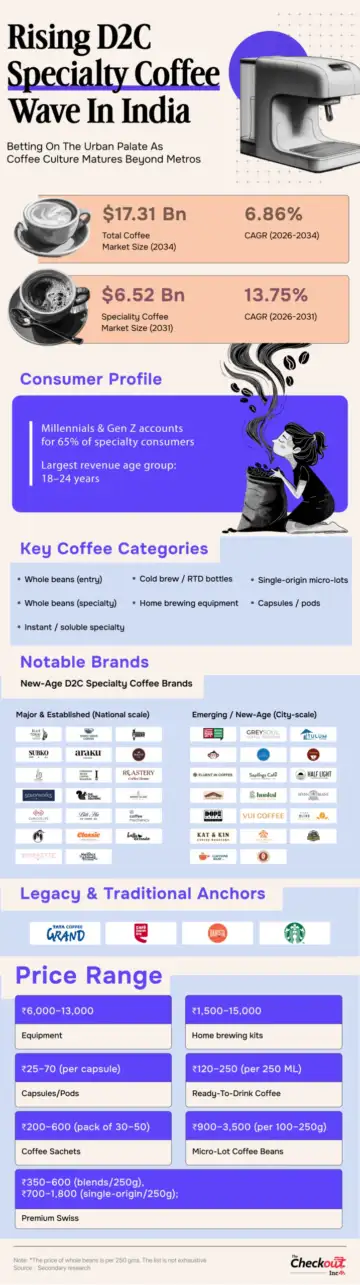
It is due to this shift that the country's specialty coffee market is expected to more than double to $6.52 Bn by 2031 from $3.01 Bn in 2025.
"Conversations around single-origin coffees have become far more nuanced, with customers showing genuine interest in exploring something different with every visit," said Rajat Luthra. CEO of Third Wave Coffee.
But, curiosity and premium pricing alone do not define specialty coffee. Several customers buying an expensive cup of coffee believe they are drinking specialty coffee, which might not be the case. While 'premium' is largely related to pricing, 'specialty' is a score based on the technicality of the coffee.
Before reaching store shelves, specialty coffee undergoes a rigorous technical evaluation and cupping process to meet quality standards. It must also score above 80 on a 100-point scale assessed by a Q grader - a certified professional trained to evaluate dry aroma, wet aroma, body, acidity, flavour notes, aftertaste, and balance.
So, what exactly is driving India's sudden obsession with specialty coffee?
A Revolution Brews
India is currently in the third wave of coffee evolution. This is a phase where coffee is no longer treated as a basic commodity but as an artisanal craft. The term originated in the US, where coffee brands and cafes tried to distinguish themselves from Starbucks and other large chains.
In India, the third wave of coffee is best represented by brands such as Blue Tokai Roasters, Third Wave Coffee, Araku, Maverick & Farmer, Subko, Roastery Coffee House, Bili Hu among others. Most of these brands have built end-to-end operations that attempt to control the chain from farm to cup.
For instance, Bengaluru-based Maverick & Farmer grows coffee on its own farms, where the team constantly tracks emerging trends and tests new experiments during every harvest season.
"The experiments that tick off all the boxes make their way onto our website and platform over the next eight to nine months until the next harvest season," said Maverick & Farmer's cofounder Ashish D' Abreo, who is a certified Q Grader himself.
The coffee industry is also witnessing a growing appetite for new formats.
While earlier consumers were restricted to the pre-existing taste, they are now moving towards lighter roasts, black coffee, manual brewing methods, fermented and experimental processing styles, and flavour-forward specialty coffees.
The newest trends include cold brews and flavoured cold coffees, which have moved from being a summer novelty to an everyday preference for many.
Another one is microlots - the small, carefully separated batches of coffee produced to highlight unique flavour profiles, origin characteristics, or experimental processing techniques.
"Cross-category innovation is also witnessing a significant push in the market with consumers bringing in ingredients like matcha, fruit-led profiles, alternate milks, wellness-led additions or globally inspired beverage formats," said Shivam Shahi, cofounder and COO of Blue Tokai.
Inside India's Specialty Coffee Obsession
The most telltale sign of specialty coffee adoption is the rise of black coffee culture in the country. Here, Maverick & Farmer's cofounder Sreeram Gangadharan believes that as more consumers start drinking black coffee, producers will push themselves to create better and more unique offerings.
Along with exploring antioxidant-rich and low-calorie black coffee, consumers are also developing a taste for flavour notes ranging from nuts and floral aromas to stone fruits and tropical fruits. This is slowly increasing their exposure to the world of specialty coffee.
Another major factor is travel and social media exposure. With ample content available online, younger consumers are researching before entering a specialty coffee cafe. As an entry point, aesthetics, café design and lifestyle associations continue to play an important role.
Meanwhile, homebrewers are also on the rise. Gangadharan points to the sheer number of brands that have entered just the brewing equipment business. His brand also sells its own ceramics and pour-over equipment.
Fragile! Handle With Care
The supply chain for specialty coffee is fundamentally different from that of regular coffee.
Although coffee does not catch fungus even if old, about a month after being roasted, it starts losing its complex notes. This becomes trickier when it comes to preserving specialty coffee.
Ideally, peak flavour performance rests between 15 and 30 days for whole beans. When it comes to ground coffee, the flavour shelf life is much lower. It dissipates flavours and aromas much faster.
"Specialty coffee depends heavily on freshness and product handling. Ensuring that a customer in a non-metro city receives coffee in optimal condition requires investment in packaging, distribution design and fulfilment capability," Blue Tokai's Shahi said.
While quick commerce is seen as the need of the hour for almost every D2C sector, specialty brands remain largely absent from the channel due to a lack of product control with dark stores.
Inventory planning for microlots and seasonal coffees is also challenging, as these limited-edition offerings are produced in small quantities and are often unpredictable in availability.
As of now, specialty coffee brands are trying to figure out how to make freshly flushed blends of coffee reach their customers on time for that perfect brew. This has also left a supply chain white space in the industry.
For now, beyond aesthetics, expensive cafés or Instagram-friendly brews, India's specialty coffee boom is reflecting a shift in consumer behaviour where buyers are beginning to care about sourcing, freshness, flavour and craftsmanship.
But the category faces a reality check. Speciality coffee remains expensive, supply chains remain fragile, and consumer awareness is still limited beyond metro cities. The challenge for these brands now is building a lasting culture around specialty coffee.
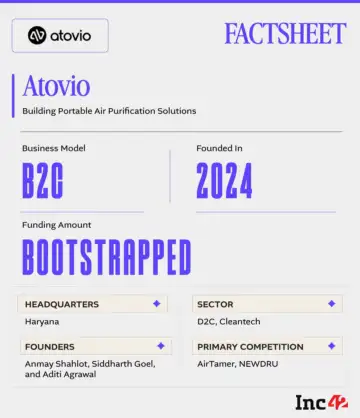
SPOTLIGHT | How Atovio Is Turning Air Purification Into A Wearable
- Atovio develops wearable and portable air purifiers designed specifically for Indian conditions. Its flagship product, Atovio Pebble, creates a personal clean-air zone around the user using Advanced Variable Anion Technology.
- Apart from portable air purifiers, Atovio also sells reusable N99 masks, nasal strips, and clean-air kits targeted at urban commuters and pollution-conscious consumers.
- It sells its product via its own website, ecommerce platforms like Amazon and Flipkart, as well as quick commerce platform Blinkit.
Ecommerce Buzz
- Yes Madam's Fundraise: At-home salon startup Yes Madam has raised ₹50 Cr in its first institutional funding round from Info Edge to expand across Indian cities, strengthen its technology stack, and scale partner and customer operations.
- Kriti Sanon Bets On GIVA: As the startup doubles down on lab-grown diamond jewellery, the D2C jewellery brand has onboarded Kriti Sanon as a brand ambassador and investor to strengthen its brand and expand consumer reach.
- Swiggy's Inventory-led Pivot Fails: The foodtech giant has failed to secure shareholder approval to become an Indian-owned and controlled company, a move that could have enabled its quick commerce arm Instamart to adopt an inventory-led model with higher margins and greater supply chain control.
- Nykaa's Q4 Show: The beauty and fashion retailer reported a fourfold jump in Q4 FY26 profit to ₹78.8 Cr from ₹19.1 Cr in the year-ago quarter. Its operating revenue for the quarter rose 28% to ₹2,648.2 Cr from ₹2,061.8 Cr
The Deep Dive
The Operator's Question
How can early stage startups in the specialty coffee space differentiate themselves through packaging, branding, and storytelling despite limited marketing budgets? What packaging elements or branding choices can help consumers immediately associate a coffee brand with quality and authenticity?
Speaking to Inc42, Impulse Coffees' founder and CEO Sarah Sarosh said that early stage brands might not stand out just with a large marketing budget. Specifying the consumer sentiment, Sarosh said that customers want to understand the story behind the brand and its commitment towards the product.
- Recall Value: A strong narrative, paired with consistency across packaging, content, and communication, can build recall over time. At Impulse Coffees, we've seen that authenticity resonates far more than trying to follow trends.
- Detailed Quality: From a packaging and branding perspective, consumers often associate quality with details that feel intentional; clean and clutter-free design, transparency around ingredients and benefits, and clear communication of the product experience.
And that's a wrap on this edition of The Checkout by Inc42. We'll be back next week with a deep dive into the latest trends shaping the ecommerce landscape.
Thanks,
Palak Sharma