





Longevity is the new frontier, and Indian founders are obsessing over it.
Take Eternal founder Deepinder Goyal, for instance, whose newest passion projects centred on ageing and longevity, came to the fore earlier this week.
Called Temple, the endeavour is expected to be around selling wearable devices that monitor brain health. While Goyal has not officially launched Temple, images of him wearing the device have emerged in the past week.
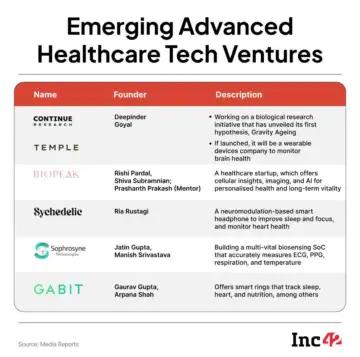
This comes hot on the heels of Goyal's Continue Research unveiling its maiden hypothesis.
Called Gravity Ageing, Continue Research claims that cerebral blood flow (CBF) or how blood reaches the brain, plays a crucial role in ageing.
Among the new bets from the Eternal founder - another one being LAT Aerospace - Continue Research has not only attracted attention but some criticism too. Its hypothesis in particular is being debated intensely, with many calling it untested and unscientific.
But this just scratches the surface of a wider longevity and healthtech movement gathering steam in India. While Goyal's high profile has turned the spotlight on Continue and Temple, there are indications that this is the dawn of a healthtech 2.0 moment.
The Buzz Around Temple
Although Continue has been conducting research in private for more than a year, Goyal's new pet project first drew public attention in October 2024 when he referred to it as his 'personal health and wellness team'.
Not much was revealed after that until this week when Continue unveiled its first public hypothesis, and soon after that images of Goyal wearing the 'Temple' device also emerged.
The hypothesis suggests that gravity's constant downward pull on blood flow to the brain may be a key driver of human ageing. According to the hypothesis, gravity can reduce blood flow to the brain by up to 17% when people are standing or sitting upright.
The research further claims that over a period of decades, such reduced circulation may weaken the hypothalamus and brainstem, two critical regions responsible for metabolism, hormonal balance, inflammation, and autonomic functions. Their gradual decline, the hypothesis argues, could trigger the ageing process.
While the hypothesis emphasises that gravity isn't the sole cause of ageing, it could be a major, yet overlooked, factor.
The hypothesis sparked intense online debate and scepticism, prompting
FITTR founder Jitendra Chouskey labelled the research initiative a parody, and said it is being used to set narrative to sell Temple's product. Similarly, renowned Indian surgeon Dr Arvinder Singh Soin said Goyal is trying to
Amid this debate, Inc42 has further learned that Goyal's new venture Temple would sell wearable devices to measure CBF. The device appears to be a direct result of Continue Research's hypothesis, and this is why it's drawing a lot of attention.
Goyal had previously noted that even if the hypothesis related to gravity having an impact on ageing does not hold, the device 'could be useful to other people'. With this, he has hinted that Temple may still operate as a standalone consumer product to help consumers track an important biomarker.
While little is known about the product, at least for now, prototypes are being shared only with research institutions.
The Healthtech 2.0 Moment
Despite the ambiguity surrounding Continue Research and Temple, the broader direction is unmistakable - extending human lifespan or in other words the longevity movement.
This has become the latest obsession among Indian founders, particularly gaining momentum after the weeklong India visit by Bryan Johnson in December 2024. Johnson's ambitious age reversal project called Blueprint is a protocol built around what the entrepreneur calls an 'Autonomous Self'.
Johnson was in India promoting his book 'Don't Die' and was involved in private sessions with several Indian founders, including a .
It's hard to say how much Goyal was inspired by this meeting, but his plans for Continue Research were announced a few months before Johnson was in India. Globally, Johnson has become the face of the longevity movement, and since late last year, we have seen a number of startups turn to this space.
Many are breaking new ground with their approach and we are seeing a number of hardware-centric and hybrid or phygital plays as well, a testament to the shift in how founders are thinking about healthcare today.
An example is Biopeak Health founded by Rishi Pardal and Shiva Subramnian, and backed by Accel partner Prashanth Prakash, Ranjan Pai, Nithin Kamath, Nikhil Kamath among others. Unlike Temple, which is a hardware play, Biopeak has opted for a hybrid approach, involving software, autonomous health guidance, biological blueprints and physical clinics.
As Inc42 reported earlier this year, Biopeak is looking to build a platform for high-resolution health assessments built on cellular data, advanced imaging, and AI-driven personalised recommendations to support long-term vitality.
Other startups are building new-age hardware and wearables, which the consumer tech market is more familiar with. This allows companies to cast a wider net when going to market. Startups such as Ultrahuman, Gabit, Noise, and FITTR have gone beyond smartwatches and into the smart ring arena. Smart eyewear is another battlefront in the healthtech 2.0 game, being led by Lenskart.
Take for example Bengaluru-based Sophrosyne, which raised $2 Mn this past week to develop a system-on-chip (SoC) capable of measuring vitals such as ECG, PPG, respiration, temperature, and other parameters with high precision. The chip is intended for wearables and other healthtech devices.
Similarly, just last week, Gurugram-based Sychedelic launched a neuromodulation-based smart headphone to improve sleep and focus. The device also tracks heart rate and stress levels.
Requesting anonymity, a healthtech industry insider said, "Given the nascent state of this industry, all efforts are welcome."
AI Changes The Longevity Game
While the market for these advanced wearables in India is at a nascent stage, it is difficult to predict how these homegrown products will perform. For instance, Apple recorded a 141% surge in shipments of Apple Watch units to India in 2025; the likes of Samsung, Oneplus and Google are also steadily growing their market share.
Many observing the Indian market fear that the new wave of Indian wearables may not be able to compete with global giants. Plus these bigger rivals have the tech and resources to compete with pretty much any startup.
"The problem is that the new Indian products claim to solve something, but the use case is very limited. Yes, the graph is going upward in terms of volume, but the market currently is very small," said an analyst tracking India's wearable market.
Currently, there's little clarity on when Temple or other solutions of its kind will make their public debut. But there's little doubt that the Indian startup ecosystem is already buzzing with new ideas for healthtech. This is arguably the clearest healthtech wave since the peak of the Covid-19 pandemic.
The emergence of advanced AI models and machine learning has also fuelled this new era where the focus is on autonomous systems, predictive insights and deep healthcare expertise rather than relatively simpler solutions like telemedicine.
Artificial intelligence has levelled the playing field to a certain extent, and made it easier for founders to envision how their products can intersect with healthcare.
While demand for advanced health and longevity products is clearly rising, the long-term sustainability of these businesses, especially without steady external capital remains uncertain. This is the paradox that most deeptech and frontier tech companies have to deal with.
Many of them will primarily cater to affluent consumers, raising questions about scale and mainstream adoption. The economies of scale are yet to play out in this space and most solutions might be out of reach for the average Indian.
It would take something truly groundbreaking innovation and global success story from India to change this reality. With Indian founders honing in on this space, the real question is where will this big breakthrough come from?
Edited by Shishir Parasher