

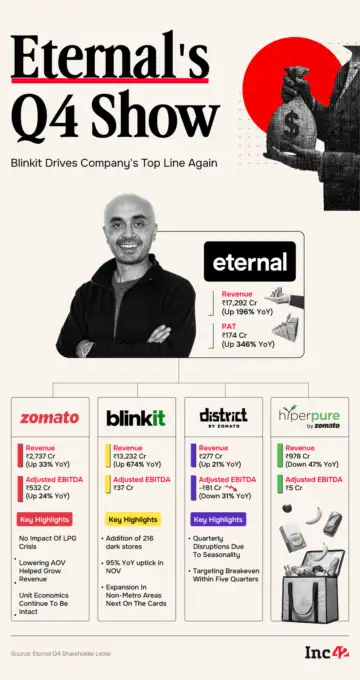
Zomato parent Eternal’s consolidated net profit zoomed 4.5X to ₹174 Cr in the fourth quarter of FY26 (Q4 FY26) from ₹39 Cr in the year-ago quarter.
On a sequential basis, profit grew 71% from ₹102 Cr.
Operating revenue skyrocketed 196% YoY and 6% QoQ to ₹17,292 Cr. Including other income of ₹342 Cr, total income for the quarter stood at ₹17,634 Cr.
Meanwhile, total expenses for the quarter zoomed 185% YoY to ₹17,406 Cr. Excluding other income, Eternal would have registered a loss in the quarter.
For the full fiscal year FY26, the company’s profit declined 31% to ₹366 Cr from ₹527 Cr in FY25. Operating revenue for the fiscal year shot up 161% YoY to ₹54,364 Cr, driven by growth in Blinkit and the transition of the quick commerce business to inventory-led model.
Total expenses for the year jumped 167% YoY to ₹55,145 Cr.
In Q4, Eternal’s consolidated net order value (NOV) zoomed 54% YoY to ₹26,880 Cr. Adjusted EBITDA jumped 160% YoY to ₹429 Cr.
Besides the financial disclosures, Eternal said it has entered into an asset transfer agreement with wholly owned subsidiary Wasteland Entertainment Pvt Ltd (WEPL) to transfer the tech stack of its ticketing platform District and employees for ₹24.19 Cr.
The transaction is being carried out to “improve organisational efficiency and unlock further business opportunities”.
Important to mention that WEPL, along with Orbgen Technologies Pvt Ltd, was acquired by Eternal (then Zomato) for ₹2,048 Cr in 2024. The subsidiary, which earlier operated Paytm Insider, is engaged in the business of providing ticketing services for the events and other activities, booking of slots for the sports facilities, and other related ancillary services to the event organisers.
With that, let's take a closer look at the performance of Eternal's core verticals.
Blinkit's Adjusted EBITDA Improves
Blinkit registered 675% YoY and 8% sequential jump in its operating revenue to ₹13,232 Cr. The sharp jump on a YoY basis was due to a change in accounting as the quick commerce arm moved to an inventory-led model.
It also reported a sharp sequential improvement in profitability in the March quarter, with its adjusted EBITDA surging over 9X to ₹37 Cr from ₹4 Cr. Blinkit added 216 new dark stores during the quarter, taking its total store count to 2,243 stores at the end of the quarter.
While it registered a 95% YoY uptick in NOV to ₹14,386 Cr, Eternal CEO Albinder Dhindsa believes that the growth rate is now “naturally moderating of a much larger base”.
Over the next three years, Blinkit is eyeing maintaining NOV growth north of 60%. Its path to sustaining this 60% NOV CAGR rests on three levers: expanding assortment, widening geographic reach, and deepening demand density.
In its top eight cities, where coverage is already nearing saturation, growth will largely come from increasing assortment - adding more SKUs and dark stores to drive higher retention, wallet share, and average order values.
In newer markets beyond the top eight, Blinkit has more room to grow on all fronts - entering more neighbourhoods, expanding product selection, and building customer density.
These cities currently have far lower serviceable pin code coverage and SKU depth, but early signs show faster store ramp-up and comparable profitability, helped by lower real estate and operating costs, Eternal said. Over time, as adoption improves, these markets can support more stores per neighbourhood, enabling faster deliveries, better availability, and stronger customer retention.
Blinkit said this creates the same flywheel which it has already seen in Delhi NCR, where higher store density has reinforced demand and driven sustained growth in both customers and spend per user.
Zomato Sees Improvement In Growth
Eternal’s food ordering and delivery business Zomato's operating revenue grew 33% YoY and 2% QoQ to ₹2,737 Cr. Its adjusted EBITDA grew 24% YoY to ₹532 Cr.
Founder Deepinder Goyal, who exited from executive role in February, highlighted that food delivery growth has structurally improved after bottoming out in Q1FY26, with NOV growth accelerating consistently over the last three quarters.
He attributed this to deliberate efforts to expand into more price-sensitive customer segments rather than a temporary demand spike. Key interventions included lowering the free-delivery threshold for Zomato Gold users to ₹99 from ₹199, targeted customer activation, and curating lower-priced meal options such as sub-₹250 offerings.
“The results have been encouraging - order volume growth is being driven by MTC growth, both from new-to-platform customers and higher frequency among existing budget-conscious customers,” he added.
While these moves lowered net average order value (NAOV), he said it was part of a strategy to broaden affordability and expand the addressable market. Importantly, Zomato said unit economics remain intact - revenue per order continues to improve, operating cost efficiencies have kept pace, and margins have remained stable despite a higher mix of lower-value orders.
Goyal also addressed the LPG crisis, which was anticipated to put a dent in Zomato’s revenue in the quarter, due to the conflict in West Asia.
“When localised supply disruptions happen - whether from LPG shortages, weather, or anything else - we typically see demand redistribute across the platform rather than it going away. The breadth of restaurant selection across cuisines, price points, and geographies means customers have alternatives within the app. Some restaurants in affected pockets did see temporary disruption, but platform-level throughput wasn't impacted,” he noted.
District Sees Sequential Volatility
The ticketing business continued to report losses, despite recording a moderate YoY uptick in revenue in Q4. Going Out posted an operating revenue of ₹277 Cr in the quarter, up 21% YoY but down 8% QoQ.
CFO Akshant Goyal urged investors to focus on annual performance for District rather than quarterly fluctuations, given the segment's inherently seasonal nature.
“This is an inherently lumpy business - Q3 is events-heavy, Q1 is IPL-heavy, and the movies NOV depends entirely on the release calendar. Quarter-to-quarter swings will be large and are not indicative of underlying momentum. The annual growth rate is a more robust signal,” he said.
FY26 also marked the first full year of District operating in its current form as a unified going-out platform. The app now combines multiple use cases - restaurant bookings, movie tickets, concert access, playing arena reservations, and local retail discovery.
As per the CFO, this integrated model gives District a unique position in India's going-out market, with no other platform currently offering comparable breadth in one app. The company reiterated confidence in its long-term guidance of $3 Bn in NOV and $150 Mn in adjusted EBITDA by FY30 for District, implying 30% annual NOV growth from current levels.
“Despite significant ₹ depreciation, we remain confident in that trajectory,” he noted.
Besides District, Eternal’s B2B arm Hyperpure operating revenue declined by 47% YoY to ₹978 Cr while it reported a profit of ₹13 Cr against a loss of ₹8 Cr in the year-ago quarter. The company didn’t share any further updates on Hyperpure’s performance in its shareholding letter.
Shares of Eternal ended today's trading session 0.7% lower at ₹253.8 on the BSE.
Edited by Vinaykumar Rai