





AI is being democratised at full throttle - much in sync with the government's target of a $1 Tn digital economy by 2030 - and what fuels this growth is the economics of AI that businesses across industries are trying to gain from.
Indian infrastructure major Larsen & Toubro (L&T) made no mistake in reading the future. AI is no longer an experimental capability or a future-facing investment - it is increasingly being embedded into the core mechanics of how the company executes projects at scale.
In an interaction with Inc42, R Ganesan, who heads the Corporate Centre at L&T Construction, framed the company's AI strategy as deliberately multi-layered. "We see different use cases across our various businesses and multiple applications of AI that can impact our execution either in terms of productivity, time to value, autonomous or near-autonomous decision-making and in some cases requiring us to reimagine processes or tasks," he said.
As India emerges as the third most competitive nation in AI adoption, led by its 6 Mn-strong army of technology graduates and powered by an ecosystem of 1.8 Lakh startups and more than 1,800 global capability centres, infra companies are increasingly adopting AI to improve efficiency, safety, and project timelines.
"How you deploy the technology and how you execute it make all the difference in this increasingly competitive landscape," Ganesan said. Instead of treating AI as a single transformation lever, his company is deploying it across the enterprise as both an execution accelerator and a structural capability.
The ambition, according to the executive, is to leapfrog to the next generation of EPC and manufacturing businesses by embedding AI and intelligent automation directly into workflows that define scale, cost, and delivery reliability.
AI In Layers From Tenders To Projects
A defining feature of AI adoption at L&T, Ganesan said, is its breadth across the project lifecycle.
AI systems are already active at the tendering stage, where teams analyse large volumes of contracts, technical documents, and risk variables under tight timelines. The entire process was dependent on manual review and expert judgment, often stretching decision cycles over months until AI shrank the process to days or weeks.
At the back office, AI systems are being used to auto-process several hundred thousand supplier invoices. This was previously manual, time-consuming, and error-prone. Automating this layer has freed up teams to focus on higher-value activities while improving accuracy and throughput.
"Contract risk classification which used to take months to conclude can now be completed within hours," Ganesan said.
The compression of these timelines directly impacts bid responsiveness and reduces friction in early-stage decision-making.
Beyond tendering, AI is being applied across multiple execution stages in both EPC and manufacturing businesses, supporting planning, monitoring, and risk identification in environments where even small inefficiencies can cascade into large cost overruns.
At the project level, AI is being used to press warning signals, point bottlenecks and predict risks. It helps teams preempt a challenge and prepare for it. In other words, being proactive, instead of being reactive after the process is paused.
Safety remains another critical focus area for the deployment of AI. Across multiple project sites, AI-powered computer vision systems analyse live camera feeds to flag safety violations almost in real time. The company is now extending these capabilities by integrating AI with robotics and drone technologies to explore safety capabilities.
While construction has historically faced steeper adoption challenges for physical AI because of its complexities and unit economics, L&T addresses this through what Ganesan described as a holistic approach aimed at adoption at scale and a hybrid build-and-buy approach.
By integrating AI applications, machinery and workforce planning processes have been reduced to 10 minutes from 2 weeks earlier. Predictive analytics and process optimisation helped L&T reduce project costs by 2-3%, contributing to enhanced operational productivity.
When compared to players like TATA Projects, unlike L&T's focus on a custom AI layer (LNTCS), they have anchored their transformation on SAP Business Suite to unify key business functions on a single, intelligent platform.
"Our LNTCS platform hosts and provides role-based access to different AI-based solutions that cut across the lifecycle of various businesses," Ganesan said.
The Platform And A Push Out Of Legacy
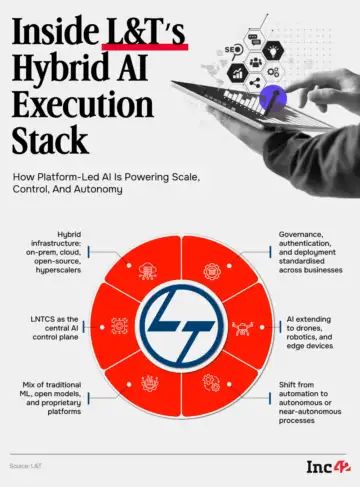
Under the hood, L&T operates a deliberately hybrid AI infrastructure.
The group runs AI workloads across on-premise and cloud environments, selecting deployment models based on data sensitivity, latency, and scale requirements. "L&T exercises both its on-prem and cloud environments for running various AI workloads," Ganesan said.
Model-wise, the company uses a wide spectrum - from traditional ML libraries to open-source models such as Llama, besides proprietary offerings like Azure OpenAI.
L&T centralises its AI ecosystem through LNTCS, the company's proprietary cognitive services platform. By hosting all solutions here, the platform functions as a vital control plane that provides a unified experience layer, standardised authentication, and streamlined service management. It allows an organisation to maintain strict governance while ensuring consistent deployment across business sectors.
Ganesan said L&T's transition has been bolstered by over a decade of proactive investment. While many large enterprises find it difficult to integrate AI into legacy IT and operational technology, L&T has built a foundation of strong systems of record or a repository of business data like invoices and other documents. This long-term evolution has created a stable environment that allows advanced technologies to be adopted with lesser friction than traditional legacy frameworks.
Ganesan stressed that the objective is moving beyond mere integration towards deep process re-engineering. He highlighted that there is significant room for improvisation to transition from standard automation to autonomous or near-autonomous execution.
Reaching For The Next Level With Tech Edge
The infra major with a market capitalisation of ₹5.74 Lakh Cr ($64 Bn) has drawn up a $1 Bn investment plan to set up AI data centres to increase capacity from 32MW to over 200MW by 2030, while it picked up 21% in E2E Networks for ₹1,407 Cr to drive Generative AI (GenAI) and cloud innovation in India. It has also invested heavily in grooming over 1,000 engineers on NVIDIA AI software to beef up its talent pool.
All these initiatives are aimed at accelerating L&T in its AI-powered journey of digital transformation.
L&T does not see AI adoption as the responsibility of central teams alone. It has institutionalised programmes such as Digital Ambassadors and Digital Catalysts to drive awareness and sponsorship at project sites. In parallel, a dedicated Digital Field Force has been deployed to work with IoT, edge devices, and smart monitoring technologies that make AI usable in real-world environments.
Dissemination happens through a platform-first model. "We have taken a platform approach towards disseminating various AI apps across the enterprise," Ganesan said. One such application is Site.AI, which enables project teams to review site documents such as vendor proposals, client communications, and meeting records.
"This is helping us de-mystify AI and take it to the last mile while ensuring that all necessary guardrails are in place."
L&T sees its next competitive edge emerging in areas where industry-ready AI solutions do not exist yet. "We are now looking at applying AI to problems such as generative design or site-level use cases where there are no industry-ready solutions yet, but the impact can be very ubiquitous and game-changing," Ganesan said.
For CXOs working on AI adoption in legacy-heavy organisations like L&T, he said: "The impact with AI is real and deep and is made possible when there is strong support and commitment from top leadership."
Equally important is building with end-users from day one and engaging the wider ecosystem of startups, technology partners, and academia. The LTTS AI Experience Zone will play a crucial role in educating the clients and the stakeholders, fostering AI adoption and pushing L&T to be a leader in AI innovation across core sectors.
Edited by: Kumar Chatterjee