






Funding in the Indian agritech space has remained volatile over the last three years, and this trend is expected to continue in the current year, too.
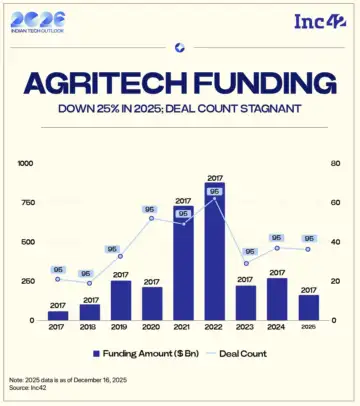
According to Inc42's 'Annual Indian Startup Trends Report, 2025', agritech startups cumulatively raised $202 Mn in funding across 36 deals last year, down almost 25% from $269 Mn raised in 2024.
The funding raised was also a far cry from the highs of 2021 and 2022, when the sector bagged $728 Mn across 49 deals and $840 Mn across 62 deals, respectively.
Imperative to mention that it has been a downhill drive for the sector since then. For context, the Indian agritech startups raised $220 Mn in 2023, a sharp 74% decline from a year ago, when pandemic-fuelled funding was the norm. Deal count, too, plummeted to 29 that year, the lowest between 2021 and 2025.
Agritech is still in its nascent stages in India, with the first prominent rise recorded in 2017, but the difficulty in raising funds is causing a dent in its growth. A case in point is BharatAgri, which shut its operations in November last year due to a paucity of funds and funding opportunities.
Industry experts believe that investors are wary of companies burning VC money to fund business operations and revenue growth instead of looking for long-term PMFs. The primary reason behind it is a lack of monetising opportunities in the agriculture sector.
What attracted the most investor interest until now has been market linkage. However, many agritech companies became logistics and inventory-focussed, leading to inefficient use of venture money.
B2B natural fibres marketplace Reshamandi, for example, was not able to figure out its unit economics and had to scale down considerably in 2024 after raising $40 Mn+ in equity funding.
Many tried to replicate models that worked in the West, while others applied SaaS-style models, which rarely work in an agricultural setting.
"Then, the focus on the very high TAM in the agricultural sector, without factoring in service, delivery, infrastructure, and acquisition costs, led to a gap between perceived and actual market potential," said the founder of Arya.ag, Anand Chandra.
As a result, standalone input marketplaces and advisory platforms struggled to scale sustainably as customer acquisition costs remained high while transaction frequency and retention remained low.
What Will Work In 2026?
According to Mark Kahn, the managing partner of Omnivore, an agriculture-focussed venture capital fund, 2026 will be a modestly better year for the sector, but he does not expect that Indian agritech startup funding will go back to 2021 levels.
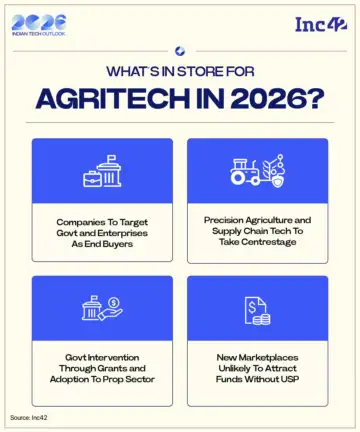
Going forward, the founders who connect their offerings with layers of commerce or credit are expected to work better. At the same time, targeting governments and enterprises instead of farmers as end buyers would provide the scale companies need to succeed in the sector. Sectoral experts also believe that farmers are unlikely to pay for technology.
Startups building in segments such as precision agriculture and supply chain tech, which lead to traction due to AI or IoT integration and infrastructure gaps, is where investors are expected to focus this year.
"Farmers are being given subsidies and asked to automate many aspects of farming. In the future, advanced manufacturing will also fit into agritech, because precision agriculture will have an element of IoT and drones. All these solutions will end up getting to different segments of agritech, in the form of FMCG, manufacturing or supply chain," said Shashank Randev, founder at 247VC.
The government is already pushing such initiatives through targeted policies and grants. A key example is the Digital Agricultural Mission, which backs technologies such as AI, IoT, blockchain, and drones within the agricultural sector.
Additionally, the Rashtriya Krishi Vikas Yojana (RKVY-RAFTAAR) provides financing to incubation centres and offers grants of up to INR 25 Lakh to agritech startups. There are expectations that real scale will only be achieved with an agristack from the government, much like what was done for fintech companies through the NPCI.
There is also heightened interest in new types of crops that are not commercial in nature. Farmers are trying new varieties of fruits and vegetables. This opens up new avenues for the country's biotechnology startups. On the other hand, marketplaces like DeHaat and Udaan might not see any investor interest if there is no differentiation, as VCs are still waiting for them to go public or provide other exit opportunities.
[Edited by Shishir Parasher]