

If data is the new gold, then banks must glow.
Sitting on a repository of huge volumes of data, the banking industry has unlocked opportunities beyond areas such as fraud detection, credit scoring, and customer service to let generative AI drive up revenues by anything between 6% and 20% in the next two years.
As GenAI scales from experimentation to implementation to enterprise-wide reinvention, it has begun unleashing dual tailwinds, pushing banks to improve their efficiency ratio up to 15 percentage points which, in turn, supports the topline growth.
Axis Bank, the third-largest private sector lender in India, with a market capitalisation of ₹4.14 Lakh Cr, offers a sneak peek into the way the banking industry has embraced AI. In the high-stakes theatre of Indian banking, where precision is not just a preference but a regulatory mandate, Axis Bank is treating AI less like a futuristic ensemble, and more like a core structural pillar.
In an exclusive interaction with Inc42, Prasad Lad, the executive vice-president who heads the lender's business intelligence unit (BIU), explained how the bank prepares its AI stack, predicts the impact, and promotes human adoption from traditional analytics to generative frontiers in a regulated environment.
"We believe that if we get this transformation right, we'll reach a place where we will not need makers, but the checkers won't go away," Lad said, clarifying that by checkers he is talking about humans-in-the-loop.
Smart Plug For AI To Power Smarter Growth
With assets zooming to ₹312.2 Lakh Cr, deposits reaching ₹231.90 Lakh Cr and credit expanding to ₹181.34 Lakh Cr, the Indian banking industry recorded a 14% growth in FY25 on the back of rapid digital adoption through UPI, and improved asset quality and a decline in gross bad debt to 2.31%.
And, AI is moving the needle in a bigger way than ever before, for the Indian lenders. A realisation that artificial intelligence is no longer discretionary, rather a core requirement for the success in banking and financial services has seeped into the rank and file across the sector.
For Axis Bank, at the centre of the analytical universe sits the Business Intelligence Unit, a multi-faceted division, designed to convert raw data into strategic foresight. The BIU has five specialised subunits - data engineering, data science, business analytics, reporting analytics, and a dedicated data governance team. This structure ensures that data is not just collected, but is well organised and served out for everything, from customer-facing apps to complex modelling.
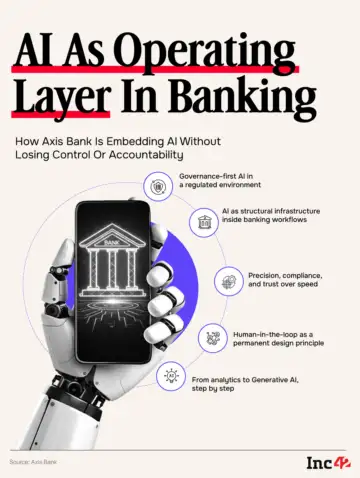
The bank set up an Enterprise AI CoE around six months back to give the entire effort a unified direction. "We realised that we needed somebody to own this and pull all of us together," Lad said.
Rather than isolating AI within IT, Axis positioned the BIU as a link between technology, product, operations and strategy. This allows the experimentation to be carried out across teams while governance and prioritisation remain controlled.
Axis's AI stack begins well before any discussion of the Large Language Models (LLMs). The bank breaks its 3-petabyte data landscape into three layers: core structured data (transactions), internal unstructured data (PDFs, voice recordings), and external regulatory data. "If your data is not well organised, AI will never be able to figure out what is happening," Lad maintained.
The bank has spent the last three years restructuring this data. While the data is now largely organised, Lad acknowledges that the semantic layer - the glossary and meaning systems that allow AI to interpret data contextually - still needs work.
In terms of AI model selection, Axis Bank avoids vendor lock-in. The bank maintains a democratised platform where it tests various LLMs alongside its Small Language Models (SLMs) and models tailored to banking terminologies.
He noted, citing Gemini, ChatGPT, and Claude as examples, that the AI models deployed or used differ based on the use case and what works best for it.
The Six Themes For AI Use Cases
Lad explained that Axis Bank organises its AI initiatives across six strategic themes:
- Knowledge management and training
- Automation of internal workflows
- Software development lifecycle (SDLC) automation
- Conversational servicing
- Assisted AI-led sales
- Fully AI-driven customer-facing propositions
In the first three themes, Axis Bank is focussed on internal scale and efficiency. Knowledge management uses AI to convert policies, documents, videos, and internal data into searchable, structured intelligence for employees, and imparts personalised training based on performance signals.
Automation targets operational workflows such as lending checks, fraud reviews, reporting, and document creation, removing most manual "maker" work while retaining human validation. In parallel, AI is being applied across the software development lifecycle - from requirements and documentation to coding and testing - improving speed without removing engineers from the loop.
The fourth theme covers conversational AI for servicing. Here, use cases are limited to high-confidence journeys such as card blocking and multilingual support, where AI improves availability and consistency. The goal is not to replicate human calls, but to solve problems humans struggle with at scale, like language coverage and product breadth.
The fifth and sixth themes focus on sales and customer-facing digital experiences. AI is used to assist relationship managers with product recommendations and nudges, while fully AI-driven customer journeys remain cautious and experimental due to accuracy, cost, and regulatory risks.
The bank has progressed greatly on the first three themes, which are largely inside-facing. One of the most mature deployments is the internal knowledge platform - a Google-style search engine for employees. Around 40% of Axis's nearly 100,000 employees now use the system regularly. Accuracy has improved significantly, with fallback or incorrect responses now dropping below 10%, compared to 20-30% in early versions. "Without AI, this was not possible," Lad said.
Framework to Measure Success Of AI Use
Axis Bank does not rush with its experiments. Every use case must pass a rigorous five-point framework.
The first lens is efficiency, measured through accuracy and latency, ensuring AI responses are reliable and fast enough for real workflows. The second is adoption, tracked through closed user group testing and active usage to confirm that employees genuinely see value in the tool. The third layer looks at input metrics, such as reduction in operational tags, improvement in first-time-right ratios, and fewer handoffs in customer journeys. The final two metrics are cost reduction and revenue impact, measured net of model, infrastructure, and token costs.
While AI is not yet a material P&L lever, the bank expects around 1% P&L impact in FY27, scaling to 10% over the following two years. "The hard work is getting to that first 1%," Lad said.
In software development, roughly 30-40% of coding is now automated. Semantic accuracy, however, remains a constraint and human review is mandatory. The bank frames AI as reskilling, not redundancy.
The AI wave sweeping the banking sector across the world comes with an undercurrent of caution, too. AI implementation is expected to bring down certain costs by as much as 70%, but these savings will be partly offset by the rising cost of technology, leaving only a 15-20% decline in the banks' aggregate costs. AI is also likely to erode bank profitability as consumers start routinely using AI agents to optimise their finances, which would reduce customer inertia and reshape industry economics.
Gaining A Tech Edge From Working With Startups
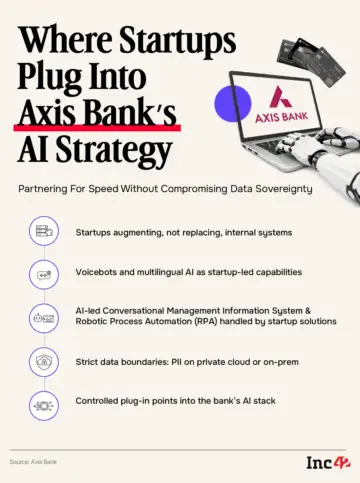
Lad mentioned that Axis Bank is partnering with a host of startups for specialised AI capabilities where products already exist and can be adapted faster than building everything in-house and raising the cost burden on its books.
A key example is voicebots, where the startups bring ready expertise in multilingual support and basic negotiation, which are essential for replacing human agents at scale. More than 80% respondents to a recent survey of 1,400 people stressed that Voice AI holds the potential to significantly transform the banking industry.
Instead of reinventing these systems, Axis works with such companies to refine their platforms for banking use cases, extending this approach to areas like AI-led RPA and conversational MIS, where startup-built products accelerate end-state solutions.
However, data governance is non-negotiable. "All startups work on our private cloud or on-prem," Lad said. "We don't expose ourselves to somebody else's cloud for PII data." Only non-PII (Personally Identifiable Information) workloads are permitted outside bank-controlled infrastructure.
Axis Bank's AI journey is still unfolding. Rather than chasing rapid automation or headline-grabbing deployments, the bank is methodically rebuilding how work gets done, how decisions are checked, and how trust is preserved in a regulated environment.
By prioritising data foundations, disciplined measurement, and human oversight, Axis Bank is positioning AI not as a short-term efficiency lever but as a long-term execution layer. The real test will not be how fast use cases go live, but how sustainably AI reshapes banking operations, revenue engines, and employee roles over the next decade.
At a recent event, Amitabh Chaudhry, managing director and CEO of Axis Bank, spoke on AI's transformative impact on banking and described how AI is evolving rapidly with real, practical use cases. He called AI a "tsunami" that will reshape the industry, rewarding early adopters.
Edited by: Kumar Chatterjee