


Fintech startup Juspay swung to profit in the financial year ending March 31, 2025 (FY25), driven by strong revenue growth and tighter control over expenses.
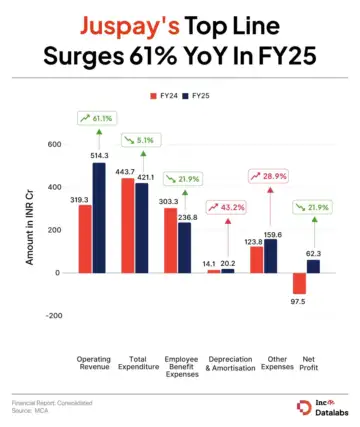
The SoftBank-backed startup reported a net profit of INR 62.3 Cr in FY25, a sharp turnaround from a loss of INR 97.5 Cr in the previous fiscal year.
Juspay posted a profit before exceptional items and tax of INR 115.3 Cr in FY25. After accounting for an exceptional loss of INR 88.4 Cr, profit before tax stood at INR 26.9 Cr in FY25.
Meanwhile, its operating revenue jumped 61% to INR 514.3 Cr in FY25 from INR 319.3 Cr in FY24. Including other income of INR 25.2 Cr, total income for the period stood at INR 539.5 Cr.
Founded in 2012, Juspay provides a full-stack payments and financial infrastructure platform, working with enterprises across ecommerce, BFSI, fintech, travel and mobility sectors.
In April, the startup raised $60 Mn in a mix of primary investment and secondary deals from Kedaara Capital, SoftBank and Accel. While reports speculated that the startup reached an unicorn valuation, there was no clarity on the valuation front shared by the startup.
Overall, the payments management SaaS startup has raised close to $150 Mn in its lifetime till now.
In the fiscal year, Juspay said that its daily transaction volume grew from 17.5 Cr to over 30 Cr, with annualised total payment volume (TPV) rising 150% YoY to $1 Tn.
In a statement, the startup claimed that the growth was driven by the addition of several leading merchants and banks to its global network as well as greater operational efficiency achieved through a significant optimisation of software infrastructure costs.
Despite the significant improvement in its financial health, it must be noted that the startup has faced some challenges in recent times. For instance, it lost clients like PhonePe, Razorpay, Cashfree, and Paytm after launching its payment aggregator service, HyperPG bacon in March. The aforementioned fintech companies feared customer poaching and raised concerns over Juspay's routing engine's transparency.
However, payment aggregation doesn't seem to be Juspay's major focus area moving forward. The startup's operating plan for FY26 would include investments in its payment orchestration offerings, payment acceptance infrastructure, artificial intelligence, and cybersecurity.
"Looking ahead to FY26, we will continue to invest on building secure, interoperable, and next-gen infrastructure that powers seamless experiences for enterprises, banks, and consumers alike," COO and cofounder Sheetal Lalwani said.
Tracing Juspay's Expenses
Even as its revenues surged, Juspay managed to bring down its overall cost base to deliver its first meaningful profit in years. The company's total expenses fell 5% to INR 421.1 Cr in FY25 from INR 443.7 Cr in FY24 led by reduction in people costs.
Here is a brief breakdown of the startup's expenses:
Employee Benefit Expenses: Employee costs declined 22% to INR 236.9 Cr in FY25 from INR 303.4 Cr in FY24. The category continued to be the fintech's largest cost component.
Finance Cost: Finance expenses jumped 76% to INR 4.4 Cr in FY25 from INR 2.5 Cr spent in FY24.
Depreciation & Amortisation: Depreciation increased 43% to INR 20.2 Cr in FY25 from INR 14.1 Cr in the previous fiscal.
Other Expenses: The company spent INR 159.6 Cr under this bucket in FY25, up 29% from INR 123.8 Cr a year earlier.