
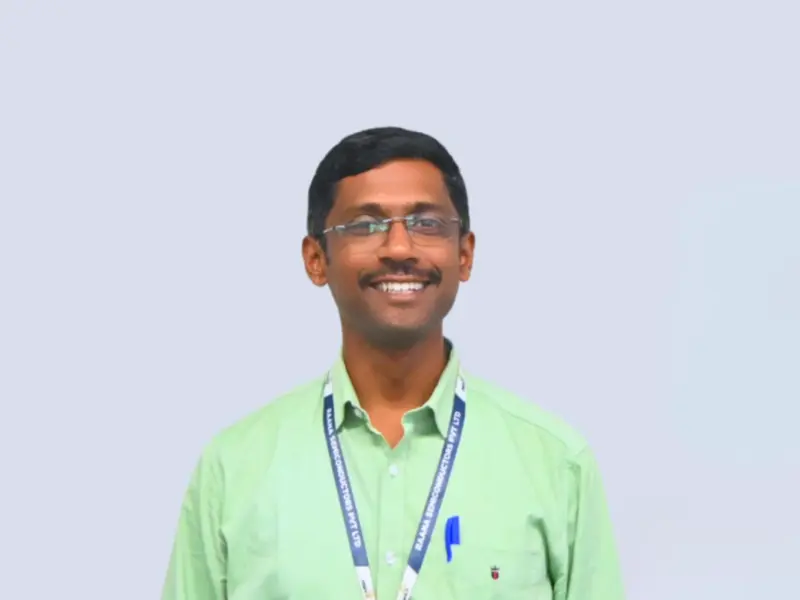

Semiconductor startup Raana Semiconductors has raised $3 Mn (around INR 27 Cr) in its seed funding round led by Equirus Innovatex Fund and Artha Venture Fund, along with participation from IvyCap Ventures, PointOne Capital, CIIE Initiatives (IIMA Ventures), and angel investor Garimella Laxminarayana.
The Tamil Nadu-based startup will utilise the freshly raised capital to accelerate product development and R&D. Raana Semiconductor aims to build an indigenously designed Czochralski (CZ) monocrystalline silicon ingot grower which will be capable of producing 10 to 12-inch diameter silicon ingots.
For context, the Monocrystalline silicon (mono-Si) grown by the Czochralski method allows to pull large, defect-free cylindrical silicon crystals (ingots) from molten high-purity silicon, forming the foundation for semiconductor wafers used in electronics and solar cells.
Monocrystalline silicon is a material in which the entire crystal has a single and continuous lattice structure. This material is the starting component for almost all semiconductors. Its structure allows electrons to move in a predictable manner, allowing high functionality electronics.
Founded by Rajasekar Elavarasan in 2015, Raana Semiconductors claims to be the only private Indian company which is exclusively focused on CZ-based crystal growth equipment. Along with semiconductor, the startup also works on making ingot growth solutions for solar-grade as well.
On the financial front, Raana claims that its revenue grew at a CAGR of 30% in recent years, with confirmed orders totaling INR 12 Cr for the ongoing fiscal (FY26). Besides, it is targeting to breach INR 200 Cr revenue within the next three to four fiscal years.
The fundraise comes at a time when the Indian semiconductor industry is firmly in the spotlight, drawing heightened interest from startups and policymakers alike.
Over the past year or so, the Central government has doubled down on its push to build domestic semiconductor capabilities in the country, in line with its long-term ambition to create a self-reliant chip ecosystem.
Last year, electronics and IT minister Ashwini Vaishnaw said India is working towards setting up a commercial-scale silicon-based fabrication facility with an above-average capacity of over 50,000 wafer starts per month.
Adding to the momentum, India last year unveiled its first indigenous semiconductor chip, which for many marked a milestone for the nascent ecosystem. To further bolster this momentum, the government is also weighing incentives worth up to $20 Bn under ISM 2.0 to attract large-scale manufacturing and semiconductor equipment players.
Backing this policy intent with capital, the Centre has cleared four new semiconductor projects involving a cumulative investment of INR 4,584 Cr under the India Semiconductor Mission (ISM). These units are slated to come up across Odisha, Andhra Pradesh and Punjab, underscoring a geographically diversified manufacturing push.
However, this optimism has not yet translated into proportionately higher startup funding in the segment. In 2025, Indian semiconductor startups raised roughly $50 Mn, according to Inc42's annual funding report. While this was nearly 80% higher than the $28 Mn raised in 2024, funding levels remain modest compared to other technology segments.
Industry stakeholders Inc42 spoke with earlier this month attributed this gap to the lag between policy announcements and commercial execution. Many highlight the fact that much of India's semiconductor framework is still in an early phase, with approvals, land allocation, infrastructure build-out and supply-chain alignment still at a very early stage. In contrast, venture capital typically follows visible progress in the form of working products, early customers or defensible intellectual property.
As a result, most investments so far have been at an early stage with relatively small cheque sizes, signalling exploratory bets rather than high-conviction capital. Moreover, much of the current policy push - particularly around fabrication, advanced packaging and manufacturing - is geared towards large, established players rather than startups, said Ashwin Raguraman, founder of Bharat Innovation Fund.