
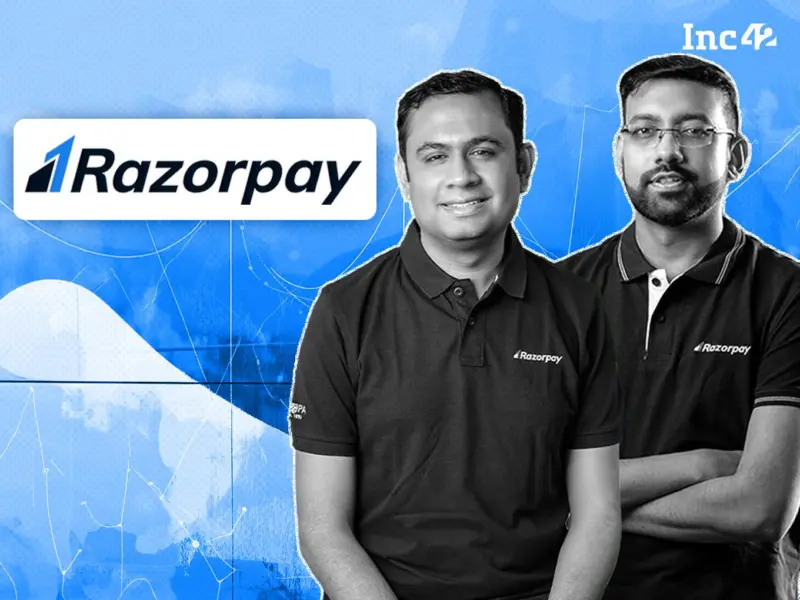

Amid aggressive international expansion, fintech major Razorpay has received the Payment Aggregator-Cross Border (PA-CB) licence from the Reserve Bank of India (RBI).
The regulatory nod will allow it to facilitate both inward and outward cross-border payments internationally.
In a social media post, cofounder and MD Shashank Kumar said the licence marks a significant step toward bringing Razorpay's vision of building a global payments network from Asia much closer to reality.
“We're already the largest non-bank cross-border payments player in India powering global brands we all know – Airbnb, Agoda, Shopify, IndiGo, and many more – and this license helps us scale that impact further,” his post read.
The Bengaluru-based fintech’s cross-border payments arm, Razorpay International Payments, is designed to help Indian businesses accept and receive payments from customers across the world.
On the export side, Indian businesses can accept payments in over 130 currencies through familiar methods like cards, wallets, and local bank transfers. Besides, it also allows global platforms to go live in India without having to set up an India entity, offering UPI, RuPay, EMIs and netbanking.
It's worth noting that Razorpay has been steadily strengthening its international playbook. Over the past few months, it has integrated with Apple Pay to enable international payments for Indian businesses, introduced zero-forex-markup support for sellers on the Amazon Global Selling platform, and partnered with NPCI International to facilitate UPI payments in Malaysia.
Overall, Razorpay provides payment solutions like payment acceptance to disbursals, lending, and business banking to over 8 Mn businesses. In its over a decade long journey, the startup has expanded its offerings via products like RazorpayX (neo-banking) and Razorpay Capital (lending), and integrations with government-backed initiatives like ONDC.
The startup has raised over $740 Mn since its inception in 2014 and counts the likes of Tiger Global, Peak XV Partners, Lightspeed, among others, as its investors.
The regulatory nod for the fintech major comes at a time when the startup is bracing to become a public entity. Razorpay is planning for an initial public offering (IPO) in India, potentially by late 2026 to 2027. The startup has already taken significant steps toward this goal, including converting to a public limited company and redomiciling to India from the US.
The reverse flip to India, which entailed tax expenses as high as INR 1,245 Cr, led to the startup slipping into the red in FY25. While the IPO-bound startup is yet to file its financial statement for the fiscal year, it said that it incurred an ESOP expense of INR 1,209 Cr in the fiscal year.
Besides, it also claimed to have seen 65% YoY jump in its operating revenue to INR 3,783 Cr in FY25 from INR 2,296 Cr in the previous fiscal year.
To get back into the black, Razorpay intends to double down on investments in AI-first products, financial infrastructure, and new verticals that enhance value for its partner businesses.