


Welcome to The AI Shift by Inc42, our all-new newsletter that delves deep into the world of artificial intelligence, LLMs, big tech giants and the major trends sweeping the Indian startup and tech ecosystem.
Here's the sixth edition; do send us your feedback and suggestions so we can improve as we go along!
Just over a year ago, OpenAI founding member Andrej Karpathy
Nowadays, thanks to memes and serious startups in this space, pretty much everyone knows vibe coding means building software by telling a chatbot your intent.
Instead of writing every line of code, a user can describe the vibe, the look, the feel, and the function. The AI then does the heavy lifting of writing code.
Across startups and enterprises, intent-first, AI-assisted building is reshaping how software gets shipped, who gets to build it, and how accountability is distributed. Teams are moving faster than before, and capabilities are spreading beyond engineering.
This does not mean that AI-assisted software development is spelling doom for developers. It is rather redefining their jobs. Being a coder today is less about being a syntax wizard and more about having high-quality logic and clarity of vision.
However, this comes with its own set of questions. When an AI interprets a "vibe" into millions of lines of code, who is responsible for the bugs and who owns the security?
Software Enters A New Era
Vibe coding represents a tectonic shift in software development, moving away from code-as-instruction to code-as-outcome.
Instead of painstakingly writing every line of syntax, developers now simply describe behaviours, flows, and intent to the chatbot. The AI then generates the skeleton and general structure, and the human simply decides if the result is acceptable.
This shift is most visible in design-led and early stage product work. Rahul Jain, founder of custom software developer Pixeldust, notes that AI has compressed delivery cycles.
Explaining this, he underlines that software development previously involved many hiccups and stakeholders - designers mapped journeys, engineers translated flows, and prototypes took days to stitch together. Today, Jain said, much of that scaffolding is automated.
"The base is ready… With extra time on their hands, teams now focus more on high-value finishing touches like building animations and creating a nuanced design language."
However, the founder of AI coding startup Workers IO, Chaitanya Choudhary, warns that agentic coding, while helping across development, fails at architecture. He feels that vibe coding still needs human judgment, clear constraints, and multiple rounds of planning before implementing key decisions.
But even as the industry weighs these architectural gaps, the barriers to entry are slowly crumbling.
Capability Is Spreading Faster Than Governance
The most consequential effect of vibe coding is not developer productivity but access. Internal tools that earlier were considered too small or low-priority to spend engineering time on are now being created by people who aren't engineers.
"Individual contributors are shipping code at lightning speed. It's easier than ever for one person to ship more code than an entire team that isn't using AI," Choudhary said.
But that speed, he noted, is shifting pressure downstream. "Review is definitely emerging as a bottleneck."
Rather than judging output alone, Choudhary said his team now evaluates intent itself. "I ask my team to share the prompt alongside the pull request so I can assess whether the approach was right, not just the output."
There are contrarian views, too. "I hate the term 'vibe coding' for what I do… It implies recklessness," said Giga AI founder Namanyay Goel. He advocates for AI-assisted coding for routine tasks, balanced by rigorous human architectural oversight.
How Enterprises Are Absorbing Vibe Coding
Despite the hype, enterprises are not embracing free-form vibe coding across their core systems. Instead, they are selectively absorbing it through constrained internal setups:
- Agent-driven tools with scoped access
- Clear read-write boundaries
- Approval layers
- Audit trails
- AI is allowed to act, but within tightly defined limits
On why guardrails are necessary, Goel underlines his experience, "Early on, I let AI touch production workflows without proper guardrails. Bad idea. A really bad idea."
Over time, his team has introduced explicit controls. Certain systems, such as authentication logic, payments, database migrations, and user data access, require manual scrutiny and partial rewrites rather than surface-level review.
Every AI-generated feature is deployed behind feature flags. And no code is merged unless the human reviewer can fully explain how and why it works.
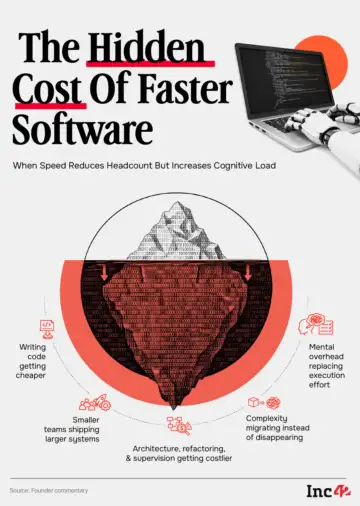
In the short term, vibe coding compresses cost. Smaller teams ship more. Prototypes appear in days. MVPs emerge faster than before. But over time, costs do not disappear. They migrate.
While AI-assisted coding allows building a SaaS product with one engineer instead of six or seven, what becomes more expensive is mental overhead, refactoring debt (i.e. inconsistent code accumulating), and constant architectural supervision.
Towards Autonomous Software Systems
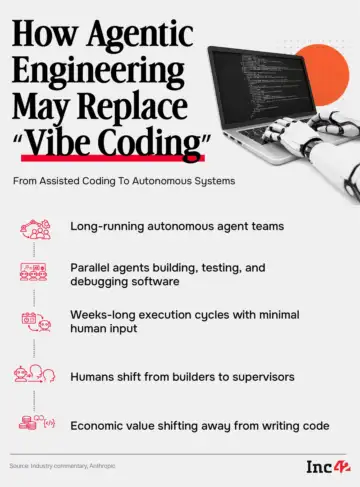
If vibe coding is about expressing intent, autonomous software development is about removing humans from large parts of execution altogether.
At Anthropic, researchers recently demonstrated what long-running autonomous agent teams can do when properly scaffolded. Using parallel instances of Claude operating with minimal human intervention, the team built a full C compiler from scratch capable of compiling the Linux kernel. The effort ran for weeks, consumed nearly $20,000 in compute, and resulted in a 100,000-line production-grade compiler.
The takeaway was not that AI can write code faster. It was that software can now be built, tested, debugged, and evolved autonomously.
Karpathy labelled a similar shift as "agentic engineering", which could be a new key term going forward to replace "vibe coding" in the future.
Among Indian tech trailblazers, Sridhar Vembu, chief scientist and cofounder of Zoho, reflected on how rapidly AI-assisted engineering is eroding the economic value of writing code itself.
Citing everything from simple consumer apps to Anthropic's compiler, Vembu argued that those who depend on coding for a living may need to start preparing for a world where software creation is no longer a scarce skill.
What's emerging, then, is not a clean handover from humans to machines, but a new engineering bottleneck. While autonomous systems can now build complex software with minimal intervention, deploying them reliably at scale remains the hard part.
As Aashish Bharadwaj, cofounder of security testing company Fencio, points out, failure modes multiply once agents leave controlled environments and enter production.
In that sense, "agentic engineering" may be less about replacing developers and more about redefining where human effort is applied.
For startups, the opportunity may lie not in chasing full autonomy, but in building the infrastructure that makes it safe, predictable, and economically viable.
Whether this ultimately makes software creation abundant or simply shifts scarcity to a new layer of the stack is still an open question. But one thing is clear: the future of software will be shaped as much by constraint and control as by capability.
Top Stories From India & Around The World
- IndiaAI Mission Targets 100 Mn Users: With thousands of GPUs deployed and domestic models underway, IndiaAI Mission is building AI as public infrastructure, where success will be measured by adoption, scale and citizen-facing impact.
- Anthropic Triggers SaaS & Indian IT Sell-Off: Anthropic's Claude Cowork launch with its plugins wiped out $285 Bn in tech market value, sparking fears that autonomous AI could disrupt SaaS and labour-heavy Indian IT services.
- Fibr AI Raises $5.7 Mn For Agentic Martech: Fibr AI raised $5.7 Mn led by Accel to build an agentic AI layer that personalises web experiences and helps brands improve conversions and reduce CAC.
The Weekly Buzz: Sarvam AI Grabs The Spotlight
Sarvam AI found itself in the spotlight this week after a public reversal from investor and AI commentator Deedy Das, who openly praised the Indian startup's rapid technical progress.
Das, a partner at Menlo Ventures, admitted he had been sceptical about Sarvam's original bet on smaller Indic language models. A year later, he said he was wrong. According to Das, Sarvam now offers what he calls the best-in-class text-to-speech, speech-to-text, and OCR models for Indian languages, with reasonable pricing and a product experience that is "dirt easy to use".
For context, the model in question is Sarvam Vision, which is an efficient 3B state-space model delivering best-in-class document intelligence and multimodal understanding across 22 scheduled Indian languages. The model demonstrates its dominance on the Sarvam Indic OCR Bench, where it maintains a significant performance gap - surpassing GPT 5.2 by over 10% in major languages like Hindi and by more than 50% in complex regional scripts like Telugu.
The praise wasn't abstract. Das shared a
Supporters see this as validation of Sarvam's thesis. While global AI labs chase frontier models, Sarvam is quietly filling a deep ecosystem gap, building infrastructure for Indian languages that few others prioritise. Critics may still question the scale of the business, but the technological appreciation feels real.
In a week dominated by agentic hype and platform theatrics, Sarvam's moment stood out for a different reason. It showed how local-first AI can unlock cultural value at scale, and why India's AI story may increasingly be written in its own languages.
Startup In The Spotlight: PredCo
Manufacturing operations have quietly become one of the most failure-prone and data-fragmented environments inside enterprises. Machine breakdowns, safety lapses, inventory delays, and disconnected legacy systems often collide at once. What's missing is not more dashboards, but a single, real-time operational layer that can see across the factory floor and act early.
PredCo was built at this fault line. Not as another monitoring tool, but as a full-stack operational intelligence platform for industrial facilities, designed to sit above machines, sensors, and cameras and turn raw signals into decisions managers can rely on.
At the heart of PredCo's platform is centralised oversight of operations. By unifying data from legacy equipment, modern IoT sensors, and vision systems, the company gives plant managers a live, end-to-end view of what's happening on the floor. The focus is on shifting teams from reactive firefighting to proactive control.
The product itself is deliberately comprehensive. Predictive maintenance models analyse sensor data to anticipate equipment failures and schedule maintenance before downtime hits. Digital twins create high-fidelity virtual replicas of physical assets, allowing teams to simulate changes and optimise performance without risking real machinery. Computer vision systems inspect products in real time, flagging defects early in the manufacturing process. On top of this, real-time tracking monitors assets, inventory flow, and safety compliance across the plant.
PredCo's AI approach is pragmatic rather than flashy. Different techniques are applied where they matter most, with an emphasis on reliability, explainability, and integration into existing industrial workflows.
Operating in a global industrial AI and manufacturing compliance market estimated at $50 Bn, PredCo is positioning itself as foundational infrastructure for the next generation of smart factories.
Prompt Of The Week
What prompts and hacks are CTOs, CEOs and cofounders using these days to streamline their work?
Here's Naman Sanghi, cofounder of ADNOXY, sharing a prompt on how he uses GenAI as a strategic thought partner to tackle challenges when operating a startup:
"Act as my strategic thought partner.
Here's the context of my startup and where we're stuck.[context] + [problem]
What is the one problem we should obsess over right now?
What are three realistic paths we can take, what do we gain and lose with each, and which one gives us the highest long-term upside?
Also, outline what the next 14 days should look like if we choose the best option."
Editor's Note: Some prompts may need to be adjusted by users for best results or may not work as intended for certain users.