





If you asked ChatGPT for a new phone, a family car or the best way to plan a holiday, you were probably looking for an answer, not an ad.
That's changing fast.
Last week, OpenAI launched ChatGPT Ads in India, bringing sponsored messages into conversations on the AI chatbot for the first time in one of its largest markets. It's the latest to introduce ads into its AI tools after Gemini and Meta, signalling a shift in digital advertising and marketing.
Ads will roll out to those using Free and Go tiers, while those on Plus, Pro, Business, Enterprise and Education plans will get an ad-free experience.
The AI giant claims more than 50 brands are expected to go live during the initial rollout, with WPP and Omnicom as OpenAI's first agency partners in India. Businesses will be able to access ChatGPT's self-serve Ads Manager, with daily budgets starting at ₹725.
OpenAI's pitch to advertisers is fairly straightforward if you believe that the world is moving on beyond search engines. The company says ChatGPT is increasingly becoming a place where people don't just look for information, but think through what they want to buy.
In India, the company claims more than 100 Mn weekly active users, though how many of these are on the free and Go tiers is unclear. ChatGPT Ads arrive at an interesting moment for the advertising industry. Google and Meta have already begun putting ads into their AI-powered experiences, while other AI companies are still figuring out whether advertising can coexist with the trust users place in conversational assistants.
OpenAI now has to answer a harder question: will advertisers actually move money to a chatbot simply because it knows what consumers are thinking about?
How ChatGPT Ads Work
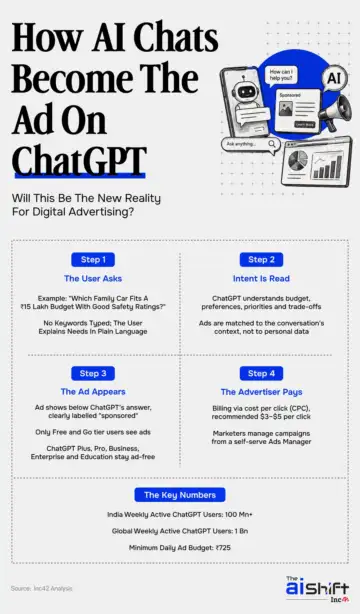
OpenAI's initial advertising model is deliberately closer to search advertising than traditional display advertising. But it also says that unlike a conventional search query, a conversation can reveal the user's budget, preferences, concerns and trade-offs.
"People do not simply enter a few keywords into ChatGPT. They express their goals, constraints, preferences and trade-offs. That produces a much richer expression of intent than a search for 'best family car," said Preetham Venkky, chief digital officer, Omnicom Advertising India.
Under the hood, OpenAI's ads system uses conversation context to show an ad relevant to what the user is exploring. It considers multiple signals, including the context and intent of users' current conversation, the ad's landing page, title, copy, advertiser-provided context hints and targeting selections.
In this case, ads will appear at the end of a response by ChatGPT. Ads are labelled as sponsored messages and visually separated from ChatGPT's response. For its rollout in India, ChatGPT is going for direct relationships with select brands and agencies to begin with.
Globally, studies show that ads on AI platforms align with the topic of the query and score high on relevance metrics. A study by SE Rankings showed that only 14% of the times the ads seemed irrelevant to a query on ChatGPT. However, for specific topics such as news and politics, the figure was much higher, up to 50%, which shows that the AI ad engines have a lot of fine-tuning ahead of them.
For now, brands who are experimenting with ChatGPT ads can use the company's SaaS tool to set their own bid strategy, choose a destination URL, add context hints and target users by devices. ChatGPT automatically generates personalised and translated versions of headlines and descriptions, which may run without individual review, if the user opts for this approach.
Helping marketing teams generate personalised versions of the campaign at hand is a key facet of this tool. This helps marketers instantly tailor their messaging for the conversational AI world.
"Search advertising responds primarily to an explicit query. Social advertising is largely built around audiences, interests and attention. Conversational AI introduces a third signal: the broader context surrounding a decision," Omnicom's Venkky added.
He cited the example of someone asking ChatGPT for a family car within a particular budget, suitable for city driving and with strong safety ratings as opposed to someone just asking about the best family car. The former is expressing a much more detailed need and the AI's advantage is the ability to understand this need and add it to the context around the stage of decision-making and intent of the user.
Will Ads Worsen The Data Privacy Issues?
Now addressing the elephant in the room. AI chatbots have had some notorious data privacy and security issues. While OpenAI says advertisements do not influence the answer generated by the model, one would assume this behaviour will not be inflexible.
The company says advertisers do not get access to conversations or personal information of the users. And while ads are selected based on the conversation's context, the content of the user's conversation is not shared with advertisers.
OpenAI has also said advertisers will receive aggregate campaign-performance information, such as impressions and clicks, rather than access to individual conversations. But there are still concerns about how far OpenAI will push the ad agenda.
A report by Wired showed that close to one in five conversations triggered an ad at the bottom of the output, often tailored to the most recent prompts. That said, the formatting and frequency of these ads may change with OpenAI's new experiments.
The company is also putting guardrails around where ads can appear. Ads will not be eligible alongside sensitive or regulated topics, including mental health and politics. They will also not be shown on accounts belonging to people who identify themselves as under 18 or are predicted to be minors by OpenAI's systems.
Users will also be able to dismiss ads, provide feedback, understand why an ad was shown, manage personalisation and clear the data used for advertising, according to OpenAI.
Will Brands Embrace The AI Shift?
OpenAI has also moved from experimentation towards a conventional advertising infrastructure. Its initial pilot used CPM, which is cost per thousand impressions, but the company subsequently added cost per click (CPC) bidding, allowing advertisers to pay based on clicks.
For CPC campaigns, OpenAI recommends starting with a maximum bid of $3-$5 per click.
In India, OpenAI is also preparing a self-serve ad management dashboard for brands and marketers. The minimum daily budget is ₹725, making the platform accessible beyond large agency-led campaigns. The important caveat for Indian marketers is that there is still limited public data on Indian clearing prices, conversion rates and return on ad spend. The market is too new for meaningful India-specific benchmarks.
That said, experts believe that these ads are expected to work best for 'intent' based buys instead of brands that lean in more towards impulse or awareness-led.
OpenAI's early signals are encouraging, but there is little evidence yet that AI advertising can outperform established channels.
The company said its initial US pilot delivered encouraging results, it revealed that ChatGPT Ads has reached $1 Bn in annualised revenue run rate in 200 days of launch. In another forecast report by Axios, OpenAI's advertising revenue is expected to reach $2.5 Bn in 2026, $11 Bn in 2027 and potentially $100 Bn by 2030.
But these are global figures and may not be justifiable in India till we see more data from the company.
Perplexity's experience offers a different picture of how the AI industry sees advertising. After experimenting with ads, the AI search startup shifted towards a more subscription-led model.
However, a Perplexity spokesperson told Inc42, "We're continually experimenting with advertisers that prioritise our users and how they use the internet now."
For ChatGPT, Google is the more consequential benchmark. Google Search advertising revenue rose 14.5% to $81.6 Bn in Q2, while the company has already integrated ads into AI Overviews in India and is testing them in AI Mode in the US. Existing AI Max and Performance Max campaigns can extend into these experiences through Google's standard auction system.
"Search is becoming an even deeper tool for discovery and decision-making through conversational AI. In India, 87% of surveyed users report making more confident decisions using AI Overviews and AI Mode," a Google spokesperson told us, adding that ads can fuel brand discovery at the moment of intent.
Meta is also using AI to automate targeting, creative and campaign optimisation through Advantage+, with Bernstein analysts expecting its ad revenue to surpass Google's in 2026.
Against these entrenched platforms, ChatGPT Ads are expected to remain experimental initially, according to advertising experts. For the first 12-24 months, most advertisers will treat ChatGPT Ads as a complementary channel funded through innovation, experimentation or performance-media budgets.
The bigger prize will depend on whether conversational intent delivers better economics. As consumers shift more product research to AI, some budgets could move from Google Search and other lower-funnel media. But stronger conversion rates, lead quality or lower acquisition costs will need to be demonstrated before ChatGPT becomes a core channel.
Brands And Industries Most Suited For GPT Ads
The brands that will do well here are the ones selling into a decision, not just a purchase. Medium and high-involvement categories are likely to adopt the format first because consumers in these categories typically search, compare and evaluate before making a decision, Omnicom's Venkky said.
The automotive industry, consumer electronics, beauty and personal care, B2B technology and travel are expected to merge as natural early categories. These are categories where someone is actually asking a question and weighing options, not just scrolling.
"If you're selling something people research before they buy, a mid-conversation ad sits naturally in that moment," said Paramdeep Singh, cofounder of Shorthills AI.
If it is an impulse or awareness-led brand, this format probably is not for them yet. The whole value of ChatGPT ads comes from intent, and low-intent categories won't get the premium they are paying for, the experts said.
Not Everyone Wants An Ads In AI
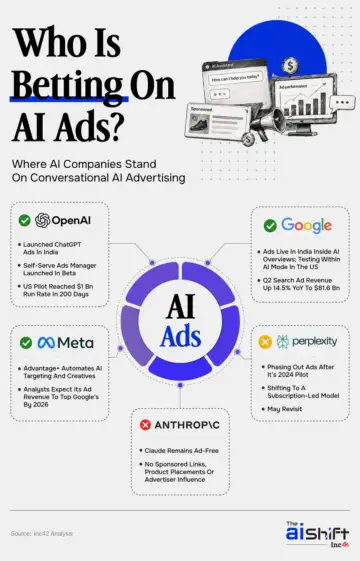
The most interesting counter-position for the ads in AI debate comes from Anthropic. In February, the company explicitly said Claude would remain ad-free. Its argument was not simply about user experience. Anthropic said advertising incentives were incompatible with its vision of Claude as a genuinely helpful assistant.
It specifically ruled out sponsored links, third-party product placements and advertiser influence over Claude's responses.
Just a year after Perplexity rolled out ads in 2024, it began phasing out ads, and reportedly said that it was not exploring any new ad deals at the moment. It is a noteworthy U-turn for the AI startup, which became one of the first generative AI companies to test ads on its platform in 2024. Similar to Anthropic, trust was the factor cited as the reason behind this decision.
Before embracing ads, CEO Sam Altman had once called the combination of AI and advertising "uniquely unsettling" and described ads as a "last resort" business model.
Now, OpenAI is betting on the very model that Altman once viewed as a last resort. Whether that becomes a major revenue engine, or remains a way to subsidise free access, will depend on whether advertisers find enough value in ChatGPT's most valuable asset: user intent.
Top Stories From India & Around The World
- Gnani.ai Unveils Sovereign AI Stack Artha For Enterprises: Gnani.ai unveiled Artha, a sovereign AI stack pairing its 30 Bn-parameter multilingual model Evon v3.3 with agentic platform Plexus. It targets Indian enterprises and government bodies seeking control over sensitive data.
- Runable Raises $21 Mn To Help Small Businesses Grow: AI agent platform Runable raised $21 Mn in a Series A co-led by Susquehanna and Nexus to automate customer acquisition, marketing and operations. The startup claims 1.5 Mn users and $2 Mn in ARR within weeks of launch.
- Ringg AI Nets Additional $10 Mn, Closes Series A At $15.5 Mn: Voice AI startup Ringg netted an additional $10 Mn, closing its Series A at $15.5 Mn. Peak XV Partners led the round, with Arkam Ventures and Capital 2B doubling down.
- ESDS Tests Market Amid Soaring Server, GPU Costs: ESDS opens its ₹720 Cr IPO at ₹408-₹429 to fund data-centre expansion and GPU-as-a-service. But server costs have nearly doubled since filing, stretching the capital it will raise.
- Nvidia is Going For Hugging Face Acquisition: Several reports suggest that Nvidia has agreed to on acquire Hugging Face, the go-to open-weight model repository used by developers worldwide for $12.9 billion. The deal would hand the GPU giant control over one of the largest distribution channels for open-source AI models, potentially reshaping how open-weight tech reaches the market. (Source: The Information)
- Sony Music, Warner Sue Anthropic Over Alleged IP Theft: Sony Music and Warner have sued Anthropic, as per a report by TechCrunch accusing the AI company of a "brazen campaign" of copyright infringement in how it trains its models. It is the latest in a wave of music-industry litigation targeting AI firms over the unauthorised use of copyrighted lyrics and recordings.
The Weekly Buzz: OpenAI Cuts Off Cursor
OpenAI is ending its long-running model-supply agreement with Cursor after SpaceXAI completed its $60 billion acquisition of the AI coding startup.
Direct access to OpenAI models will terminate on November 12, 2026, the maximum notice period permitted under the contract's change-of-control clause. Future models, including the upcoming Astra, will also be withheld from the platform. In its official statement, OpenAI said it could not be confident that SpaceXAI would respect its terms of service, citing previous contract violations by Musk-linked companies including X and xAI.
Cursor CEO Michael Truell responded that OpenAI models currently account for only about 5% of user traffic and that discussions between the two sides are continuing. Anthropic quickly announced it would increase compute support for Claude models inside Cursor to help fill the gap. The decision escalates the already bitter rivalry between OpenAI and the SpaceXAI ecosystem at a moment.
Removing OpenAI models forces a faster shift toward Anthropic, open-weight alternatives, and Cursor's own internal models. The episode highlights how fragile commercial alliances have become in the frontier AI stack. Model access is no longer neutral infrastructure. It is now shaped by personal history, competitive positioning, and control over the next generation of agentic coding systems.
Startup In The Spotlight: Gocodeo
Founded in 2023 by Meghana Jagadeesh and Jatin Garg, Bengaluru-based GoCodeo is an AI coding agent that works across the software development lifecycle. AI coding tools mostly behave like glorified autocomplete - helpful for snippets but stopping short of the full development loop professional teams actually run.
Instead of one-off suggestions, GoCodeo pitches context-aware, autonomous actions inside the IDE. Its VS Code-native agent handles build, test and deploy workflows, with Git integration for repository initialisation, commits and pull requests, and generates production-ready tests with debugging support.
The startup has open-sourced a full-stack SaaS builder framework and claims a developer base of over 25,000. It counts backing from Google for Startups and NSRCEL alongside its investors.
GoCodeo operates in the rapidly expanding AI software development tooling market, part of India's enterprise AI opportunity, projected to grow from $11 Bn in 2025 to $71 Bn by 2030. As agentic coding tools move from snippet generation to owning the full build-test-deploy loop, GoCodeo believes an agent that ships production-ready code could help developers shift from assisted autocomplete to genuinely autonomous software delivery.
Prompt Of The Week
What prompts and hacks are CTOs, CEOs and cofounders using these days to streamline their work?
Here's the prompt Viren Inaniyan, cofounder and CEO of Tru Commerce, uses to see a brand exactly the way ChatGPT sees it before deciding what to fix in its AI search presence.
"You are a brutally honest AI-commerce analyst. I'm the founder of [brand] in [category]. Treat me as an operator, not a beginner. Using only what you actually know or can infer about my brand and category, produce three sections, no preamble:
- The shelf test: Answer the 10 highest-intent buying questions in my category the way you would for a real shopper (for example, 'best under [price]', '[brand] vs [top competitor]', 'is [brand] legit'). For each, state which brands you would name, in what order, and whether my brand appears at all.
- The why: For every question where my brand is absent or ranked low, name the exact reason missing structured product data, thin third-party validation (Reddit, reviews, press), weak comparison content, or you simply don't know the brand exists. Flag which reasons are fixable in 30 days vs 90 days.
- The fix list: Give me a prioritised 5-item action plan to win these answers: what to publish, where to earn citations, what data to structure, ranked by impact on revenue, not vanity metrics. For each item, name the query it will move and how I would verify it moved in 4 weeks."
Editor's Note: Some prompts may need to be adjusted by users for best results or may not work as intended for certain users.
[Inputs by Gargi Sarkar]
[Edited by: Nikhil Subramaniam]
[Creatives by: Abhyam Gusai]