



Running out of pooja samagri just before an aarti is no longer the household crisis it once was. The missing camphor, flowers or diya can now arrive at your doorstep within minutes.
A gemstone recommended during an online astrology consultation can be bought before the call is over. Even prasad and blessed products can travel from a temple to a devotee living in another city or country without any hassle.
Thanks to the rising bandwagon of 900+ new-age D2C brands, such as Phool, Astroyogi, Japam, Sri Mandir and Vama, among others, the Indian spiritual or faith commerce ecosystem has come a long way over the past decade.
For decades, VCs found it difficult to invest in faith commerce. This is because the market was largely cash-based, fragmented, offline and culturally sensitive.
But times have changed. India's faith ecommerce market has been successful in grabbing eyeballs. According to experts, India's spiritual economy is estimated at approximately $60-70 Bn, while funding into spiritual tech companies has accelerated materially over the past few years.
Abishek Balendran, partner, SilverX Fund & Silverneedle Ventures believes the interesting bit isn't that faith suddenly became a venture category. It's that India's digital infrastructure has finally made faith-centric D2C commerce measurable, repeatable and scalable.
Three significant factors have powered this shift:
- Digital Infrastructure: UPI and smartphones made faith services easier to access and enabled seamless, low-value digital transactions.
- Regional Language Internet: Non-English internet adoption in India brought the category's core consumers online, significantly expanding the addressable market.
- Pandemic-Driven Behaviour: Covid-19 accelerated digital adoption across age groups, encouraging founders to build trusted, convenient and personalised faith experiences online.
"The other major unlock has been the diaspora opportunity. For an Indian living in New York or Dubai, access is a problem. Technology solves that. When you see platforms deriving a meaningful share of revenue from international users who are willing to pay a premium to stay connected to their roots, it fundamentally changes the total addressable market," said Padmaja Ruparel, cofounder, IAN Group.
But as the sector matures, several questions emerge. Can faith commerce produce enduring, venture-scale businesses? And what challenges must founders overcome to unlock the market's full potential?
No Longer A Niche Bet
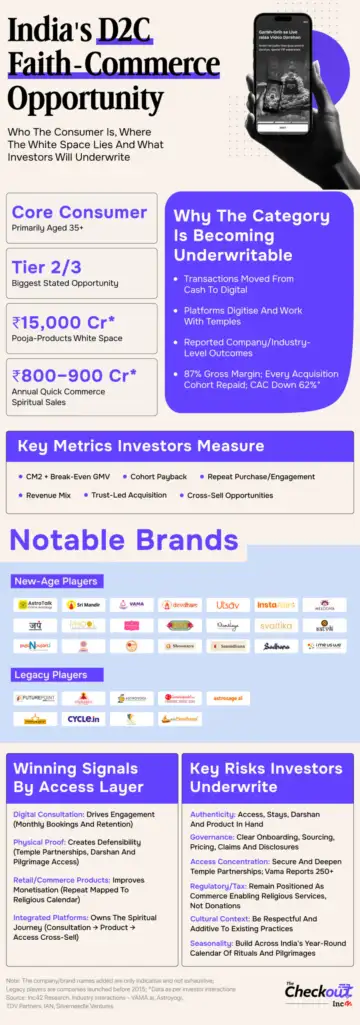
India's D2C spiritual tech market is rapidly evolving from a niche digital experiment into a meaningful consumer internet category. While astrology took more than a decade to establish itself online, temple-led commerce began gaining traction only after the pandemic. But that gap is now narrowing.
Vama offers an early glimpse of this shift. According to cofounder Manu Jain, temple-led products emerged as a breakout vertical for the company, helping it grow its revenue 3X by June 2026 compared with the previous financial year.
The demand is also spreading across categories. Astroyogi serves more than 40 Mn users across consultations, tarot, numerology and retail, while its retail business, Yogii, launched two years ago, is growing by around 50% QoQ.
"The opportunity is not to create a new market, but to make a large, fragmented market more accessible, convenient and organised," said Astroyogi's cofounder Meena Kapoor.
Meanwhile, AstroTalk showed just how large that opportunity could become. Its spiritual-products division crossed ₹140 Cr in revenue in its first year and recently crossed a daily GMV run rate of around ₹1 Cr in August 2025.
The company reported revenues of ₹1,182 Cr in FY25 and a ₹250 Cr net profit. It is targeting a ₹2,000 Cr run rate ahead of a planned IPO in late 2026 or early 2027. If successful, it would become India's first listed consumer astrology company.
Naturally, investor interest has followed.
For D2C faith commerce, the biggest challenge is convincing consumers that what they see online is genuine. This is particularly difficult in categories such as gemstones, where buyers may be unable to verify authenticity or identify treatments. The proliferation of fake websites and dropshippers makes that trust deficit harder to address. For investors, the concern is when a product or service cannot be independently verified.
Vama counters this by sending temple certificates with spiritual products and sharing videos of items being energised at the temple. It also reinforces its status as an authorised temple partner throughout the customer journey.
According to Vama's Jain, the hardest operational challenge, apart from trust, is managing logistics and execution during festivals such as Diwali, when demand can spike sharply. Companies should be able to forecast inventory, distribute stock across fulfilment centres and coordinate execution seamlessly.
Jain also believes technology should complement, not replace, the offline faith experience. Devotees still want a connection with the temple, and digital platforms work best when they strengthen that relationship. Companies that can preserve this authenticity while managing trust, logistics and seasonal demand will be better positioned to build loyal customers in an increasingly competitive market.
Nevertheless, not all are blessed in the faith economy. In May 2026, spiritual tech startup DevDham (formerly DevDarshan) shut down roughly two years after its major seed funding round. The startup failed due to monetisation challenges, scaling pressures and failed acquisition talks.
The Next Big Moat
Going forward, IAN's Ruparel expects the product layer to remain fragmented because anyone can launch devotional merchandise. Consultation businesses will continue to grow because they have exceptionally strong retention. But the real value will accrue to companies that own the customer relationship.
Access is where the analysts see the most durable moat. If a platform becomes the default gateway for discovering temples, booking pilgrimages, making donations, accessing content and purchasing associated products, it benefits from powerful network effects.
The ecosystem expects darshan and access to consolidate naturally, as a temple is unlikely to grant exclusive digital rights to multiple platforms. This makes supply relationships defensible and creates a high-frequency, relatively low-CAC entry point.
"Access by itself is not where the biggest margins sit, but it becomes the moat. Astrology has very low barriers to entry, so it tends to fragment and become price-competitive. Ecommerce, meanwhile, has super-high gross margins, monetises the believer's full wallet and scales," said Silverneedle's Balendran.
Meanwhile, Ujwal Sutaria, founder and managing partner at TDV Partners believes access has the best economics because it has scarce supply, inelastic demand, high average order value and no cost of goods sold (COGS) drag. Whoever locks up the temple towns that matter will be hard to dislodge.
Over the next five years, the winners will look less like ecommerce companies and more like consumer platforms with multiple monetisation engines. They can win one layer of the stack, use ownership of access to build the customer relationship and then monetise that relationship through commerce over time.
SPOTLIGHT | Inside Sarkar's Bet On Accessible Luxury Fragrances
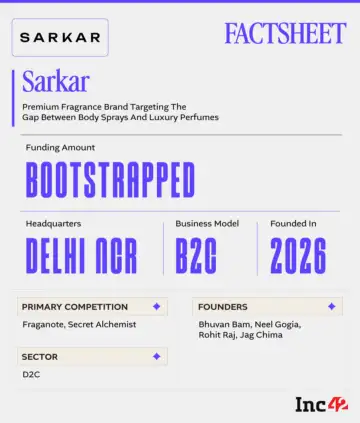
- Sarkar is a bootstrapped Indian fragrance brand offering unisex perfumes priced between ₹1,000 and ₹2,000, targeting the gap between mass-market body sprays and luxury fragrances.
- The debut collection comprises four fragrances - Orion, Noble, Throne and Regal. Each of these fragrances comprises a 25% oil concentration, formulated in France and Spain, and compliant with IFRA standards.
- The products are now available on Sarkar's official website and ecommerce channels, including Amazon and Flipkart.
Ecommerce Buzz
- Vishal Mega Mart Goes Quick: During its Q1 earnings call, value retail chain Vishal Mega Mart's MD and CEO said that the company was looking to double down on quick deliveries. Its quick commerce network has expanded to 767 stores across 520 cities, with the number of registered users crossing 1.4 Cr.
- Flipkart's Food Delivery Bet: The ecommerce giant is mulling the rollout of its food delivery services in Bengaluru by mid-August. For this, Flipkart is planning to charge a commission of 10-11% per order from restaurants.
- Zepto Defers IPO: Quick commerce giant Zepto has officially paused its IPO, with the fresh timeline set for the next two to three quarters. In the meantime, the company said it will increase focus on execution after receiving the board's nod to raise a pre-IPO funding round.
- Atomberg's Public Transition: Consumer appliances startup Atomberg has converted into a public entity in the run up to its potential public listing this year. It will aim to raise ₹1,500-2,000 Cr ($165-220 Mn) through the IPO for capital expenditure, debt repayment, and marketing.
The Deep Dive

Operator's Question
What must new faith commerce entrants get right to earn the trust devotees once placed only in known people? And where do most companies still fall short across sourcing, verification, communication and after-sales?
Speaking to Inc42, D2C spiritual wearables brand Japam's founder Ritoban Chakrabarti said the category requires trust to be built in layers, as the product remains with the customer for a long time. Outlining what new entrants should prioritise, Chakrabarti laid out the key focus segments.
- Sourcing: Chakrabarti said a rudraksha's origin and 'mukhi' count, or whether a gemstone is natural or treated, determines everything. According to him, if a brand cannot name its supply chain, it effectively does not have one.
- Unit-Level Verification: Authenticity should not rely on a brand-wide "100% authentic" badge, but on a government-approved lab certificate tied to the exact piece inside the box, allowing customers to verify it independently.
- Diagnosis Before Prescription: Recommendations should be based on the customer's own 'kundali', much like a family astrologer first studies a person's chart before suggesting anything. Brands should also be willing to tell customers when they do not need a product.
- After-Sale: Brands should focus on guidance on energisation, the appropriate day to wear the product, the associated mantra, and ongoing care. Since most buyers are first-time users, many quietly abandon the product within a month without adequate hand-holding.
Finally, the industry undermines itself by using fear to drive sales, as dosha panic may convert customers but hollows out the category over time. Another mistake is treating faith like performance marketing - buying attention and never earning belief.