
The Debate Over UPI Market Share
NPCI is all set to host a meeting with third-party payment apps later today. But the agenda of the sit-down seems clear - smaller UPI players want new rules to curb the dominance of PhonePe, Google Pay and Paytm.
So, how do the underdogs plan on rallying against the giants?
Curbing The Triopoly: Smaller UPI players like MobiKwik, Navi, super.money and Amazon Pay intend to seek tighter controls on how market leaders acquire users. They are pitching measures like banning the use of contact book data for targeted app downloads and limiting "collect requests" unless paired with broader merchant-side participation.
They are also expected to push for restrictions on UPI Autopay mandates, which have become a powerful lever for bigger players to dominate recurring payments.
The Monetisation Conflict: The underdogs are also likely to pitch rules that bar payment aggregators and gateways from charging tokenised-UPI-checkouts. Their rationale? Lower the barrier for smaller apps to compete in the high-frequency ecommerce segment. By stripping away these advantages, the challengers hope to neutralise the sheer network effects currently enjoyed by the market leaders.
Ghost Of The 30% Cap: The discussions reignite the long-stalled debate over NPCI's bid to cap the UPI market share at 30%. Originally proposed in 2020, the implementation of the plan has been repeatedly deferred due to dominance of top players.
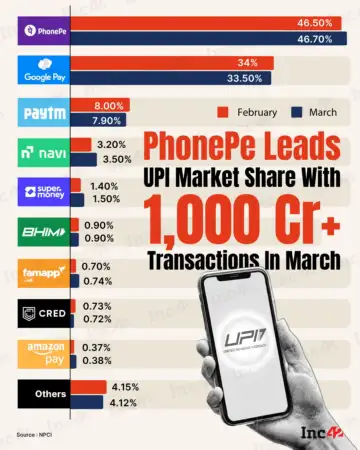
Giants Keep Pulling Ahead: The timing appears awkward for the incumbents. PhonePe, Google Pay and Paytm together accounted for 87% of the total UPI transactions in March, with PhonePe consistently commanding nearly half of the UPI market share for years. Transactions also hit a record high last month, showing that the ecosystem is growing even as concentration remains stubbornly high.
As UPI explores future tech like agentic AI frameworks to boost accessibility, will NPCI finally act or will smaller players continue to fight for scraps? Let's find out…
From The Editor's Desk

- Ahead of its listing, the lending tech startup's parent OnEMI Technology Solutions has raised ₹277.8 Cr from anchor investors. The startup allotted 1.62 Cr equity shares to anchor investors at ₹171 apiece, the upper band of its price spectrum.
- Of the total, 92.6 Lakh shares (57% of the total anchor round) were picked up by seven domestic mutual funds via a total of 13 schemes. Kissht's public issue will now open on April 30 and close on May 5.
- The startup's public issue comprises a fresh issue of shares worth up to ₹850 Cr and an OFS component of up to 44.4 Lakh shares. At the upper end of its ₹162 to ₹171 price band, the IPO will value the company at about ₹2,881 Cr.

- The trading platform has raised around ₹312 Cr in its Series B round led by Accel to enhance its tech stack, expand its product suite, scale its user base and foray into the wealthtech segment.
- Founded in 2023, Sahi offers professional-grade trading tools for individual traders. The startup claims to have clocked a 24X increase in trade volumes and served more than 13 Cr traders in FY26. Prior to the current round, it raised $10.5 Mn last year.
- The fundraise comes at a time when trading platforms are facing revenue pressures. SEBI has tightened F&O norms, which has impacted the top line and user base of giants like Zerodha and Groww.

- The payments bank saw its net profit plummeted 70% YoY to ₹7.1 Cr in Q4 FY26, while total income for the quarter declined 31% YoY to ₹340 Cr. Its total expenditure, excluding provisions and contingencies, declined 28% YoY to ₹334.6 Cr.
- For the full FY26, the company's PAT declined by 43% YoY to ₹52.5 Cr, while total income fell 14% YoY to ₹1,587.9 Cr.
- The lacklustre financials come as Fino is dousing fires on multiple fronts. Its stock is down more than 47% on a YTD basis, while the company's CEO Rishi Gupta was arrested last month on charges of alleged GST evasion.

- The Nasdaq-listed travel tech major has appointed Axis Capital, Morgan Stanley and JP Morgan as advisers for its proposed IPO, which could happen as soon as Q1 2027. The company plans to add more bankers to its kitty going forward.
- While details are scant, the MMT's proposed listing aims to raise capital from domestic investors. This follows the travel tech major publicly announcing plans to list on the local bourses to improve access to capital from domestic institutional and retail investors.
- Founded in 2000, MMT is an online travel aggregator that offers services like air and rail ticketing, hotel booking, and travel packages. Having processed more than 8.7 Cr transactions so far, the company's m-cap currently stands at over $5 Bn.

- The used car marketplace's cofounder and chief marketing officer Gajendra Jangid has resigned from his executive role. He will now transition to an advisory position with the company.
- Jangid cofounded Cars24 in 2015 as a marketplace for automobiles for buying and selling pre-owned cars. He has been heading the company's marketing division since inception. Prior to this, he worked at Schlumberger for over nine years.
- Jangid is the second top-level executive to quit the company within a month. In March, Cars24 said that its India used car business CEO Himanshu Ratnoo would step down from his role. The leadership changes come as the startup gears up to go public in 2027.
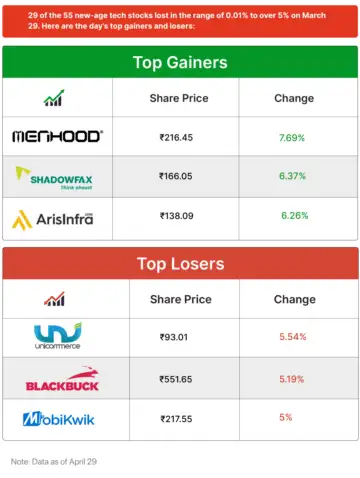
Inc42 Markets
Inc42 Startup Spotlight
Can Bharat1.ai Build India's Missing Deeptech Base?
India has plenty of AI talent, but too many founders still have to leave the country to find capital, customers and ecosystem support. Bharat1.ai is trying to change this by creating a physical AI hub where startups, researchers and enterprises can build together.
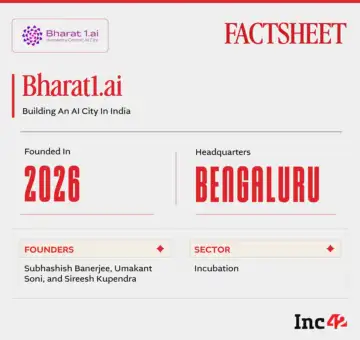
A Deeptech Hub: Founded earlier this year by Subhashish Banerjee, Umakant Soni and Sireesh Kupendra, Bharat1.ai has set up an AI city in Bengaluru. In its first phase, the 5 Lakh sq ft facility will host startups and large enterprises, looking to develop solutions around agentic AI, physical AI and robotics. It claims to offer connectivity of up to 400 GBps to AI clouds, along with access to NVIDIA's software stack and compute infrastructure.
Collaboration At Scale: More than 25 startups are already working out of the facility, and this number is expected to cross 60 in the coming months. The company is using a structured membership model, including invite-based entry and buildathons, to attract serious deeptech teams.
From Superpark To AI City: Bharat1's longer-term ambition is a 70-acre AI city that can host 25,000 AI researchers and builders. The founders say the goal is to create a self-sustaining innovation flywheel that keeps more Indian companies rooted at home while speeding up experimentation and adoption. So, can Bharat1.ai help India retain and scale its next generation of AI companies?
Infographic Of The Day
PhonePe continued to dominate the UPI market with 46%+ market share and over 1,000 Cr transactions in March, staying comfortably ahead of Google Pay and Paytm.