

If you ask some ecommerce startups in India, Diwali has come early this year with the Centre announcing a bumper sale on the Goods And Services Tax rates.
On 15th August this year, Prime Minister Narendra Modi announced next-generation GST reforms, to present a tax framework which enhances " the quality of life of every last citizen". Followed by this announcement, the Ministry of Finance released new GST rates earlier this week, effective from September 22nd.
While there are goods that are taxed at higher than 18%, the simplified GST rate structures have reduced the tax on a bulk of the eligible goods (see below). And many large manufacturers have committed to passing on the savings to consumers by reducing the retail price on goods.
Soon after the announcement, ecommerce stocks went on a roll. Yesterday, the shares of beauty marketplace Nykaa touched a 52-week high and omnichannel kids wear brand FirstCry's shares was trading 13.88% higher than its previous close.
While almost every industry is currently wrapping their heads around the GST cut rates, the festive clock is ticking.
Soon traditional markets will be flooded with offers, there will be festive sales on ecommerce platforms - will the new GST rules spur consumption in this peak sales season?
GST Shrinks On Festive Favorite Commodities
"If you look at how consumption has fared over the last few quarters, while rural consumption has been on a recovery trend, urban consumption has been fairly subdued," said Yuvika Singhal, economist at independent research firm QuantEco.
The biggest argument in favour of the GST cuts was that it would encourage consumer spending and revive urban consumption, especially during the festive season.
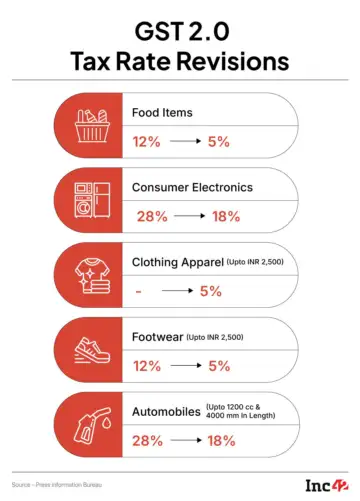
As per the ministry of statistics, commodities such as food & beverages, clothing and footwear, housing, and fuel and light accounted for a huge chunk of consumer spending in the 2024 festive season. Here's how each of these heads is treated under the new GST regime:
- Food - GST reduced from 18% and 12% to a uniform 5% on almost all food products
- Clothing And Footwear- GST on apparel and footwear priced above INR 2,500 has increased to 18% from the earlier 12%, but lowered to 5% for apparel priced up to INR 2,500 and footwear below INR 2,500
- Consumer Electronics - Consumer electronic products including air conditioners, dish washers, televisions, monitors, projectors, among others have seen a rate cut from 28% to 18%.
- Automobiles - Motor vehicles powered by petrol, LPG or CNG with an engine capacity not exceeding 1200 cc and measuring no more than 4000 millimeters in length will be taxed at 18% instead of 28%
The Consumer Glowup - Spur For Premium Consumption?
The GST cuts might look beneficial on the surface, however, there are deeper nuances and theories that may define whether the benefit will reach the end customers. For certain industries the impact will be neutralised due to multiple segment operations and concurrent changes.
With GST rates increased to 18% for clothing apparel sale above INR 2,500, the segment may fall out of the affordability criteria.
"Brands selling Indian wear in traditional stores usually have higher price points than INR 2,500. In that case, Indian wear might not be on the affordability chart," fashion brand Libas founder Sidhant Keshwani told Inc42.
However, the tax rate has been cut down to 5% for clothing apparel sales below INR 2,500. This can be a balancing factor for the brands dealing in both the price range.
On the other hand, several cuts might also allow consumers to upgrade their purchasing segment from mid-segment to premium. For instance, the festive season also attracts lots of tourism, giving a boost to the travel segment.
With the GST rate cut on hotel accommodation from 12% to 5% for segments offering services worth less than INR 7,500, the customers are likely to upgrade their stays. Similarly, the festive season witnesses a big chunk of revenue from the consumer electronic segment, which is also likely to see reduction in price due to 10% relief on the GST.
"A customer who previously might have booked a hotel in a lower category could now choose to upgrade to a better hotel simply because they will save 7% due to the tax reduction," added Karan Miglani, cofounder of Peak XV-backed hospitality startup ELIVAAS.
Despite the partial existence of anti-profiteering law, which compels the brands to pass on GST cut rates benefit to the consumers, the power to pass on the benefits currently rests with the brands.
"On paper, it does appear that there will be some degree of comfort in terms of price coming off. Now we'll have to wait and see how quickly this gets passed on to the consumers. From a business perspective, passing on the reduced costs ahead of the festive season will help in getting that sentiment and consumer buoyancy in place," added QuantEco's Singhal.
While finance teams at major companies are currently figuring out the best strategy for the new regime, several hefty discounts and price cuts are indicated in statements of major players.
"Reliance Retail is fully committed to ensuring that the entire benefit of this reform reaches our customers transparently and without any delay. Our pledge is simple: whenever costs go down, our customers must get the benefit in their wallets," said Reliance Retail Ventures Limited executive director Isha Ambani in a stock exchange filing after the new rules were announced.
The Consumption Power Boost
As per Ministry of Statistics and Programme Implementation, the Consumer Price Index (CPI) percentage surged from 3.65% in August to 5.49% in September and continued going up to 6.21% in October last year. Every year, the festive season witnesses a jump in the inflation rate which gradually decreases by the last quarter of the fiscal.
The price surge during the festive season, driven by supply chain disruptions and heightened demand, restrains consumers from indulging in carefree spending. Even after the rise in this rate, inflation percentage for urban households remains to be soft when compared to the rural areas.
While the new rates are likely to increase consumers' consumption power during the festive season, there are other factors through which the government is trying to increase liquidity in the market.
This year, the government also reduced income tax rates and raised tax rebates for individuals to offer more disposable income for consumers, especially to the middle class households. Meanwhile, the central bank also announced a phased 100 basis points (bps) cut in the Cash Reserve Ratio (CRR) starting from September this year, offering INR 2.5 Lakh Cr ($ 29.15 Bn) liquidity to the banking system for lending to productive sectors.
"So all these factors, in any way, are aligned in favor of urban consumption. But somehow I think there was greater conviction needed in terms of the urban consumers going out to spend. That's why the festive season compliments the GST cut rates," Singhal added.
Case in point: Just hours after the GST 2.0 announcements, Amazon and Flipkart announced their flagship festive sales, the Great India Festival and the Big Billion Days respectively.
"For the next few months, we think the new GST policy will be more favorable for ecommerce as compared to offline and the latter will be better in terms of scaling up business and boosting," Libas' Keshwani added.
The new GST regime is likely to multiply the ecommerce effect which is already fully in play during the festive season. Now the question is: how will marketplaces and large brands react to these changes.
[Edited By Nikhil Subramaniam]