




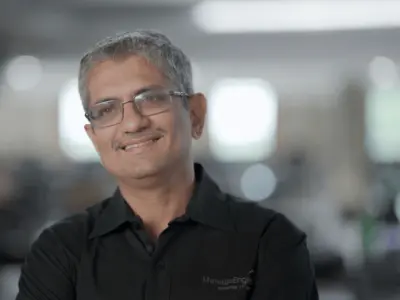

SaaS unicorn Zoho is working on developing its own large language model (LLM), with a focus on Indian languages, its group CEO Shailesh Kumar Davey said.
During its enterprise IT management division ManageEngine's media roundtable on Monday (March 3), Davey said that the company aims to integrate the LLM into its products and make it available for businesses at the "right time".
Zoho is currently developing two AI models - a general LLM and an Indic language model, specifically designed for Indian users. While the general model is expected to be launched this year, there is no timeline for the launch of the Indic language model.
The company is collaborating with IITs, AI4Bharat, and data collection firms like Karya to build a strong dataset.
Indian languages present unique challenges due to the mixed nature of available data, often interspersed with English words and phrases. To address this, some industry players rely on synthetic data for training. However, Davey said that Zoho has not used synthetic data so far.
"AI4Bharat has access to government data and has curated some datasets, which we utilise alongside our own data collection efforts. We are training our model using these datasets," he said.
AI4Bharat is a research lab at IIT Madras which works on developing open-source datasets, tools, models and applications for Indian languages.
Speaking about the challenges in developing an Indic LLM, Davey said, "… much of the available data is in English, and tokenisation for Indian languages is vastly different from European languages. That presents a challenge we are actively working on. Many companies in India are tackling similar issues, but we believe in getting hands-on to solve them. We'll share more details once we have meaningful progress."
Notably, for the general model, there would be two versions one with 7 Bn parameters and other with 13 Bn parameters.
Leveraging The GenAI Boom
The development comes at a time when GenAI has taken the world by storm. Amid this, the success of China's DeepSeek has ignited a debate about the need for India to develop its own LLM.
Zoho has taken a leaf out of DeepSeek's book and is focussing on developing energy and resource efficient LLMs."For our LLMs, we're not thinking about massive power-hungry models like OpenAI. Instead, we're focused on right sizing our LLMs to be as efficient as possible, more like DeepSeek or even more optimised. That means they won't consume excessive power or resources," said Davey.
Besides the development of LLM, Zoho is focussing on "verticalisation" for leveraging the GenAI boom.
AI models are rapidly becoming commoditised, much like open-source models such as Meta's Llama and Hugging Face models. But, Zoho believes that there is a big opportunity in fine-tuning AI models specifically for IT applications.
The company believes that its strength lies in developing bespoke foundational AI models, such as anomaly detection, forecasting, knowledge graphs, and security algorithms for malware detection in PDFs, among others.
Currently, Zoho claims to have deployed over 80 IT native, bespoke AI algorithms which process more than 5 Bn API calls per month across ManageEngine. It claims to have seen a 50% year-on-year growth in AI usage from 2023 to 2024.
Responding to a question on challenges, Davey said, "Right sizing is key, especially in B2C use cases where models must cater to a wide range of queries and users expect immediate responses and often share outputs publicly, making accuracy and efficiency critical."
Meanwhile, commenting on the evolution of GenAI, the group CEO said that DeepSeek was not built in a short period and required extensive experimentation and efforts from their team. He believes that another iteration is remaining when it comes to redefining how foundational models should be built.
"When that happens, Zoho wants to be prepared to adopt it and act quickly," he added.
Davey was recently promoted to the role of the group CEO of Zoho after its cofounder Sridhar Vembu stepped down in January to take up the role of chief scientist and focus on the company's R&D initiatives.