




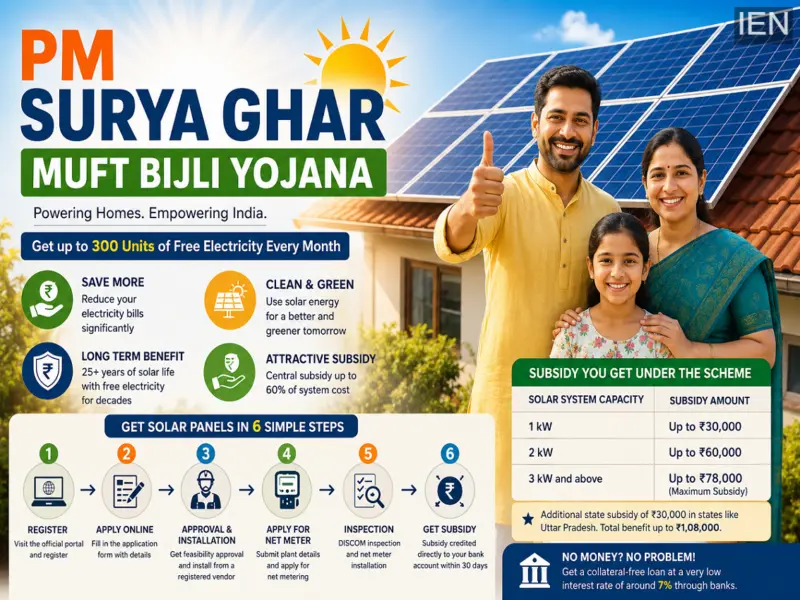

The PM Surya Ghar Muft Bijli Yojana is rapidly becoming one of the most talked-about government schemes for households struggling with rising electricity bills.
Under this flagship initiative, the government is offering major subsidies for rooftop solar panel installations, allowing eligible families to receive up to 300 units of free electricity every month.
The scheme is designed to encourage clean energy adoption while helping middle-class families reduce long-term power expenses.
How Much Subsidy Is Available?
The amount of subsidy depends on the capacity of the solar system installed.
According to the scheme details:
| Solar System Capacity | Government Subsidy |
|---|---|
| 1 kW | Up to ₹30,000 |
| 2 kW | Up to ₹60,000 |
| 3 kW and above | Maximum ₹78,000 |
Even if a household installs a system larger than 3 kW, the maximum subsidy remains capped at ₹78,000.
Solar Installation Cost Without Subsidy
Market estimates suggest that rooftop solar installation typically costs:
- Around ₹60,000 to ₹80,000 per kW without subsidy
However, under the PM Surya Ghar scheme:
- The government covers nearly 40% to 60% of the cost through subsidy support.
Extra Benefit for Uttar Pradesh Residents
Some state governments are also offering additional incentives.
For example:
- Uttar Pradesh is reportedly providing an extra ₹30,000 state subsidy in addition to the central subsidy
This means eligible households in Uttar Pradesh may receive:
- Total benefits of up to ₹1,08,000.
How Much Can You Save?
Let's understand the savings with a 3 kW solar system example.
Estimated Cost Calculation
Suppose:
- Total installation cost = ₹1,80,000
- Central subsidy received = ₹78,000
Your effective expense becomes:
180000−78000=108000180000 - 78000 = 108000180000−78000=108000
So, the customer pays approximately ₹1,08,000 from their own pocket.
How Much Electricity Does a 3 kW System Generate?
A 3 kW rooftop solar system can reportedly generate:
- Around 250 to 300 units of electricity every month
At an electricity rate of ₹8 per unit:
- Monthly savings may reach approximately ₹2,200
- Annual savings could be around ₹26,400.
How Long Does It Take to Recover the Cost?
Based on the estimated annual savings:
10800026400≈4.1\frac{108000}{26400} \approx 4.126400108000≈4.1
The investment may recover in:
- Around 4 years and 1 month
For households receiving additional state subsidies, such as in Uttar Pradesh:
- Recovery period could reduce to nearly 3 years.
Long-Term Benefit of Solar Panels
One of the biggest advantages of rooftop solar systems is their long operational life.
According to reports:
- Solar panels generally last over 25 years
This means:
- After recovering the installation cost, households may continue receiving almost free electricity for nearly two decades.
Who Is Eligible for the Scheme?
To apply for the PM Surya Ghar scheme, applicants must:
- Be Indian citizens
- Own a rooftop suitable for installation
- Have a valid electricity connection.
Step-by-Step Process to Install Solar Panels
Eligible households can apply through the official portal in six simple steps.
Step 1: Registration
Visit the official portal:
PM Surya Ghar Portal
Register using:
- State details
- DISCOM information
- Consumer number
- Mobile number
- Email ID
Step 2: Apply Online
Log in and complete the:
- Rooftop Solar application form
Step 3: Approval and Installation
After technical approval from the DISCOM:
- Choose a registered vendor from the portal
- Install the rooftop solar system
Step 4: Apply for Net Metering
Once installation is completed:
- Upload plant details
- Apply for net meter installation
Step 5: Inspection
DISCOM officials inspect the system and:
- Install the net meter
- Generate the commissioning certificate
Step 6: Receive Subsidy
Upload:
- Bank account details
- Cancelled cheque
After approval:
- Subsidy is reportedly transferred directly to the bank account within 30 days.
Low-Interest Loan Facility Also Available
For households unable to pay the installation cost upfront, the government is also facilitating:
- Low-interest loans through banks
- No collateral requirement
Reports suggest interest rates are:
- Around 7%
- Only slightly above the RBI repo rate
This helps reduce EMI burden for customers planning rooftop solar installations.