




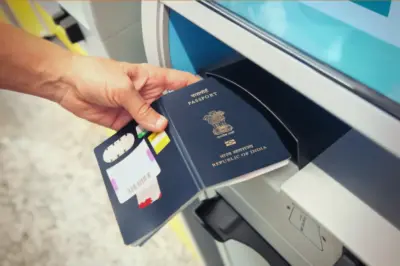

India's decision to roll out e-passports symbolizes its confidence in digital governance. Yet, almost simultaneously, the government has reminded citizens that the passport itself is not conclusive proof of Indian citizenship.
That legal clarification has exposed a larger question, which is that in a nation of 1.4 billion people, what document actually proves that one belongs to the Republic of India ?
The recent assertion of the Ministry of External Affairs that the passport is not proof enough of Indian citizenship is legally accurate. The crux of its position rests on Section 20 of the Passports Act 1967, which empowers the government to "issue an Indian passport or travel document to a person who is not a citizen of India if it deems it necessary in the "public interest" (such as for stateless persons or specific refugees)". The logic here is that because the law permits a non-citizen to hold an Indian passport under rare circumstances, a passport cannot, by absolute legal definition, serve as conclusive proof that the holder is a citizen.
We know who you are, but can you prove you are a citizen?
This is where the government's position becomes awkward. A passport is issued only after the government verifies identity, nationality, police records and supporting documents. When an Indian citizen loses all other documents overseas but still retains his passport, the Indian Embassy will generally treat that passport as the primary evidence of nationality and entitlement to consular protection. Even if an Indian tourist loses his passport overseas, the concerned Indian embassy will verify his identity and nationality through government databases before extending assistance. Clearly, the state possesses information that allows it to recognize him as an Indian.
So when the government says that passport is not adequate proof of citizenship, the general interpretation is that the government itself is not willing to stand behind the citizenship determination it made while issuing the passport.
Legally the government is making a narrower argument. However, politically and administratively, the distinction sounds strange because the passport is one of the most rigorously verified documents issued by the Indian state.
This has triggered bewilderment and wider concern about what proof would confirm citizenship. The head scratching is understandable because the common man now asks himself that when his country can identify him, tax him, subsidize him, educate him, employ him, issue him a passport and even pension him, yet it cannot tell which single document proves he is a citizen of India. How can a state know so much about a person and yet unable to provide a definitive answer to whether that person is a citizen?
Under the constitution, citizenship is established depending on how it was acquired, that is, whether by birth, descent, registration, or naturalization. For most Indians born in India, a birth certificate plus supporting family and identity records is usually the foundation of that proof, rather than any single card or document
Many countries maintain authoritative citizenship or population registers. Singapore has a comprehensive citizen database, while several European countries maintain population registers. India, by contrast, has built a sophisticated digital identity system without creating a universally accepted citizenship record.
India sits in an unusual position. It has built one of the world's largest digital identity systems through the Unique Identification Authority of India. But Aadhaar was deliberately designed as a proof of identity and residence, not citizenship. Today, most Indians hold an Aadhaar card, Pan card and Ration card, all of which are not proof of citizenship. In addition, he may have passport and voter ID, both of which are not conclusive citizenship proof. The natural and legitimate question to ask is if none of these prove citizenship, what does?
The issue is not that they are not citizens. The issue is that the documentary trail may be fragmented. The practical reality is that millions of Indians would struggle to assemble a watertight documentary chain proving citizenship if suddenly asked to do so. This is not just a rural problem. Many urban Indians were born before universal birth registration became common or have inconsistent names across documents, have parents whose records are incomplete or have migrated across states, which would make it difficult to satisfy a highly legalistic citizenship inquiry. This issue should be handled sensitively.
The larger lesson
The deeper issue is that India built a world-class digital identity infrastructure before it built a universally accepted citizenship registry. That may have been the correct choice at the time because Aadhaar was intended to improve welfare delivery, not determine nationality. But the consequence is that today India can identify over a billion residents digitally, authenticate them instantly, and transfer money directly to their bank accounts, yet cannot conclusively point to a single document that establishes the citizenship of an Indian beyond doubt.
For a country that has excelled in digital governance, that gap is difficult to explain. India still relies largely on a patchwork of historical records, family documents, and administrative verification when it comes to proving citizenship. Citizenship is the most fundamental relationship between an individual and the nation. Voting is only one expression of that relationship. A citizen may never vote, never join a political party and never seek public office. Yet he remains entitled to the protection by the state and subject to its laws.
It is a question of whether the country can account for its own citizenry with confidence. Simply put, a country should not leave its citizens wondering whether the very passport issued by the Republic of India is sufficient evidence that they belong to it.