




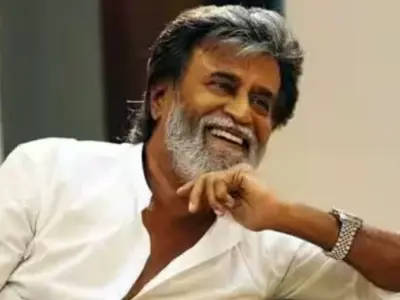

By TN Ashok There are actors who become stars, stars who become superstars and, once in a generation, a performer who becomes something larger than cinema itself.
Rajinikanth belongs to that last category. On August 15, 2026, as India celebrated its Independence Day, Rajinikanth quietly crossed another extraordinary milestone: 51 years in Indian cinema. There was no grand public ceremony, no retrospective parade. The celebration took place on the set of Dharman, his 173rd film, where the cast and crew cut a cake for him. It was an appropriately modest celebration for an actor whose mythology has long been anything but modest.
There was another poignancy to the occasion. Dharman is being produced by his old friend, rival, contemporary and fellow titan Kamal Haasan through Raaj Kamal Films International. A friendship that goes back almost five decades has finally produced the collaboration the two men had talked about for years.
Kamal has said that the idea was born during a flight to Bombay roughly 40 years ago: one day, one would produce a film starring the other. Now that promise has come true.
It is difficult to imagine a more fitting setting for Rajinikanth’s 51st anniversary. His story began far from the arc lights.
Born Shivaji Rao Gaekwad in Bangalore in 1950, he worked as a bus conductor with the Bangalore Transport Service. He acted in amateur plays, discovered that audiences responded to something instinctive in him and eventually enrolled at the Madras Film Institute. He was not conventionally handsome. His Tamil was limited. He had neither a film family nor the conventional advantages of a screen hero.
What he possessed was presence. K. Balachander recognised it. The celebrated director encountered the young Shivaji Rao when he visited the Film Institute. Balachander noticed the powerful eyes, angular face and unusual physicality. Rather than seeing his dark complexion and lean frame as impediments, he saw possibilities. He offered him a small but memorable part in Apoorva Raagangal, released in 1975.
The role was tiny. The destiny was not. Balachander is credited with giving him the screen name Rajinikanth, and with insisting that the young actor master Tamil. His first appearance was almost a footnote in a film dominated by Kamal Haasan and Srividya. Yet Rajinikanth’s brief appearance as Bhairavi’s former lover carried an unmistakable charge.
The bus conductor had entered the cinema. Cinema would never quite be the same again.
Rajinikanth’s early career was anything but the safe, heroic journey of a conventional leading man. He played antagonists, anti-heroes and morally ambiguous characters. He could sneer, swagger, smoke, spit out a line and disappear into darkness. Directors discovered that he could make even a villain strangely attractive.
His early roles included Moondru Mudichu, Avargal and 16 Vayathinile. But the transformation began with films such as Bhuvana Oru Kelvi Kuri, Mullum Malarum and Aval Appadithan, which demonstrated that behind the mannerisms was a serious actor. Mullum Malarum, in particular, established his ability to play wounded, vulnerable masculinity rather than merely theatrical menace.
Then came Billa in 1980. A remake of Amitabh Bachchan’s Don, it gave Rajinikanth dual roles and transformed him into a full-fledged action star. The film’s success helped create the Rajini phenomenon: sunglasses, cigarettes, jackets, swagger, clipped dialogue and the seemingly effortless gesture that could send a theatre into delirium.
But Rajinikanth was not simply copying the Hindi superstar. He was creating a new grammar of mass cinema. He could throw a cigarette into the air and catch it. He could toss his sunglasses onto his face with a flick of the wrist. He could turn his back to the camera, pause, then deliver a line that audiences already knew would become a slogan. Style became substance.
The title ‘Superstar’ eventually became inseparable from his name. Yet Baashha in 1995 was perhaps the film that crystallised the mythology.
As Manikam, a mild-mannered auto-rickshaw driver concealing a violent past as a Bombay don, Rajinikanth embodied two versions of himself: the ordinary man and the larger-than-life avenger. When the hidden Baashha finally emerged, Tamil cinema audiences did not merely watch a character reveal himself. They watched the Rajinikanth myth reveal itself.
Baashha ran for almost 15 months in theatres and became one of the defining commercial successes of his career. The formula thereafter was familiar but never quite exhausted: an ordinary man pushed beyond endurance, injustice demanding a response, the hero rising, and the audience rising with him.
In Annamalai, he became the wronged milkman who challenges power. In Arunachalam, the reluctant heir. In Padayappa, the returning patriarch confronts a formidable antagonist. In Muthu, the loyal servant whose identity and destiny unravel through a romantic melodrama. In Sivaji, the idealistic software engineer who takes on corruption. In Enthiran, he stretched the Rajini persona into science fiction, playing both scientist Vaseegaran and his dangerous robot creation Chitti.
Muthu became a big hit in Japan, encouraging producers in Tokyo to buy the script and turn it around to
make a Japanese version. In Hong Kong, a new Rajinikanth film replaces all Jackie Chan films in theaters, of
course with Jackie’s permission who respects him. In South East Asia, Singapore, Malaysia, Indonesia, his
films run to packed houses. He is an international phenomenon.
He has repeatedly embraced multiple identities. Billa gave him two roles; Moondru Mugam gave him
three; John Jani Janardhan, Adhisaya Piravi, Shivaji and Enthiran allowed him to play variations on doubles,
divided identities or opposing personalities. In Baashha, Kabali, Kaala, Jailer and other films, the distinction
between the ordinary man and the formidable figure beneath the surface became one of his favourite
dramatic devices.
The most striking film of his career is a sociological film where there are no Rajnisms but a simple common
man whose life into the 60s is portrayed raising the emotional quotient with matured audiences. The film 6il
irunthu 60 varai , from 6 to 60, the story of betrayal, by people and relatives whom he served and brought
up, and then the recompense.
He has also never been afraid of the antagonist. Indeed, the villainy of his early career helped make his
heroism more compelling.
His cinematic journey has also been accompanied by an extraordinary roll-call of leading ladies: Srividya,
Jayasudha, Sridevi, Sripriya, Suhasini, Ambika, Radha, Radhika, Shobana, Revathi, Khushbu, Meena, Nagma,
Soundarya, Manisha Koirala, Simran, Aishwarya Rai Bachchan, Shriya Saran, Deepika Padukone, Sonakshi
Sinha, Amy Jackson, Radhika Apte and Nayanthara, among others.
Sridevi appeared opposite him in several films and, remarkably, played his stepmother in Moondru
Mudichu when she was still a child. Meena progressed from playing a child in Anbulla Rajinikanth to
becoming his heroine in Ejamaan and Muthu.
Aishwarya Rai was his leading lady in Enthiran, Deepika Padukone in Kochadaiiyaan and Ra.One in an
extended appearance, while Nayanthara became his leading lady in Darbar and Jailer. His comeback after
illness was in Shah Rukh Khan’s Ra2. and daughter Soundarya’s animated film Kochadaiyaan which
surprisingly bombed at the box office. His official reentry is recognised in Lingaa which also fared poorly
because of bad timing – the monsoon season, school and college exams, in an extraordinary gesture he
compensated the distributors for their losses through his films fees.
The women around Rajinikanth’s characters have changed with the generations; Rajinikanth himself has
remained the constant.
His appeal was never confined to Tamil Nadu. He crossed into Hindi cinema with Andhaa Kaanoon in 1983
and subsequently appeared in films including Geraftaar, Meri Adalat, John Jani Janardhan, Hum, Insaniyat Ke
Devta and ChaalBaaz. He worked with Amitabh Bachchan, Govinda, Sridevi, Hema Malini, Rekha and other
major Hindi stars.
But his greatest experiment outside Indian cinema was Bloodstone, the 1988 English-language action-
adventure film directed by Dwight H. Little. Rajinikanth played Shyam Sabu, and the film was shot largely in
India. It remains his only foreign-language international feature. He even received English-language coaching
before the production.
For an actor who had begun life speaking Kannada and Marathi and had only gradually mastered Tamil, it
was another unlikely border crossed. (IPA Service)