




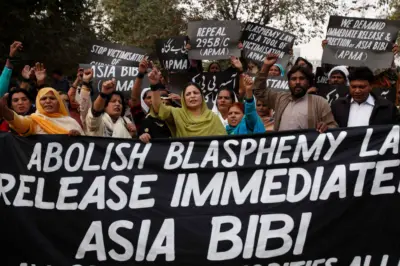

Blasphemy means making statements that oppose or insult God, deities, religious symbols, sacred things, or beliefs—statements which are generally considered wrong according to religious norms.
Historically, every religion has defined blasphemy in its own way. Incidents of blasphemy have always occurred, but in recent years, such incidents have increased.
The current Punjab government has introduced a bill in the legislative assembly regarding blasphemy and has referred it to a select committee. Often, such laws are brought in merely to gain political advantage. As religious fundamentalism and orthodoxy are spreading across the world, the use of such laws is on the rise.
In Pakistan, for instance, blasphemy laws are very strict, and even death penalties have been carried out. The danger lies in the fact that such laws are often misused. Governments, administrations, or police can misuse them to unfairly harass common people or those with differing opinions.
These kinds of laws essentially target scientific rational thinking, as science always encourages questioning. By bringing in such bills, the space for questioning may be eliminated altogether. It is unfortunate that religion has not adapted much with time and continues to function in the same manner as it did hundreds of years ago. However, modern technologies are fully utilized to propagate religion.
When a progressive-minded person challenge orthodox thinking, some people see them as a major threat. Throughout history, science has always challenged conservative ideologies. Those who challenged them have often faced torture and even death penalties. Some of the most prominent among them were Socrates, Galileo, Copernicus, and in India’s ancient history, sages like Charvak. Guru Nanak Dev and several Sufi saints also raised their voices against orthodoxy. In today’s context, they might be labelled as blasphemers. Yet these great personalities never abandoned their commitment and stood firm.
With the introduction of new laws on blasphemy, the situation could arise where anyone who challenges orthodox thought could be labelled a blasphemer and subjected to legal action. For instance, a fatwa was issued against Salman Rushdie, and there were several assassination attempts on him. Recently, in Uttar Pradesh, a teacher who wrote a poem essentially urging people not to become Kanwariyas but to seek knowledge instead, had an FIR registered against him.
Modern, rational societies value tolerance. They encourage respecting others’ sentiments, honouring others’ beliefs, striving for a secular and harmonious society, and inspiring curiosity and questioning.
Therefore, it’s important to understand that such laws may instill fear, but only for a short period. Fear does not create tolerance—it breeds hatred.
In recent times, the way the central government led by Modi, backed by the RSS, is promoting extreme religious ideology of a particular religion and targeting others, is extremely dangerous.
According to such laws, if someone challenges any biased act, they could be labelled a blasphemer and subjected to legal action. We know the character of our administrative systems, they are neither transparent nor sensitive. That’s why there is no place for such laws in India.
When governments fail to solve people’s real issues, they raise such topics to distract people from the actual problems. Therefore, it is essential to have a serious debate on the need for such laws. We hope the Select Committee will take this into consideration. (IPA Service)
By Dr. Arun Mitra