




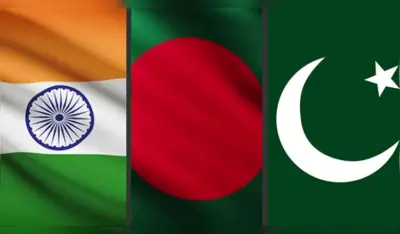

Needless to say, South Asia is one among the most deprived regions in the world. The Human Development Index figures of the countries of the region are dismal; India-130, Pakistan-168, Bangladesh-130, Nepal-145, Sri Lanka - 89. The region requires intensive development programmes.
It is essential that there is lasting peace and inclusive economic growth. But, ironically, the region has become a centre of increasing arms race, mainly due to perpetual conflict between India and Pakistan. There is rise of religious fundamentalism and also increase in the role of non-state actors. Internal situation in the countries of the region is reflected in the foreign relations. The situation demands urgent attention because both India and Pakistan are nuclear armed states and have fought five full-fledged wars in 1948, 1965, 1971, 1999 and recently 2025.
After the terrorist attack on the Indian Parliament on 13th December 2001, tensions grew very high and both countries moved troops to the border in high alert position. This military standoff between India and Pakistan cost India an estimated $1.8 billion and Pakistan $1.2 billion in troop mobilization and readiness. During this period, India reported 798 military deaths and 1,874 total casualties, largely from mine-laying accidents, equipment failures, and artillery exchanges, rather than full-scale combat. Pakistan’s casualties were never officially disclosed, though outside estimates suggest they were substantial. Both the countries issued threats of use of nuclear weapons against each other.
India has a declared “No First Use” policy, meaning it has vowed not to be the first to use nuclear weapons in a conflict. However, after the 2019 Balakot airstrikes, following the Pulwama terrorist violence, there were indications that India was reconsidering this policy. Pakistan, in contrast, has adopted a “Full Spectrum Deterrence” doctrine, which includes the potential use of battlefield nuclear weapons to counter a conventional Indian military offensive. This doctrine is a primary factor in increasing the risk of a nuclear conflict.
The narrative by the nuclear lobby that nuclear weapons serve as deterrence is completely false. It is easily understandable that any such weapon which is present on the earth could be used any time, if not by the state then by the non-state actors, nuclear accident, natural or man-made calamity. Such a situation would be catastrophic not only for the two countries or the region but will have global impact.
It is also to be noted that China which is an immediate neighbour of both India and Pakistan is a big military power with nuclear weapons and global spending on arms second to the US. The United States has the highest military budget, followed by China and Russia. Recent data for 2025 shows the U.S. at approximately $895 billion, China at $266.85 billion, Russia at $126 billion, India $75 billion and Saudi Arabia $74.76 billion.
Chinese military equipment as per the experts is technologically highly advanced. Chinese support to Pakistan during the recent four days war during Operation Sindoor has proven this. There have been few serious skirmishes at the Indo-China border including the Galwan. All these prove the point that the region is highly vulnerable and any act by the non-state actor could flare the existing volatile situation.
Whatever the reason, the end of war in four days has been a big relief. But it may not happen in case of any escalation next time. In these conditions it is important that steps are initiated for arms reduction and confidence building measures among the countries of the region.
Lack of trust has led to development of tendency with the governments of both India and Pakistan to blame the other for any act of violence/terrorism. Many a times, such blame sans any evidence. A section of the media on both the sides helps in building the narrative of jingoism. Such narratives are made to escape from own failures to provide security and fulfil the basic needs of the people.
It is to be noted with concern that the third party intervention in the region is increasing. Recent invitations to Pakistan army chief to America twice in a short span of time are clear cut signs of US involvement. Events in Bangladesh are direct result of US strategy of its increasing role in the Asia Pacific.
The South Asian countries have to evolve a collective system of security for lasting peace. For this it is of utmost importance to have repeated dialogue between the governments without any preconditions. As a country known for promoting global peace and our history of nonalignment makes it obligatory that we should take initiative. After the Pahalgam incident Prime Minister Shri Narendra Modi ordered the Operation Sindoor. He said that any act of terrorist violence in the future will be taken as a full-fledged war against India and responded accordingly. This is not a correct narrative; we cannot be in a perpetual full-fledged war with the neighbour.
For a lasting peace steps have to be taken to organise citizens groups. People to people exchange programme should be encouraged. Health professionals exchange programmes should be encouraged as this can play a vital role in building bridges of peace. For this VISA should be made easy. Visit of religious Jathas, trade groups, professional groups and peace activists should be made visa free. To ease tensions the region should be declared nuclear weapons free zone.
The world has become multipolar despite the persistent efforts by the US and the erstwhile colonial powers. It is time to understand the intricacies of this multi polarity. It is important to strengthen SAARC. Organisations like the BRICS and the SCO can play a positive role in promoting relations among the South Asian nations and thereby among the developing countries of the world. (IPA Service)
The article South Asia Needs Collective Security For Lasting Peace appeared first on Latest India news, analysis and reports on Newspack by India Press Agency).
By Dr Arun Mitra