

Fabiana Bolsonaro, a rising conservative politician in Brazil, has suddenly become one of the most talked about names in global politics.
Her actions were meant to challenge ideas around identity, particularly gender, but instead triggered accusations of racism and transphobia. As the debate continues to grow, many are now asking a simple question: who exactly is Fabiana Bolsonaro?
Who is Fabiana Bolsonaro?
Fabiana Bolsonaro, whose full name is Fabiana de Lima Barroso Souza, is a 32-year-old Brazilian politician from São Paulo state. She is a member of the right-wing Partido Liberal and has built her political identity around strong conservative values.Interestingly, she is not related to former president Jair Bolsonaro. She adopted the surname as a political choice, aiming to connect with conservative voters who support his ideology. That decision alone helped her gain visibility early in her career.
Fabiana was born on April 10, 1993, in Barrinha, a small city in São Paulo. She comes from a deeply religious and politically active evangelical family. Her father, Adilson Barroso, is a pastor and a known political figure who founded a party and served as a federal deputy.
She studied Law and later expanded her academic path into Journalism and Public Management. Her entry into politics came early. At just 27, she became the vice mayor of Barrinha in 2020, making her one of the youngest women in that role. She also worked as the city's Secretary of Social Development before stepping into state-level politics.
In 2022, she was elected as a state deputy with over 65,000 votes. Her campaign strongly focused on conservative themes such as opposition to abortion, defence of traditional family values, criticism of gender ideology, and support for stricter law enforcement and gun rights.
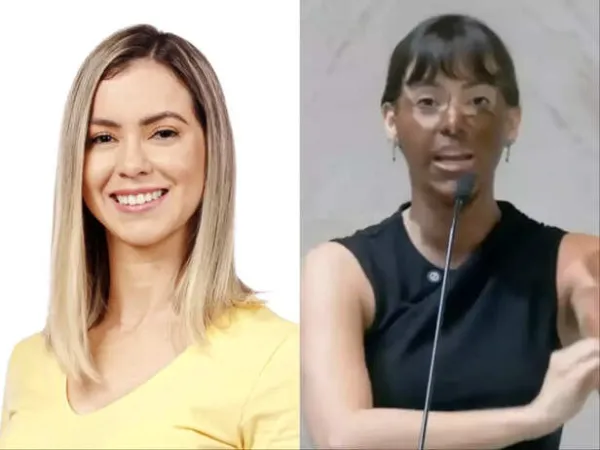
Fabiana took the podium and began her speech by acknowledging what she described as her own "white privilege". Then, in a shocking move, she started applying dark brown makeup to her face, neck, and arms while speaking live.
She studied Law and later expanded her academic path into Journalism and Public Management. Her entry into politics came early. At just 27, she became the vice mayor of Barrinha in 2020, making her one of the youngest women in that role. She also worked as the city's Secretary of Social Development before stepping into state-level politics.
In 2022, she was elected as a state deputy with over 65,000 votes. Her campaign strongly focused on conservative themes such as opposition to abortion, defence of traditional family values, criticism of gender ideology, and support for stricter law enforcement and gun rights.
The moment that triggered national outrage
The controversy that pushed Fabiana Bolsonaro into global headlines happened on March 18, 2026, during a session of the São Paulo Legislative Assembly. The debate at the time was already tense. It centred around representation in women's rights spaces, especially after a Black trans woman politician, Erika Hilton, was appointed to lead a major women's rights commission. This decision had sparked strong reactions across political lines.Fabiana took the podium and began her speech by acknowledging what she described as her own "white privilege". Then, in a shocking move, she started applying dark brown makeup to her face, neck, and arms while speaking live.
She used the act to make a point. She asked whether changing her appearance made her Black. She then said she "identified as Black" and questioned whether that would allow her to lead an anti racism body.
Her argument was direct. She claimed that external changes do not alter a person's core identity. She linked this idea to gender identity debates, suggesting that changing one's body does not change one's gender. Her final statement made her stance clear. She said that despite the makeup, she was not Black. The chamber quickly erupted.
Lawmakers interrupted the session. Some demanded that the broadcast be stopped. Others accused her of racism and transphobia on the spot. Within hours, multiple complaints were filed against her. These included calls for her removal from office for breaking parliamentary decorum.
Her argument was direct. She claimed that external changes do not alter a person's core identity. She linked this idea to gender identity debates, suggesting that changing one's body does not change one's gender. Her final statement made her stance clear. She said that despite the makeup, she was not Black. The chamber quickly erupted.
The act was called 'blackface'
The reaction was immediate and intense. Many lawmakers and activists described her action as blackface, which has a long and painful history tied to racism. Blackface is widely criticised because it was historically used to mock and dehumanise Black people. Critics argued that Fabiana's act ignored this context and reduced serious racial struggles to a political stunt.Lawmakers interrupted the session. Some demanded that the broadcast be stopped. Others accused her of racism and transphobia on the spot. Within hours, multiple complaints were filed against her. These included calls for her removal from office for breaking parliamentary decorum.
Political fallout and growing investigations
The backlash did not stay inside the assembly. It quickly spread across Brazil and beyond. Several political parties and lawmakers filed ethics complaints. There were also discussions around possible legal action related to racial discrimination and hate speech.Another issue added fuel to the controversy. Reports surfaced that Fabiana had previously identified as "parda" during her 2022 campaign, a classification used in Brazil for mixed race individuals. This reportedly allowed her access to specific campaign funds linked to racial quotas.
Critics questioned whether this was a misuse of the system, especially since she identified as white in other contexts. At the same time, her supporters defended her strongly. They argued that her demonstration was a form of political expression and a critique of identity politics.
The incident quickly became one of the most talked about political moments in Brazil. On social media, reactions were deeply divided. One user on X said, "This was not a debate. This was disrespect disguised as a message." Another wrote, "She made a bold point. People are angry because it challenges their narrative." A third user commented, "You cannot compare race and gender like that. It ignores history and lived experience."