
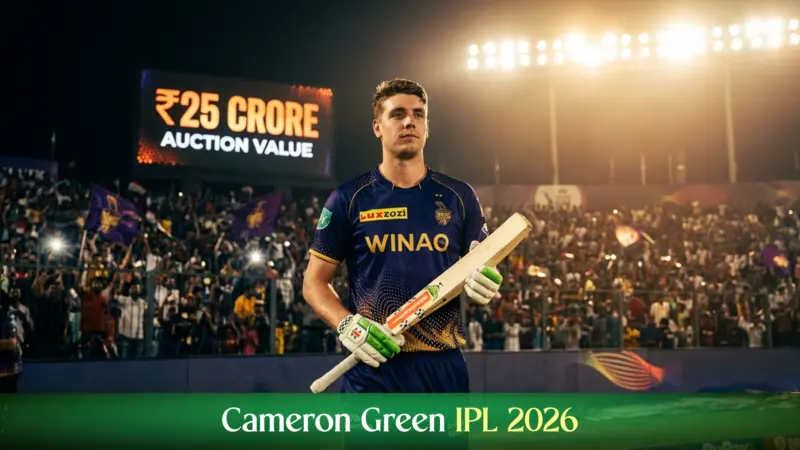

Cameron Green IPL 2026: The Case for KKR's ₹25 Crore Gamble
When KKR pushed their paddle up at ₹25 crore for Cameron Green at the IPL 2026 auction, the number generated predictable shock.
Green has played 29 IPL matches. He missed most of IPL 2024 with a back injury. His bowling in T20 cricket is promising but carefully managed. So what were KKR buying for ₹25 crore? They were buying the specific combination of skills that almost no other available overseas player in the auction pool could provide and they were betting that a fit Cameron Green transforms their XI from a good side into a title-winning one.
This piece breaks down exactly what Cameron Green brings to KKR in IPL 2026, why the price is defensible on pure cricketing logic, and where the risk actually sits.
What Cameron Green Actually Provides
The framing that Green is an 'all-rounder' undersells the specificity of what he does. He is a 6'5" right-arm fast-medium bowler who has hit Test hundreds and T20 fifties batting at No. 3 with a 153+ strike rate. That combination genuine pace bowling at 140+ kph and top-four batting firepower is what makes him uniquely valuable.
Metric | Cameron Green (IPL 2023) | IPL All-Rounder Average (Comparable Tier) |
Batting Strike Rate | 153.4 | ~138 |
Batting Average | 32.3 | ~24 |
Bowling Economy (IPL) | 8.2 | ~9.1 |
Wickets in 16 matches | 5 | ~4 |
Bowling Speed (avg) | 140 kph | ~128 kph (medium-fast all-rounders) |
The strike rate and bowling speed combination is what the ₹25 crore is pricing. Hardik Pandya costs ₹16.35 crore but Hardik is bowling at 130–133 kph currently. Green is the rare overseas option who brings genuine 140+ kph alongside a 150+ SR bat.
What KKR's Squad Needed
KKR's IPL 2025 problem was structural: they had five specialist bowlers and needed a sixth. With Narine bowling four overs, Chakravarthy bowling four, and three pace options for four remaining slots, they were either bowling a part-timer at death or burning their pacers too early. A sixth bowling option who is not a liability with the bat was the specific gap.
Green's three to four overs at 140 kph changes the bowling rotation. It means Narine and Chakravarthy are not overexposed on flat pitches, and it means KKR's death bowling combination can be structured without compromise. The batting bonus, Green at No. 4 with his power-hitting in the last 8 overs is the additional asset that made him worth outbidding the rest of the auction room for.
The Injury Risk: What KKR Is Managing
Green's back injury in IPL 2024 is the elephant in the room. A stress fracture is the kind of injury that does not simply heal and disappear, it requires sustained load management and monitoring. Cricket Australia has been careful with Green's bowling workload, often restricting him to three-over spells or managing him out of the most intense Test match workloads.
KKR's ₹25 crore bet works only if Green plays 12 or more of their 14 league matches. At 8 matches, the effective per-match cost is ₹3.125 crore, sustainable for the stats he produces. At fewer than that, the squad balance and financial structure both suffer. KKR's management will have done detailed due diligence on his current medical status before committing at auction.
How Eden Gardens Suits Green's Game
Eden Gardens' slow surface in the early part of the tournament (March-April) does not obviously suit a 140 kph seamer in the powerplay. But by the time IPL moves into May, the surface quickens and becomes more two-paced conditions in which Green's pace through the pitch is an asset rather than a liability.
Green's batting at Eden Gardens is less pitch-dependent. He hits straight and over the boundary at cow corner - a short boundary at Eden Gardens and his cover-drive has been the standout shot of his IPL career. Against spin, which Kolkata's pitches bring into play more than most, Green's reach and aggression make him harder to contain than the average overseas batter.
Comparable Purchases: How ₹25 Crore Stacks Up
Player | Team | Price | Primary Value | Comparable Risk |
Cameron Green (2026) | KKR | ₹25.00 Cr | Bat + 140kph bowl | Injury history |
Mitchell Starc (2024) | KKR | ₹24.75 Cr | Left-arm pace | Age, T20 form |
Rishabh Pant (2025) | LSG | ₹27.00 Cr | WK-Batter leadership | Post-accident form |
Shreyas Iyer (2024) | KKR | ₹26.75 Cr | Batting anchor, captain | Workload management |
Frequently Asked Questions
Q1: What is Cameron Green's IPL record before 2026?
Cameron Green played for Mumbai Indians in IPL 2023 (₹17.5 crore), where he scored 452 runs in 16 matches at a strike rate of 153.4 and took 5 wickets. In IPL 2024, he missed the majority of the season due to a back injury. His 2025 IPL stint was a partial return. Despite injury concerns, his productivity when fit -150+ strike rate batting at No. 3 or 4 justified KKR's bid.
Q2: Why did KKR need Cameron Green specifically?
KKR's auction need was precise: an overseas player who could bat in the top four AND bowl meaningful overs (not just part-time) in the powerplay and death. Green's ability to bowl at 140–142 kph consistently, while also providing 180+ strike rate batting when set, is a combination that IPL teams rarely find in a single overseas slot. He solves the 'sixth bowler' problem KKR faced in IPL 2025.
Q3: Has Cameron Green ever bowled regularly in T20 cricket?
Green's bowling in T20 cricket has been limited by injuries and careful management by Cricket Australia. In Test cricket he has demonstrated genuine pace - 143 kph is his typical range, touching 147 kph and in T20Is he has shown he can bowl three to four disciplined overs. KKR's expectation is that he bowls 3–4 overs per match, which transforms their bowling balance from five bowlers to six.
Q4: What is Cameron Green's biggest risk as an IPL purchase?
Injury availability. Green has had multiple stress fracture concerns and managed loads across his Australian summer schedule. Cricket Australia and KKR will need to coordinate carefully on his pre-IPL workload. KKR's ₹25 crore effectively prices in a full-season Cameron Green - a half-season Cameron Green at that price makes the acquisition financially inefficient relative to other options at the same budget.
Conclusion
Cameron Green at ₹25 crore is not a speculative punt, it is a precise, well-researched solution to KKR's structural squad problem. The bowling economy, batting strike rate, and pace bowling combination he brings is genuinely difficult to find in the overseas market. The price reflects scarcity as much as quality. KKR paid ₹24.75 crore for Starc in 2024, a bowler who added less with the bat. Green adds more in both departments when fit.
The risk is real and the injury history is not ignorable. But if Cameron Green plays 12+ matches for KKR in IPL 2026 at anywhere near his IPL 2023 level, the ₹25 crore will look like smart money in retrospect. That is the bet KKR made. Given the squad problem they needed to solve, it was a rational one.
Key Takeaways
- Cameron Green's specific value is his 140+ kph bowling combined with a 150+ T20 strike rate - a combination almost uniquely scarce in the overseas IPL market.
- KKR's structural need was a sixth bowling option - Green's three to four overs per match changes their entire bowling rotation and death bowling strategy.
- Green's IPL 2023 numbers (452 runs at SR 153.4, 5 wickets in 16 matches) justify the price if he replicates that form over a full season.
- Injury availability is the primary risk, KKR's bid only makes full financial sense if he plays 12 or more of their 14 league matches.
Eden Gardens' May conditions suit Green's pace-through-pitch bowling better than the early-tournament slow Kolkata surfaces.
#KKR #CameronGreen #Cricket #KKRsquad #batting #bowlingspeed #Edengardens #Kolkata #IPL #IPL2026