
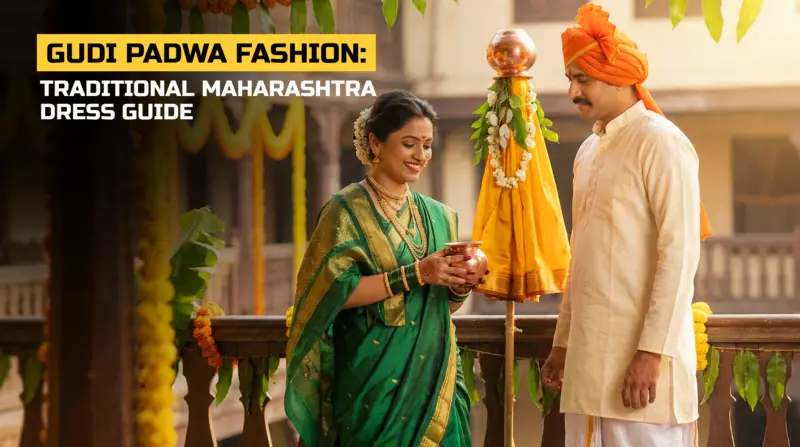

Gudi Padwa is not just a day for rituals, it is one of Maharashtra's biggest fashion moments. The streets of Pune, Nashik, and Mumbai's Dadar fill up with Nauvari sarees, Puneri pagdis, and a sea of green, yellow, and red on the morning of the Maharashtrian new year.
If you want to dress right for Gudi Padwa this year - whether you are attending a puja, visiting family, or simply representing the culture, this guide covers everything from traditional textiles to modern adaptations.
Gudi Padwa fashion has deep roots in Maratha court culture and Peshwa-era Pune. The colours, draping styles, and jewellery forms that define it are not arbitrary, each has a cultural logic. Here is what to wear, why it matters, and where to find it.
The Nauvari Saree: The Signature Look for Women
The Nauvari, literally 'nine yards' is the defining garment of Maharashtrian festival dressing for women. Unlike a conventional six-yard saree, the Nauvari is draped in a distinctive style: the extra fabric is pulled through the legs and tucked at the back, creating a silhouette somewhere between a saree and a salwar. This drape style was practical for active, working Maharashtrian women and warriors - it allowed full freedom of movement.
For Gudi Padwa, the Nauvari is traditionally worn in bright auspicious colours. Green is the most favoured, it represents new beginnings, aligned with the agricultural new year the festival marks. Yellow (associated with turmeric and prosperity) and red (for power and celebration) are also common. The Paithani variety - woven in Paithan near Aurangabad with gold zari borders and peacock motifs is the prestige choice for families who can access or afford it. A pure silk Paithani can run from ₹15,000 to over ₹2 lakh depending on the weave density and gold content.
Budget options include cotton Nauvaris from Solapur's handloom industry (₹800–₹3,000) and synthetic Nauvaris widely available in Dadar and Matunga markets (₹400–₹1,500).
Men's Traditional Gudi Padwa Dress
The male traditional outfit for Gudi Padwa centres on three elements: the dhoti, the kurta or angarkha, and the Puneri pagdi.
The dhoti is typically white cotton with a coloured silk border - yellow, green, or saffron. It is worn in the Maharashtrian style, which differs slightly from the Bengali or South Indian dhoti drape: tucked at the front and flowing at the back. Paired with a kurta in a complementary colour often cream or pale gold. This combination is the standard formal-traditional look for the festival.
The Puneri pagdi is the element that elevates the outfit from generic Indian traditional to specifically Maharashtrian. This turban style, associated with the Peshwa courts of Pune, is folded in a sharp, structured triangular form and is distinctly different from Rajasthani or Sikh turban styles. It is increasingly worn at cultural events, political functions, and Gudi Padwa processions as a marker of Maratha identity. Ready-tied Puneri pagdis are available in Pune's Laxmi Road market for ₹300–₹1,500 depending on fabric.
Key Fabrics and Textiles to Know
Fabric | Origin | Best For | Price Range |
Paithani Silk | Paithan, Aurangabad | Nauvari sarees, borders | ₹15,000–₹2L+ |
Solapur Cotton | Solapur, Maharashtra | Budget Nauvari, dhotis | ₹400–₹3,000 |
Yeola Brocade | Yeola, Nashik district | Blouses, dupattas | ₹1,000–₹8,000 |
Himroo Weave | Aurangabad | Shawls, angarkhas | ₹2,000–₹15,000 |
Chanderi Silk-Cotton | MP, popular in MH | Light Nauvaris | ₹1,500–₹6,000 |
Traditional Jewellery: The Kolhapuri Finish
No Nauvari look is complete without traditional Maharashtrian jewellery. The key pieces form what is collectively called the 'Saaj' - a set of ornaments specific to Maharashtrian bridal and festival dressing.
- Thushi: A tight choker necklace with a distinctive beaded gold pattern - the most recognisable piece of Maharashtrian jewellery
- Nath: A large nose ring, often with a pearl or coral drop - essential for the traditional Nauvari look
- Kolhapuri Saaj: A longer gold necklace with pendant motifs, named after Kolhapur's gold jewellery tradition
- Jodvi: Traditional Maharashtrian toe rings worn by married women
- Bangles: Green glass bangles are considered auspicious on Gudi Padwa worn in stacks
Artificial versions of the Thushi and Kolhapuri Saaj are widely available at ₹200–₹800 in markets like Dadar, Matunga, and online via Meesho and Flipkart. Gold versions range from ₹15,000 upward depending on gram weight.
Modern Adaptations and Indo-Fusion Options
Not every woman wants to drape a full Nauvari and not every man wants to tie a pagdi. That is fine, Gudi Padwa fashion has evolved alongside the people who celebrate it. The cultural expectation is festivity and colour, not a specific dress code.
Popular modern options for women include anarkali suits and sharara sets in Paithani-inspired colours (greens, yellows, golds), kurtas with Kolhapuri-style jewellery as the traditional anchor, and fusion drapes that reference the Nauvari silhouette without the full nine-yard commitment. Many Maharashtrian women in Mumbai's Bandra and Andheri West opt for this approach - traditional jewellery with a contemporary silhouette.
For men, a plain kurta-pyjama in festival colours with a Puneri pagdi as the single traditional element is the most common urban compromise. The pagdi does the cultural work even if the rest of the outfit is contemporary.
Where to Shop for Gudi Padwa Outfits
- Mumbai - Dadar's Maharashtrian fabric stores, Matunga market, and the Ruia College area cluster of textile shops
- Pune - Laxmi Road, Tulsi Baug, and the Mandai area for traditional textiles and pagdis
- Nashik - Sharanpur Road market for Yeola brocades and traditional clothing
- Online - Craftsvilla, Meesho, and Instagram-based Maharashtrian weavers who ship nationally
- Government emporiums - Maharashtra State Handloom Corporation outlets in Mumbai for authenticated Paithani and Solapur products
Frequently Asked Questions
Q1: What is the traditional dress for Gudi Padwa for women?
The Nauvari saree, a nine-yard saree worn in the distinctive Maharashtrian style is the traditional Gudi Padwa dress for women. Draped without a petticoat in a trouser-like style, it is typically in green, yellow, or red, and paired with traditional Kolhapuri jewellery.
Q2: What do men wear for Gudi Padwa?
Traditional Gudi Padwa dress for men includes a white dhoti with a coloured border, a kurta or nehru-collar shirt, and the Puneri pagdi, a distinctive turban style from Pune. The pagdi is increasingly worn by men across Maharashtra as a cultural identity marker on the festival.
Q3: Where can I buy authentic Maharashtrian festival clothing in Mumbai or Pune?
In Mumbai, Dadar's Maharashtrian fabric stores and Matunga are the go-to areas. In Pune, Laxmi Road and the Tulsi Baug market area have traditional weavers and retailers. Online, platforms like Meesho, Craftsvilla, and Instagram-based Maharashtrian weaver collectives offer Nauvari sarees and Puneri pagdis with delivery across India.
Q4: Is it appropriate to wear modern Indo-fusion outfits for Gudi Padwa?
Yes. Many younger Maharashtrians opt for anarkali kurtas in green or yellow, Kolhapuri-inspired jewellery sets, and fusion draping styles that reference the Nauvari without the full traditional nine-yard drape. The cultural expectation is colour and festivity, not strict dress code enforcement.
Conclusion
Gudi Padwa fashion is a living tradition. The Nauvari saree, the Puneri pagdi, the Kolhapuri jewellery these are not museum pieces. They are worn by real people every Gudi Padwa morning in cities across Maharashtra and by the Maharashtrian diaspora across India. The tradition has adapted without breaking modern fabrics, easier draping methods, and fusion styling have brought Gudi Padwa fashion to a new generation that wants to celebrate the festival without making it a performance.
Whether you go full traditional or pick one anchor element and build around it, dressing for Gudi Padwa is a gesture toward a culture that runs deep. Get the Nauvari right or put on the pagdi either way, you are saying something worth saying on the Maharashtrian new year.
Key Takeaways
- The Nauvari nine-yard saree in green, yellow, or red is the signature Gudi Padwa garment for women - Paithani silk is the prestige version, Solapur cotton the practical one.
- Men's traditional Gudi Padwa dress combines a white dhoti with coloured border, a kurta, and the structured Puneri pagdi.
- Traditional Maharashtrian jewellery - Thushi choker, Nath nose ring, Kolhapuri Saaj, completes the Nauvari look and is available in both gold and affordable artificial versions.
- Modern adaptations are widely accepted: festival colours, Kolhapuri jewellery, or just the Puneri pagdi as a single traditional element are all valid approaches.
- Dadar and Matunga in Mumbai, and Laxmi Road in Pune, are the primary offline shopping hubs; Craftsvilla and Meesho serve online shoppers nationwide.
#traditionaldress #nauvarisaree #pagdi #paithani #silksaree #kurta #dhoti #gudipadwa #hindufestival #gudi #indianculture #tradition #maharashtra #ritual #mumbai #pune