
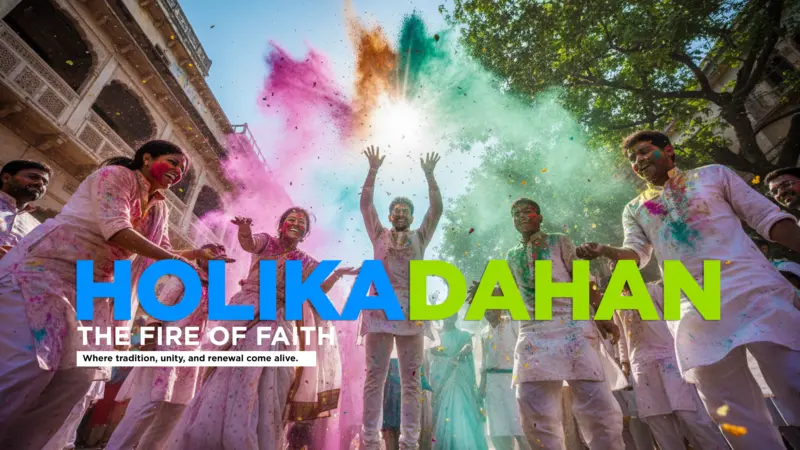

The night before Holi, as darkness falls across India, neighbourhoods light enormous bonfires that glow well into the night. This ritual is Holika Dahan, one of the most significant events in the Hindu calendar and the spiritual foundation on which the festival of Holi is built.
Holika Dahan is not merely a bonfire. It is a re-enactment of an ancient story about devotion, tyranny, and divine protection. Every year, millions of families gather around these fires to perform puja, offer grains, and pray for the removal of negativity from their lives. Understanding Holika Dahan, its mythology, its rituals, its regional variations, and its deeper meaning gives the entire Holi celebration a context that goes far beyond colour and festivity.
The Story of Holika Dahan: Why the Bonfire Is Lit
The story of Holika Dahan comes from the Bhagavata Purana, one of the eighteen major Puranas in Hindu scripture. At its centre is the conflict between Hiranyakashipu, a powerful demon king, and his son Prahlad, an unwavering devotee of Lord Vishnu.
Hiranyakashipu had received a boon from Lord Brahma that made him nearly impossible to kill. He could not be slain by man or animal, inside or outside, during day or night, on the ground or in the air, by any weapon made or thrown. This boon filled him with arrogance. He declared himself the supreme power and forbade worship of any god, demanding that all his subjects worship him alone.
His son Prahlad refused. Despite being put through a series of terrible trials - being thrown from cliffs, trampled by elephants, given poison, and attacked by soldiers, Prahlad survived every ordeal through his devotion to Vishnu.
Frustrated and enraged, Hiranyakashipu turned to his sister Holika. She had been granted a special boon: a divine shawl that made her immune to fire. The plan was simple: Holika would sit with Prahlad in a raging bonfire, using the shawl as protection. Prahlad would burn, and Hiranyakashipu would finally be rid of his devout son.
What happened confounded them both. As the fire grew, the divine shawl flew off Holika and wrapped itself around Prahlad. Holika burned to death. Prahlad walked out of the flames unharmed, protected by his faith. Lord Vishnu then appeared as Narasimha, half man, half lion - and slew Hiranyakashipu at the threshold of his palace at twilight, satisfying every condition of the boon.
This night of Holika's destruction is what Holika Dahan commemorates. The bonfire represents the burning of evil, ego, and all that is destructive, while Prahlad's survival represents the enduring power of devotion and righteousness.
What Holika Dahan Symbolises: The Deeper Meaning
Beyond the mythological narrative, Holika Dahan carries layers of symbolic meaning that resonate across different aspects of life - spiritual, social, and seasonal.
At its most fundamental level, the ritual is about the triumph of satya (truth) over adharma (unrighteousness). The story of Prahlad is not just a tale of divine intervention, it is a teaching about the inner strength of the faithful in the face of oppressive power. The bonfire makes this teaching visceral and communal.
The fire also has a purifying function. In Hindu tradition, Agni, the fire deity, is a witness and purifier. Lighting a communal fire during Holika Dahan is an act of collective purification. Families offer items into the flames to symbolise the release of negativity, old grievances, and accumulated harm from the past year.
Seasonally, the bonfire also marks a practical transition. Holika Dahan falls at the end of winter, and in agrarian communities, lighting large fires was a way to ward off the last cold nights and welcome the warmth of spring. The smoke was also believed to cleanse the atmosphere after winter's dampness.
For many families, the festival carries a personal dimension too. It is common to write the names of personal troubles, bad habits, or enemies on paper and symbolically offer them to the fire, seeking a fresh start as the new season begins.
Holika Dahan Rituals: How the Puja Is Performed
The rituals of Holika Dahan follow a broadly similar pattern across most of India, though specific customs vary by region and family tradition. Preparations typically begin several days before the main event.
Collecting wood and building the pyre
In the weeks leading up to Holika Dahan, communities collect dry wood, cow dung cakes, and dried leaves to build the communal bonfire. A wooden or clay effigy of Holika is traditionally placed at the centre. In some communities, a green branch representing Prahlad is placed inside the pyre as well; this branch, being green, does not fully burn, symbolising Prahlad's survival.
Choosing the auspicious time
The bonfire is lit only during the muhurat, the auspicious time window determined by the Hindu lunar calendar. This window falls during the Pradosh period (after sunset) when the Purnima tithi (full moon) is active. Lighting the fire outside this window is considered inauspicious. Panchangs (Hindu almanacs) and priests specify the exact muhurat each year.
The puja ritual
- Worshippers circle the bonfire clockwise - a ritual called parikrama - three or seven times while holding offerings. Common offerings include:
- Raw coconut - symbolising the ego being surrendered to fire
- Unbroken grains of wheat or barley from the new harvest
- Gulal (colour powder) - sprinkled as the fire is lit
- Flowers, especially marigold, offered as a mark of devotion
- Roasted seeds, dried fruits, and coconut pieces
Mantras and prayers dedicated to Lord Vishnu and Agni are recited. Families often bring small amounts of the ash home after the bonfire dies down; it is considered sacred and used for tilak (forehead mark) the next morning.
Holika Dahan Date and Muhurat: What to Know
The date of Holika Dahan is determined by the Purnima tithi of the Hindu month of Phalgun. Since the Hindu calendar is lunisolar, this date shifts each year in the Gregorian calendar, falling somewhere in February or March.
The timing of the muhurat is critical. According to Hindu tradition, the bonfire must be lit when both of the following conditions are met: the Pradosh Kaal (approximately 1.5 hours after sunset) is active, and the Purnima tithi has begun. If the Purnima tithi starts after midnight, the Holika Dahan takes place the previous night.
Year | Holika Dahan Date | Approx. Muhurat Window | Holi (Rangwali) Date |
2024 | 24 March 2024 | 11:13 PM – 12:27 AM | 25 March 2024 |
2025 | 13 March 2025 | 10:35 PM – 12:30 AM | 14 March 2025 |
2026 | 2 March 2026 | 6:20 PM – 8:47 PM | 3 March 2026 |
Note: Exact muhurat timings vary by geographic location and should be confirmed through a local panchang or priest. The timings above are indicative.
How Holika Dahan Is Observed Across Different States
While the ritual of lighting a bonfire is universal, India's cultural diversity means that Holika Dahan takes different forms in different states. These regional variations add texture to what is already a richly layered tradition.
Uttar Pradesh and Bihar
In the Braj region - Mathura, Vrindavan, and Barsana - Holika Dahan is elaborate and emotionally charged. Communities gather in large numbers, often singing devotional songs (bhajans) well into the night before the bonfire is lit. The tradition of playing Lathmar Holi begins in this region even before the main festival.
Maharashtra
In Maharashtra, the tradition is called Shimga. A bonfire is lit, and it is customary to roast papad (papads) over the fire and distribute them to neighbours. The practice of collecting wood for the bonfire begins weeks in advance and is considered a community effort.
Bengal and Odisha
In West Bengal and Odisha, Holika Dahan is preceded by a tradition of children making small bonfires in their neighbourhoods in the days leading up to the main festival. Effigies of Holika and Putana (another demon from Krishna's mythology) are burned together.
Punjab
The Punjabi tradition of Lohri, which falls in January, shares similarities with Holika Dahan both involve communal bonfires, offerings of food, and community singing. By the time Holika Dahan arrives, the celebration tends to merge with the broader Holi festivities observed vigorously across Punjab.
Rajasthan
In Rajasthan, Holika Dahan bonfires in villages can be extremely large, sometimes using entire tree trunks. Communities gather in open grounds, and the ritual is followed by folk music and dance. The ash from the bonfire is used in Ayurvedic preparations and for skin application the following morning.
Why Holika Dahan Remains Culturally Central in Modern India
In an era of rapid urbanisation and changing lifestyles, Holika Dahan has retained its cultural centrality in a way that many ancient rituals have not. Several factors explain this.
First, it is a communal event. Unlike personal pujas performed at home, Holika Dahan is inherently public. It brings an entire neighbourhood or village together around a shared fire. In urban India, housing societies and apartment complexes often organise collective Holika Dahan events, which serve a social function that residents actively look forward to.
Second, the environmental conversation around Holika Dahan has added a new dimension to the festival. Growing concern about air quality in Indian cities particularly in North India has led to civic discussions about the scale of bonfires and the materials burned. Many municipalities now encourage smaller fires, ban the burning of plastics, and promote the use of cow dung cakes over wood. This dialogue, rather than weakening the festival, has shown communities engaging with ancient tradition in a contemporary context.
Third, for younger generations, Holika Dahan has become a bridge to heritage. Many urban families who may not observe daily rituals still make it a point to attend or organise a Holika Dahan. The combination of storytelling, fire, and community creates an experience that is memorable and meaningful across age groups.
Religious tourism also plays a role. Cities like Mathura, Vrindavan, and Varanasi see a significant influx of visitors specifically for Holika Dahan, contributing to the local economy and keeping regional traditions alive on a national stage.
Common Dos and Don'ts on Holika Dahan Night
For those observing Holika Dahan for the first time or looking to understand the tradition more fully, a few practical and customary points are worth knowing.
What to do
- Observe the fast (upvas) during the day if following a traditional practice, break it after the puja is complete
- Wear clean, preferably traditional clothing when attending the puja
- Bring offerings - coconut, grains, flowers, and gulal to contribute to the communal ritual
- Perform the parikrama (circumambulation) of the bonfire an odd number of times typically three or seven
- Collect a small amount of the sacred ash to bring home as prasad
What to avoid
- Do not light the bonfire before the prescribed muhurat - this is considered inauspicious
- Avoid burning plastic, synthetic materials, or household waste in the bonfire
- Do not turn your back to the fire during the puja, face the bonfire while performing rituals
- Avoid bringing children too close to the fire unsupervised
- In many traditions, newly married women perform specific rituals, check with family elders for local customs
Frequently Asked Questions About Holika Dahan
What is the significance of Holika Dahan?
Holika Dahan marks the victory of devotion and righteousness over evil and arrogance, as told in the story of Prahlad and Holika from the Bhagavata Purana. The bonfire ritual symbolises the burning of negativity and a collective prayer for protection and renewal.
Why is Holika Dahan performed at night?
Holika Dahan is performed after sunset during the Pradosh period when the Purnima tithi is active. This timing is considered auspicious according to the Hindu lunar calendar, and the ritual must be completed within the prescribed muhurat window.
Can Holika Dahan be performed at home?
While Holika Dahan is primarily a communal ritual, smaller home ceremonies are performed in some families. A small symbolic fire or lamp may be lit with prayers and offerings. However, the communal bonfire in open public spaces is the traditional and more commonly observed form.
What items are offered in Holika Dahan puja?
Common offerings include raw coconut, uncooked grains of wheat or barley, marigold flowers, gulal, roasted seeds, and cow dung cakes. Each item carries a symbolic meaning, and specific customs vary by region and family tradition.
Conclusion
Holika Dahan is far more than a bonfire lit the night before Holi. It is a living ritual that connects millions of Indians to a story about moral courage, the limits of arrogance, and the protection that comes from genuine faith. The fire that burns each year on the full moon of Phalgun carries centuries of accumulated meaning - mythological, seasonal, and deeply personal.
What makes Holika Dahan endure is precisely that it is not an abstract ceremony. It is experienced through fire, sound, community, and prayer. Families gather across generations. Neighbours who may barely speak through the year find themselves circling the same bonfire. The ritual creates shared memory, and shared memory creates community.
Whether you observe it as a religious practice, attend as a cultural participant, or simply watch from a distance, Holika Dahan offers a rare moment - a night when an ancient story feels immediately present, and a fire lit thousands of years ago still warms the hands of a new generation.
Key Takeaways
- Holika Dahan commemorates the story of Prahlad and Holika from the Bhagavata Purana, symbolising the victory of devotion over evil.
- The bonfire must be lit during the muhurat - the auspicious window determined by the Pradosh period and Purnima tithi each year.
- Rituals include parikrama (circling the fire), offerings of coconut, grains, and flowers, and recitation of mantras.
- Regional traditions vary widely from Shimga in Maharashtra to elaborate community bonfires in the Braj region of Uttar Pradesh.
- Sacred ash from the Holika Dahan bonfire is brought home as prasad and applied as tilak the following morning.
#Holi #Holikadahan #Rituals #Culture #Traditions #puja #indianfestival #bonfire