


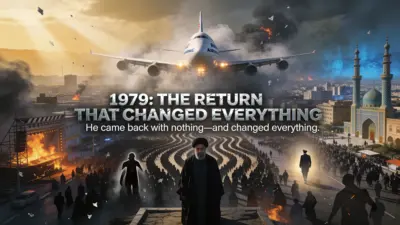

On a foggy Thursday morning, a chartered Air France Boeing 747 descended toward Tehran. Before landing, the pilot looped around once, circling low over the city to make sure no tanks were blocking the runway.
The precaution turned out to be unnecessary. The tanks were gone. The Shah was gone. The city below was waiting.
Between five and ten million Iranians had poured into the streets. They had been waiting fifteen years. Ayatollah Ruhollah Khomeini was coming home. When a reporter aboard the plane asked how he felt about returning after all this time, the old man paused. Then he said, simply: 'Nothing.'
It was the most terrifying word he could have spoken. Not joy. Not relief. Not triumph. Nothing. He had not come home for himself. He had come to complete a task.
The Shah's Bargain
To understand why the revolution happened, you have to understand what Mohammad Reza Pahlavi had built and what he had traded away to build it. The Shah was, in many ways, a genuine modernizer. His White Revolution redistributed land, extended voting rights to women, built roads and schools and hospitals, and expanded the Iranian middle class in ways unimaginable a generation earlier.
But the White Revolution came with a hidden cost. The Shah's modernization project was American-backed and American-designed. The CIA had helped restore him to the throne in 1953, after the elected Prime Minister Mohammad Mossadegh had tried to nationalize Iran's oil. That episode, the coup, the restoration, the foreign hand was not forgotten. SAVAK, the Shah's security service, used torture against dissidents with a systematic efficiency that made a mockery of his modernizing image. A country with growing universities and an expanding educated class had no legitimate way to participate in its own governance.
The Cassette Revolution
Khomeini understood something that the Shah's technocrats never grasped: that in a culture of oral tradition and deep religious faith, the mosque was more powerful than the ministry. And tapes traveled faster than censorship.
From his exile in Najaf and later in a Paris suburb, Khomeini recorded his sermons. These tapes were smuggled into Iran, copied by the thousands, and distributed through mosques and bazaars. His message was electrifying: Islam did not just govern prayer and fasting, it governed politics, economics, and foreign policy. A properly Islamic state did not bow to America. It did not quietly cooperate with Israel. In an Iran where formal politics were closed off, Khomeini's vision offered total transformation. Not reform. Revolution.
"The revolution was unusual. It happened not in poverty, but in prosperity. Not in military defeat, but in growing strength. It was a revolution of the spirit."
The Spiral of 1978
The revolution accelerated through 1978 in a self-reinforcing pattern that became impossible to stop. Protests were crushed. Mourning ceremonies for those killed - held forty days after death, as Shia tradition required - became occasions for new protests. New crackdowns followed. New martyrs. New mourning ceremonies. The Shia calendar of grief became a revolutionary calendar of resistance.
In August 1978, arsonists locked the Cinema Rex cinema in Abadan and set it on fire. More than four hundred people died. On September 8, Black Friday, soldiers opened fire on protesters in Jaleh Square in Tehran. After Black Friday, the revolution became unstoppable. By November, the Shah was trying concessions. By December, apologies. By January 1979, he was gone, leaving Iran on the pretense of a vacation, never to return.
Ten Days That Changed History
Khomeini returned on February 1. Within ten days, his hold on the revolution was total. He dismissed the Shah's appointed prime minister as illegitimate. Iran's military declared neutrality on February 11. In April, Iranians voted in a referendum: Islamic Republic, yes or no? The result - 98.2 percent in favor reflected both genuine popular enthusiasm and the total absence of organized alternatives.
The hostage crisis followed in November, when students stormed the U.S. embassy and took 52 Americans captive. Khomeini endorsed it. The crisis lasted 444 days and destroyed Jimmy Carter's presidency. For Israel and the United States, the calculations of thirty years vanished overnight. The oil stopped. The embassies closed. The intelligence alliance became an intelligence war.
The country that had been America's most important Persian Gulf ally was now its most dedicated enemy and was beginning to arm and fund the forces that would spend the next four decades trying to destroy the Jewish state from its borders inward. Khomeini's successor, a soft-spoken man who had spent time in SAVAK's prisons, believed resistance to America and Israel was not a policy choice but a sacred obligation. His name was Ali Khamenei. He would rule Iran for thirty-six more years.
#IranRevolution #Iran1979 #Khomeini #MiddleEast #IranFiles #History #WorldNews #IslamicRevolution #Iran
Read More:
Part 1 "Iran and Israel Were Secret Allies for 30
Years. Here's What Ended It." - https://dhunt.in/13BPbe
Part 3 "Who Was Qassem Soleimani? The Man
America Killed And Why It Mattered" - https://dhunt.in/13CF1K
Part 4 "Iran's Nuclear Program: The Full Timeline
From Secret Bunkers to U.S. Airstrikes" - https://dhunt.in/13BVR9
Part 5 "How Israel Has Been Secretly Killing Iran's
Scientists for 15 Years" - https://dhunt.in/13CQR0
Part 6 "From October 7 to the Fall of Hezbollah: How Israel Dismantled
Iran's Empire" - https://dhunt.in/13BNSK
Part 7 "Khamenei Is Dead. Who Was He And What
Happens to Iran Now?" - https://dhunt.in/13BWmD
Part 8 "What Comes After Khamenei? Three
Futures for Iran - and the World" - https://dhunt.in/13CXl0