
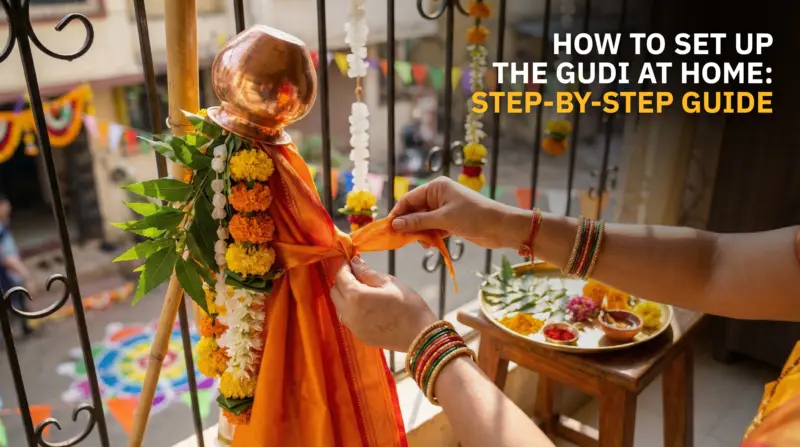

Gudi Padwa marks the Maharashtrian new year and one of its most visible traditions is the Gudi - a decorated bamboo staff raised outside the home at sunrise.
If you have never set one up before or want to do it properly this year, this guide covers every step: what to buy, how to assemble it, where to place it, and the rituals that accompany it. The process takes under an hour but the symbolism it carries goes back centuries.
The Gudi represents victory, prosperity, and the triumph of good over evil. In Maharashtra's cities, from Nashik to Nagpur, Pune to Palghar, you will see them lining streets on Gudi Padwa morning. Here is how to set yours up correctly.
What You Need Before You Start
Gather all materials the evening before so the setup is smooth on the morning itself. The core components are non-negotiable; the decorative ones are customisable.
Essential materials:
- Bamboo stick - minimum 4 to 5 feet long, straight and clean
- Bright silk or brocade cloth - traditionally yellow, green, or red
- Copper or silver lota (small pot) - cleaned and polished
- Neem leaves - a fresh bunch, not dried
- Mango leaves - a small cluster
- Sugar crystal garland (saakhar gathi) - available at any Maharashtrian sweet shop
- Gathi of flowers - marigold works well
- Turmeric, kumkum, and roli for the ritual tilak
Optional but traditional:
- A small garland of dried tamarind and jaggery
- A coconut to place beside the Gudi base
- Rangoli materials for the base decoration
Step 1 - Clean the Space and Draw the Rangoli
Start at dawn. The Gudi must ideally be raised at sunrise, so preparation begins at least 30 minutes before. Clean the entrance or window area where the Gudi will stand. In traditional homes this means a floor wash with water and a sprinkle of cow dung solution, though most urban households substitute this with a clean mop and a rangoli instead.
Draw a rangoli at the base of the chosen spot. This does not need to be elaborate - a simple floral or geometric pattern in traditional colours is sufficient. The rangoli signals that this is a sacred and prepared space.
Step 2 - Dress the Bamboo Stick
Lay the bamboo stick flat on a clean surface. Starting from the top, tie the silk or brocade cloth firmly around the upper quarter of the stick. The cloth should hang down like a flag - vibrant and visible. Use a thin thread or ribbon to secure it; do not use tape or rubber bands as these are considered inauspicious substitutes in the ritual context.
Below the cloth, tie the neem leaves and mango leaves in a cluster. These should face upward or outward not drooping. Layer the sugar garland over these, followed by the flower garland. The visual order from top to bottom should be inverted pot, leaves and garland, cloth, bare stick.
Step 3 - Place the Copper Pot
This is the most visually distinctive element of the Gudi. Take the cleaned copper or silver lota and invert it over the very top of the bamboo stick. It should sit snugly. If the stick's diameter makes this difficult, wrap a small piece of cloth around the tip first to create a tighter fit.
The inverted pot symbolises the dome of the sky and victory - it is the element that gives the Gudi its distinctive silhouette across Maharashtra's rooftops. Some families place a small idol of Brahmadev inside the pot before inverting it; this is a regional variation from parts of Vidarbha.
Step 4 - Position and Raise the Gudi
Place the base of the bamboo stick in a sturdy holder, a metal stand, a heavy pot filled with soil or sand or wedge it securely into a window grille. The Gudi must not wobble or lean. In apartment settings in Mumbai or Pune, a balcony railing is the standard placement - tie the stick to the grille with twine for stability.
The Gudi should be positioned on the right side of the main entrance and face the street or road. It should be raised at the exact time of sunrise on Gudi Padwa. In 2026, check the Panchang for your city's specific sunrise time - Pune and Mumbai typically differ by a few minutes.
Step 5 - Perform the Puja
Once the Gudi is raised, perform a brief puja. Apply turmeric and kumkum to the pot and the base of the stick. Light an incense stick and offer it in a circular motion three times. Offer flowers - drop them at the base, not thrown at the Gudi.
Recite the traditional Gudi Padwa prayer or a shloka of your choice. Many families read from the Panchang on this day, noting the tithi and nakshatra. Offer prasad, typically panchamrut or a small piece of shrikhand-puri, which is the traditional Gudi Padwa meal.
Some families also eat the neem-jaggery mixture at this point, a pinch of neem leaves, raw jaggery, tamarind, and a little salt combined and consumed as the first food of the new year.
Step 6 - The Decoration Details That Elevate the Setup
The base area below the Gudi deserves attention. Place a small decorative thali with kumkum, rice grains, a diya, and a small flower arrangement. This frames the Gudi and signals the ritual care that has gone into it.
If space permits, place a coconut with a turmeric-marked forehead beside the base. Many Pune households also add a kalash of water with mango leaves tucked inside. This is drawn from the broader Hindu ritual tradition and considered auspicious for the new year.
Common Mistakes to Avoid
Mistake | Why It Matters | Correct Approach |
Using plastic or synthetic cloth | Considered inauspicious; disrupts ritual integrity | Use silk, cotton, or brocade only |
Placing the Gudi on the left side | Traditional placement is right side of entrance | Always position on the right |
Skipping the neem leaves | Neem is ritually essential, not just decorative | Fresh neem is non-negotiable |
Leaving Gudi up after sunset | The Gudi is a sunrise-to-sunset ritual object | Take down ceremonially before dark |
Pot facing upright | The inverted pot is the key visual symbol | Always invert the lota on top |
Frequently Asked Questions
Q1: Which direction should the Gudi face?
The Gudi is traditionally erected facing the road or street - ideally on the right side of the main entrance. It should face east or north and be visible from outside the home as a public declaration of the new year.
Q2: What is the significance of the neem leaves on the Gudi?
Neem leaves represent the bittersweet nature of life and are believed to ward off evil. Eating neem leaves mixed with jaggery on Gudi Padwa morning is a ritual said to build immunity and prepare the body for the summer season ahead.
Q3: Can the Gudi be set up in an apartment?
Yes. Apartment dwellers in Mumbai and Pune typically place the Gudi on a window ledge or balcony railing. The essential elements - bamboo stick, silk cloth, neem, mango leaves, sugar garland, and the inverted pot remain the same.
Q4: What time should the Gudi be taken down?
The Gudi is traditionally taken down at sunset on Gudi Padwa day. It should not be left overnight. After the rituals are complete, the components are carefully dismantled, the cloth and utensil stored, and neem and mango leaves disposed of respectfully.
Conclusion
Setting up the Gudi at home is one of those rituals where the physical act and the symbolic meaning reinforce each other completely. The bamboo stick that goes up at sunrise is not decoration - it is a statement. Every element on it, from the inverted copper pot to the bitter neem leaves, carries a specific meaning rooted in Maharashtrian tradition and the agricultural calendar that Gudi Padwa historically marks.
For families in the diaspora or those who grew up away from Maharashtra, this guide gives you everything you need to set it up correctly this year. The materials are available at any Maharashtrian puja shop, and the process, once done once, becomes second nature. Know how to set up the Gudi at home and raise it right.
Key Takeaways
- Gather all materials the evening before: bamboo stick, silk cloth, copper lota, neem leaves, mango leaves, and sugar garland.
- The Gudi must be raised at sunrise on Gudi Padwa, check the city-specific Panchang for exact timing.
- Position it on the right side of the main entrance, facing the street or road, for correct traditional placement.
- The inverted copper pot is the most important visual element, it must always face downward on the stick.
- Take the Gudi down ceremonially before sunset; it is a sunrise-to-sunset ritual, not an overnight decoration.
#gudipadwa #hindufestival #gudi #indianculture #tradition #maharashtra #ritual #mumbai #pune