
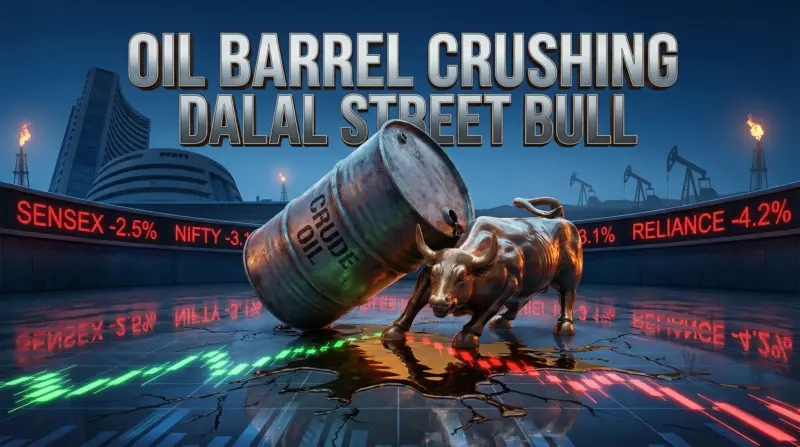

When the news broke that US and Israeli strikes had hit Iran in early March 2026, Indian investors did not wait to understand the details.
The BSE Sensex fell nearly 1,750 points in a single session. The Nifty 50 dropped over 530 points. Defence stocks surged. Oil companies slid. Broader markets bled. For the more than 10 crore Indians who now hold Demat accounts, many of them first-generation investors who have never experienced a major geopolitical market shock - the fall was alarming and confusing in equal measure. This article explains exactly why wars in the Middle East affect Indian stock markets, which sectors get hit hardest, which ones sometimes benefit, and what the evidence says about what retail investors should actually do.
Why a War Thousands of Kilometres Away Moves Indian Markets
Oil and inflation
India imports over 85 per cent of its crude oil, much of it transiting through the Strait of Hormuz. When war breaks out in that region, oil prices rise on supply-risk fears, India's import bill grows, the rupee weakens, and inflation threatens to accelerate. Markets price all of this in almost immediately.
Foreign Institutional Investor (FII) behaviour
Foreign portfolio investors tend to pull money out of emerging markets like India during global crises and move it into safe-haven assets - US treasury bonds, gold, and the dollar. This capital flight puts direct selling pressure on Indian stocks, amplifying domestic market falls.
Corporate earnings expectations
Rising oil costs, a weaker rupee, and the prospect of higher interest rates all compress profit margins for Indian companies, particularly in aviation, paints, chemicals, logistics, and FMCG. When analysts revise earnings estimates downward, stock prices follow.
How Indian Markets Have Responded to Past Geopolitical Crises
Event | Sensex Reaction | Recovery Timeline | Key Lesson |
9/11 Attacks (2001) | Fell ~5-8% in days | Recovered in weeks | India not directly exposed; recovery fast |
2003 Iraq War | Markets fell pre-war; rallied once war began | Months | Uncertainty worse than the event itself |
2008 Global Crisis | Sensex fell ~55% peak to trough | ~2 years to recover | Financial crisis worse than geopolitical shock |
2022 Russia-Ukraine War | Sensex fell ~10–12% in weeks | Recovered within months | Oil shock absorbed; IT exports offset pain |
2026 Iran-Israel Conflict | Sensex fell ~1,750 pts (Day 1) | Ongoing | Oil and FII selling driving immediate pain |
Which Sectors Get Hit - And Which Sometimes Gain
Sectors that typically fall
- Aviation: Jet fuel costs spike immediately; rerouting adds cost.
- Paints and chemicals: Crude-derived inputs hit margins quickly.
- FMCG: Packaging, logistics, and ingredient costs rise.
- Logistics and shipping: Higher fuel, insurance, and route disruption costs.
- Automobiles: Higher input costs, reduced consumer confidence.
Sectors that sometimes hold up or gain
- IT and software exports: Earn in dollars; weaker rupee improves rupee revenue conversion.
- Pharmaceuticals: Defensive, export-oriented inelastic healthcare demand.
- Defence: Domestic and export order flows typically accelerate during conflict.
- Oil exploration PSUs: Companies like ONGC benefit when crude prices rise.
What the Data Says: Should You Sell, Hold, or Buy?
Selling at the bottom has historically been the worst decision
In virtually every geopolitical shock over the past 30 years, investors who sold equities at the point of maximum fear crystallised their losses and missed the recovery. Markets recovering from geopolitical shocks tend to move quickly once clarity improves.
Holding through the crisis has been the default winning strategy
For investors with a horizon of three or more years, staying invested through geopolitical market falls has produced better outcomes than trying to time an exit and re-entry. A 10 to 15 per cent fall during a crisis looks small in the context of a decade-long investment.
Adding to equity SIPs during a fall has historically worked
Continuing SIPs through a geopolitical crisis or temporarily increasing the SIP amount if financial circumstances allow takes advantage of lower prices and lowers the average portfolio cost over time.
A Sector-by-Sector Portfolio Review Checklist
If You Hold | Crisis Impact | Action to Consider |
Aviation stocks | High negative - fuel costs, route disruptions | Review position size; consider trimming if overweight |
Oil marketing companies | Mixed - crude cost rises, government may delay price hikes | Monitor government pricing policy closely |
IT stocks (TCS, Infosys, Wipro) | Positive - dollar revenues, rupee weakness helps | Hold or add; natural hedge in crisis |
Pharma stocks | Mildly positive - defensive, export earner | Hold; stable in uncertainty |
Paint / chemical stocks | Negative - crude-linked input costs | Monitor; may recover as raw material outlook clears |
Defence PSUs (BEL, HAL) | Positive - demand typically rises in conflict | Monitor valuation - sector can run ahead of fundamentals |
Broad market index funds | Falls with market; recovers with market | Continue SIPs; do not panic-redeem |
What Individual Investors Should Actually Do Right Now
- Do not make any major portfolio decision in the first 48 to 72 hours of a crisis - markets overshoot on both sides.
- Review your asset allocation, not just your portfolio value. If equity has drifted down, rebalancing means buying more at lower prices.
- Continue all existing SIPs without exception, the mechanism works precisely because of market volatility.
- Check your emergency fund before checking your portfolio.
- Avoid watching markets intraday, checking every hour generates anxiety without actionable information.
Frequently Asked Questions
Why does the Sensex fall when there is a war in the Middle East even though India is not involved?
Indian markets fall because of oil price increases, FII selling, rupee weakness, and lower corporate earnings expectations not because India is directly involved in the conflict.
Which sectors are safest to hold during a Middle East conflict?
IT and software exporters hold up well; pharmaceutical stocks are defensive and export-oriented; gold-related holdings benefit from safe-haven demand. These are historical patterns, not guarantees.
Should I stop my SIP if the market keeps falling?
No. Stopping a SIP during a market fall locks in losses and removes you from the recovery. The only valid reason to stop a SIP is a personal cash flow problem, not a market fall.
Conclusion
The Sensex fall that follows the outbreak of conflict is the market pricing in real economic risks in real time. For retail investors, the fall looks alarming and feels personal. But the historical record is clear: investors who stayed invested through geopolitical market shocks fared better than those who tried to exit at the bottom. Recovery tends to be swift, and the investors who benefit most are those who did not exit during the fall. The practical response is disciplined non-reaction - continue SIPs, review allocation, keep the emergency fund intact, and trust that a portfolio built for the long term is designed precisely for these moments.
Key Takeaways
- Middle East conflicts hit Indian markets through oil prices, FII selling, rupee weakness, and earnings downgrades not because India is involved.
- Aviation, paints, chemicals, and FMCG are most exposed; IT, pharma, and defence stocks often hold up better.
- Foreign institutional investors sell Indian equities during global crises, amplifying market falls beyond what fundamentals justify.
- Historical evidence strongly supports holding through geopolitical market falls rather than selling.
- Continue SIPs, check asset allocation rather than portfolio value, avoid intraday market-watching during crisis periods.
#stockmarket #Indianstockmarket #NIFTY50 #middleeast #portfolio #investing #sensex #SIP #stocks #indianmarket