


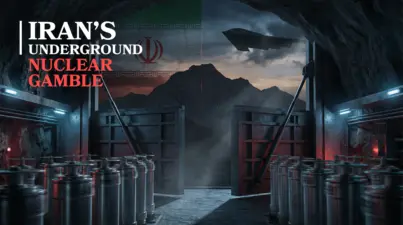

Nearly 300 feet beneath a mountain near the Iranian city of Qom, workers bored a tunnel into the rock. The facility they built was designed to house centrifuges, thousands of machines that spin uranium gas at supersonic speeds until it becomes fuel, or worse.
It was designed, above all, to be survivable. To resist the bunker-busting bombs that America or Israel might someday drop.
The facility was called Fordow. Iran kept it secret for years. When President Obama revealed its existence in September 2009, standing alongside the leaders of Britain and France, his language was careful: the configuration of the site, he said, was 'inconsistent with a peaceful nuclear program.' Some experts later estimated that Fordow, if fully operational and stocked with advanced centrifuges, could produce enough enriched uranium for a nuclear weapon in less than a week.
The Shah's Legacy
Iran's nuclear ambitions did not begin with the Islamic Revolution. They began with the Shah. In the 1960s and 1970s, with American encouragement, Iran developed an ambitious civilian nuclear power program. The Shah signed the Nuclear Non-Proliferation Treaty in 1968 as a non-nuclear state, pledging not to develop weapons. After the 1979 revolution, Khomeini initially suspended the program, calling it a symbol of Western decadence. But the Iran-Iraq War changed his thinking. Watching Saddam Hussein deploy chemical weapons against Iranian troops with Western acquiescence, Iran's leadership drew a conclusion: if you did not have weapons of mass destruction, your enemies might use them against you without consequence.
The Secret Comes Out
For years, Iran built its nuclear infrastructure covertly, lying to the International Atomic Energy Agency. Then, in August 2002, an Iranian opposition group held a press conference in Washington and detonated a diplomatic bomb: Iran had secretly built a uranium enrichment facility at Natanz and a heavy water production plant at Arak. The revelation triggered an international crisis. The key issue was not the facilities themselves enriching uranium is legal under international law, provided it is declared. The problem was that Iran had been building them for years without telling anyone.
A Pakistani scientist named Abdul Qadeer Khan had provided crucial help in the 1980s and 1990s, centrifuge designs, components, and technical assistance through his clandestine proliferation network. Khan had essentially sold the technology of Pakistan's own bomb program to the highest bidders. Iran, Libya, and North Korea all benefited.
"Even after this deal, our policy towards the arrogant U.S. will not change." - Supreme Leader Khamenei on the 2015 nuclear agreement
The Cycle of Enrichment
What followed over the next two decades was a grinding, repetitive cycle. By April 2006, Iran had enriched uranium to 3.5 percent using 164 centrifuges at Natanz. By 2007, it had 3,000 centrifuges. By 2012, it was enriching to 20 percent just a modest further step from weapons-grade material at the buried Fordow facility.
The Joint Comprehensive Plan of Action, signed in July 2015, was the closest the world came to resolution. Iran agreed to limit enrichment to 3.67 percent, reduce its centrifuge count by two-thirds, and accept intrusive monitoring. In exchange, international sanctions were lifted. For two years, it worked.
The Deal Destroyed
In May 2018, Donald Trump withdrew the United States from the deal, calling it the 'worst deal ever negotiated.' Iran, facing economic collapse, began systematically dismantling the restrictions: enriching to 4.5 percent, then 20 percent, then 60 percent just below the 90 percent weapons-grade threshold. By 2024, Iran's stockpile was large enough to produce material for nine nuclear weapons.
On June 21, 2025, U.S. B-2 Spirit bombers dropped their largest bunker-busting bombs on Fordow, Natanz, and the Isfahan nuclear technology center. Trump declared the facilities 'completely and totally obliterated.' Iran's nuclear scientists, dispersed across safe houses and alternative sites, kept working. The program was damaged. It was not destroyed. Whether it will be reconstituted - and whether Iran will ultimately cross the final threshold to a weapon - remains the central unresolved question of Middle Eastern security.
#IranNuclear #IranNuclearDeal #JCPOA #IranBomb #MiddleEast #IranFiles #WorldNews #NuclearWeapons #Iran #WorldPolitics
Read More:
Part 1 "Iran and Israel Were Secret Allies for 30
Years. Here's What Ended It." - https://dhunt.in/13BPbe
Part 2 "How Iran's 1979 Revolution Changed the
Middle East Forever" - https://dhunt.in/13CW4d
Part 3 "Who Was Qassem Soleimani? The Man
America Killed And Why It Mattered" - https://dhunt.in/13CF1K
Part 5 "How Israel Has Been Secretly Killing Iran's
Scientists for 15 Years" - https://dhunt.in/13CQR0
Part 6 "From October 7 to the Fall of Hezbollah: How Israel Dismantled
Iran's Empire" - https://dhunt.in/13BNSK
Part 7 "Khamenei Is Dead. Who Was He And What
Happens to Iran Now?" - https://dhunt.in/13BWmD
Part 8 "What Comes After Khamenei? Three
Futures for Iran - and the World" - https://dhunt.in/13CXl0