


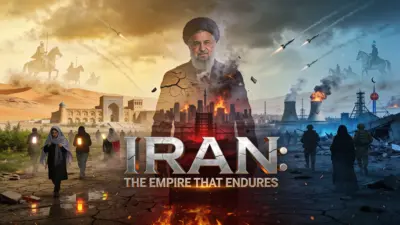

Every empire that has tried to control Iran has eventually left. Alexander the Great conquered it in 330 BCE and within two generations his successors had converted to Persian culture.
The Mongols burned Iranian cities in the 13th century and within two generations their rulers had converted to Islam and become Persian in habit and practice. The British and Russians carved Iran into spheres of influence in 1907. The CIA and MI6 overthrew its elected government in 1953. The Americans backed a Shah who was overthrown anyway. Each time, Iran bent. Each time, it remained.
This history is not a reason for complacency about what has just happened. It is a reason for humility about what anyone including the people of Iran can predict about what comes next.
The Immediate Picture: March 2026
Iran is in a state of unprecedented crisis. Its Supreme Leader is dead for the first time in thirty-six years. Its nuclear facilities have been struck twice in less than a year. Its most capable proxy, Hezbollah has been dramatically weakened. Its missile arsenal has been degraded. Its economy, already devastated by sanctions, faces further contraction.
The Islamic Revolutionary Guard Corps still has guns and still controls significant parts of the state apparatus. A three-person leadership council is managing the transition. The Iranian constitution requires that a new Supreme Leader be selected by the Assembly of Experts, a body of senior clerics and this process will unfold over weeks or months. But the process has never run without Khamenei watching over it. For three decades, he was the system's ultimate arbiter. The men who might have provided coherent succession are largely gone.
The People Watching
The Iranian people are not passive objects in this drama. The 2022 Woman, Life, Freedom protests ignited by the death of 22-year-old Mahsa Amini in morality police custody lasted for months, spread to more than 150 cities, and represented something qualitatively different from previous protests: they were led by young women taking off their hijabs in public, demanding not a better version of the Islamic Republic but its fundamental transformation. The UN's fact-finding mission documented at least 551 protesters killed, including 49 women and 68 children.
The 2025-2026 protests were larger and angrier, with monarchist slogans appearing for the first time in significant numbers. Security forces used heavy machine guns against crowds. Iran's execution rate roughly doubled in 2025 compared to 2024. But the protests revealed something about the regime's fragility: it needed brutality to survive. A government that can only hold its population through snipers and machine guns is a government that has lost something more fundamental than a policy debate.
"The fire creates space. What grows in that space is the question no one can answer yet."
Three Possible Futures
In the first future, Iran's crisis becomes an opening for genuine transformation. The Revolutionary Guard fragments or negotiates. A new leadership emerges willing to trade the nuclear program and proxy networks for reintegration into the global economy. The Iranian people, given space to choose, choose differently than Khomeini chose in 1979. This has happened in history authoritarian regimes, faced with existential crisis, have sometimes produced reform rather than retrenchment.
In the second future, the IRGC closes ranks. A new Supreme Leader is elevated who is more hardline than Khamenei, a figure who claims that the Islamic Republic's resistance has been vindicated, that the martyrdom of its leadership has elevated the revolution. The nuclear program is reconstituted. New proxies are cultivated. The conflict resumes at a higher level of mutual hostility.
In the third and arguably most likely future, Iran enters a prolonged period of internal instability. Neither transformation nor restoration, but a grinding factional struggle that keeps the country turned inward. This reduces its regional capacity while also reducing the prospects for meaningful change. It is the most likely outcome because it is the least dramatic, and history tends toward the undramatic.
What Is Certain
The framework that governed the Middle East for forty-five years an Islamic Republic committed to exporting revolution, to destroying Israel, and to resisting American power no longer exists in the form it took. Whether what replaces it is better or worse for the people of Iran, for the people of Israel, for the Americans stationed at bases across the Gulf, for the families in Tehran who lost children to security forces in the streets that verdict is not yet written.
History, in this part of the world, moves in long arcs. The people who will live inside the outcome of these weeks and months have not yet been born. The articles that will explain what happened written by the next generation trying to understand how it all came to this don't exist yet. But they will.
#Iran #IranFuture #KhameneiDead #IranCrisis #IranFiles #MiddleEast #WorldNews #IranAnalysis #IranRegimeChange #Iran
Read More:
Part 1 "Iran and Israel Were Secret Allies for 30
Years. Here's What Ended It." - https://dhunt.in/13BPbe
Part 2 "How Iran's 1979 Revolution Changed the
Middle East Forever" - https://dhunt.in/13CW4d
Part 3 "Who Was Qassem Soleimani? The Man
America Killed And Why It Mattered" - https://dhunt.in/13CF1K
Part 4 "Iran's Nuclear Program: The Full Timeline
From Secret Bunkers to U.S. Airstrikes" - https://dhunt.in/13BVR9
Part 5 "How Israel Has Been Secretly Killing Iran's
Scientists for 15 Years" - https://dhunt.in/13BVR9
Part 6 "From October 7 to the Fall of Hezbollah: How Israel Dismantled
Iran's Empire" - https://dhunt.in/13BNSK
Part 7 "Khamenei Is Dead. Who Was He And What
Happens to Iran Now?" - https://dhunt.in/13BWmD