


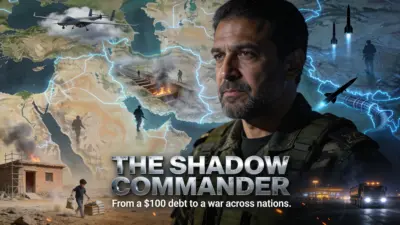

He grew up in a single room home in the mountains of Kerman province, in the remote southeast of Iran. His father was a farmer. The family was poor.
When Qassem Soleimani was thirteen years old, his father took out a loan of approximately one hundred dollars from a local lender to cover farm expenses. Unable to repay it, the family faced the prospect of the father being imprisoned.
So the boy walked to Kerman city and got a job at a construction site. He spent eight months carrying materials and laying foundations, saving every rial, until he had enough to clear the debt. The episode imprinted something on him: a resentment toward the system that allowed a farmer's family to be crushed by a hundred dollar loan, and a determination that he would never be crushed again.
That boy grew up to command military operations across six countries simultaneously. He became what one former CIA operative called 'the single most powerful operative in the Middle East.' And when he was finally killed by an American drone, at Baghdad's international airport, on January 3, 2020, the reverberations reached every corner of a conflict that is still unfolding.
The Revolutionary Guard
After the 1979 Islamic Revolution, 22 year old Soleimani joined the newly formed Islamic Revolutionary Guard Corps, the ideological paramilitary created to protect the revolution. He had approximately six weeks of formal military training. What he brought instead was an aptitude for leadership and an intuitive understanding of how men in desperate circumstances think and fight.
When Saddam Hussein's Iraq invaded Iran in September 1980, triggering an eight year war that would kill somewhere between 500,000 and one million people, Soleimani fought through the war's most brutal engagements. He survived chemical weapons attacks in Iraqi Kurdistan. He watched Iran fight a superpower backed Iraq head on and nearly lose. He emerged with two convictions that would define everything he did afterward: never fight conventionally against a stronger enemy, and never fight alone.
"You should know that I, Qassem Soleimani, control the policy for Iran with respect to Iraq, Lebanon, Gaza, and Afghanistan." - Letter to U.S. General David Petraeus, 2008
Building the Axis of Resistance
In 1998, Soleimani was appointed commander of the Quds Force, the IRGC's external operations division. Its name, 'Quds,' is the Persian word for Jerusalem, and its mission was explicit: to build the military infrastructure that could threaten Israel from multiple directions simultaneously.
Under his command, the Quds Force became something that had never quite existed before: a state run foreign legion. It did not fight wars directly. It recruited, trained, funded, and coordinated proxy militias then stepped back to let them fight. Hezbollah in Lebanon became his most capable instrument. He poured resources into its rocket arsenal and tunnel networks. By the mid 2000s, Hezbollah possessed more precision missiles than most nation states. In Iraq, he built a network of Shia militias that fought the American occupation with Iranian supplied weapons. In Syria, he saved Bashar al Assad's government from collapse. He flew to Moscow to secure Russian military intervention.
The Celebrity General
By the mid 2010s, Soleimani had become something unusual for a covert operator: a public figure. Photos of him posing with fighters across the Middle East circulated on social media. Khamenei called him a 'living martyr.' He cultivated an image of asceticism, reportedly living in a small apartment, praying visibly, visiting his men in the field. In a society with a well known corruption problem, he was seen as above reproach.
The Americans had tracked him for years. Presidents Bush and Obama both considered targeting him and pulled back, calculating that the fallout wasn't worth the gain. He reportedly traveled openly, almost daring surveillance, certain that no president would pull the trigger. Donald Trump did.
The Strike
On the night of January 2, 2020, Soleimani flew from Damascus to Baghdad, where he was greeted by Abu Mahdi al Muhandis, the commander of Iran's most powerful Iraqi proxy militia. A U.S. MQ 9 Reaper drone was circling overhead. At 12:47 a.m. on January 3, it fired. The convoy was destroyed. Soleimani and al Muhandis were killed.
Iran fired ballistic missiles at U.S. bases in Iraq within days, injuring over a hundred American service members, the most direct military confrontation between the two countries in decades. Then both sides stepped back from the edge. But the web Soleimani had spent twenty years building, the Axis of Resistance, survived him. It would take a different kind of war, fought by a different kind of weapon, to truly begin dismantling what he had built.
#iran #drone #war #resistance #general #proxy #khamenei #security #operations #strategy #power
Read More:
Part 1 "Iran and Israel Were Secret Allies for 30
Years. Here's What Ended It." - https://dhunt.in/13BPbe
Part 2 "How Iran's 1979 Revolution Changed the
Middle East Forever" - https://dhunt.in/13CW4d
Part 4 "Iran's Nuclear Program: The Full Timeline
From Secret Bunkers to U.S. Airstrikes" - https://dhunt.in/13BVR9
Part 5 "How Israel Has Been Secretly Killing Iran's
Scientists for 15 Years" - https://dhunt.in/13CQR0
Part 6 "From October 7 to the Fall of Hezbollah: How Israel Dismantled
Iran's Empire" - https://dhunt.in/13BNSK
Part 7 "Khamenei Is Dead. Who Was He And What
Happens to Iran Now?" - https://dhunt.in/13BWmD
Part 8 "What Comes After Khamenei? Three
Futures for Iran - and the World" - https://dhunt.in/13CXl0