
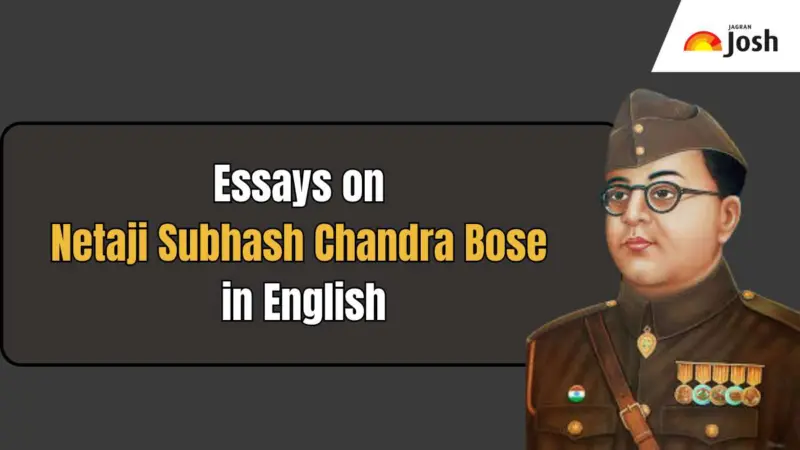

Essays on Netaji Subhash Chandra Bose: The article covers essay examples for school competitions and events to celebrate Netaji Subhash Chandra Bose . The Jayanti, also known as Parakram Diwas, observes the day of Netaji's valour, and his radical vision that shaped India and its constitution.
Students can find essays in 200-400 word count to use as an inspiration to participate in Netaji's Jayanti celebration in schools.
You may also like:
Why is Parakram Diwas Celebrated?
The day is observed on the birthday of Netaji Subhash Chandra Bose. The 'Parakram Diwas' which translates to 'The Day of Valour' is associated with Netaji because of his prominent and influential role in India's independence.
The Government of India started celebrating this day from 2021, which marked Netaji's 124th birth anniversary. He was honored for his unshakable spirit, his contribution and service to the nation.
Essay on Netaji Subhash Chandra Bose (Parakram Diwas) in English (200 words)
Netaji Subhash Chandra Bose: The Icon of Valour
Born in Cuttack on January 23, 1897, Netaji Subhash Chandra Bose is still regarded as one of the most charismatic and brave leaders of India's freedom movement. To commemorate his selfless devotion and steadfast dedication to the country, his birth anniversary is officially observed as Parakram Diwas (Day of Valour).
Netaji was an exceptionally bright individual who placed fourth in the esteemed Indian Civil Service (ICS) test. He famously resigned from an affluent employment, claiming he was unable to serve the British monarchy. He took a strong stance on freedom, believing that "Purna Swaraj" (total independence) requires more than just peaceful talks.
His audacious escape from house detention in Kolkata to Europe and ultimately Southeast Asia during World War II demonstrated his strategic prowess. His famous rallying cry, "Tum mujhe khoon do, main tumhe aazadi dunga" (Give me blood, and I shall give you freedom), inspired soldiers and revived the Indian National Army (Azad Hind Fauj).
In addition to his military prowess, Netaji's legacy encompasses his vision of an inclusive, contemporary, and unified India. By commemorating Parakram Diwas, we serve as a reminder to the children of 2026 that bravery, self-control, and "Nation First" are the fundamental principles that propel a nation to greatness.
Essay on Netaji Subhash Chandra Bose (Parakram Diwas) in English (300 words)
Essay on Netaji Subhash Chandra Bose: Parakram Diwas's Light
Overview India commemorates Netaji Subhash Chandra Bose's 129th birthday on January 23, 2026, which is officially known as Parakram Diwas (Day of Valor). This day has been a nationwide commemoration of the great bravery and selfless dedication provided by one of India's most famous independence fighters since its establishment in 2021. The notion that "freedom is not given, it is taken" was demonstrated by Netaji's life, and millions of people are still inspired to be patriotic by his revolutionary spirit.
The Journey of a Visionary Subhash Chandra Bose, a gifted student who famously placed fourth in the Indian Civil Service (ICS) exam, was born in Cuttack, Odisha, in 1897. He refused to serve the colonial monarchy, nevertheless, and resigned from the esteemed position out of a deep love for his homeland. His foray into politics signaled a change toward a more radical and assertive attitude to independence. His objective remained the same-complete sovereignty for India-despite ideological differences with other modern leaders.
Azad Hind Fauj and His Impact on the World: The restructuring of the Indian National Army (Azad Hind Fauj) was Netaji's most important achievement. One of the most exciting moments in history is his audacious flight from India to seek foreign assistance in Germany and Japan. He inspired thousands of Indian citizens and prisoners of war in Southeast Asia to march toward Delhi with the stirring phrase "Tum mujhe khoon do, main tumhe aazadi dunga" (Give me blood, and I shall give you freedom).
Conclusion: Netaji's ideas of discipline, togetherness, and "Nation First" are more important than ever in 2026 as India moves closer to becoming a Viksit Bharat (Developed India). In addition to being a day of commemoration, Parakram Diwas is a call to action for young people to embody the same "Parakram" in their chosen vocations. Netaji Subhash Chandra Bose is still regarded as an eternal hero, and his legacy tells us that even when people die, their ideas live on in a thousand lifetimes to strengthen our country.
Essay on Netaji Subhash Chandra Bose (Parakram Diwas) in English (400 words)
The True Valour: How the British Raj Was Overthrown by Netaji?
The loyalty of the British Indian Army was a single, crucial pillar supporting British authority in India for almost two centuries. The British realized they required the "brown" soldiers to maintain peace because they could not rule 300 million people with 40,000 European soldiers. In addition to winning a war, Netaji's biggest "Parakram" was demonstrating to the British that they could no longer rely on their own sword. He broke down the psychological barrier that kept Indian soldiers faithful to the Crown by creating the Azad Hind Fauj.
In 1945, Netaji's vision really began to take effect. Shah Nawaz Khan, a Muslim, Prem Sahgal, a Hindu, and Gurbaksh Singh Dhillon, a Sikh, were the INA officers that the British tried to court-martial at the Red Fort in order to demonstrate "treason." Rather, they inadvertently brought a divided country together. The Royal Indian Navy Mutiny of 1946, in which more than 20,000 sailors rebelled and raised the tricolor on British ships, was sparked by the trials. At this point, London recognized their military tool had finally become a nationalistic one.
Beyond the battlefield, Netaji was a realist who recognized that a modern nation needed strategy, not simply feelings. He founded the National Planning Committee in 1938, which served as a model for India's post-independence planning strategies. Long before such concepts established international norms, he imagined a state-run industrial revolution and a society in which women served in combat capacities (the Rani of Jhansi Regiment).
In 2026, Netaji is regarded as the visionary who made the British withdrawal unavoidable rather than as a "defeated" commander. He made the colonial authorities decide between a peaceful retreat and a violent, unmanageable military uprising. By selecting the latter, the British tacitly admitted that Netaji's spirit was too strong to be put out. Thus, Parakram Diwas honors the man who made the Indian soldier an Indian citizen.
Essay on Netaji Subhash Chandra Bose (Parakram Diwas) in English (500 words)
Netaji Subhash Chandra Bose and His Valour To Stand Firm
The importance of January 23rd On January 23, 2026, India commemorates Netaji Subhas Chandra Bose's 129th birthday. One of the most charismatic and radical leaders of the Indian independence movement is honored nationally on this day, which was officially declared Parakram Diwas (Day of Valour) in 2021. Netaji's life was a master class in military prowess, selfless service, and the "Nation First" philosophy that now directs the nation toward its goal of a Viksit Bharat.
Subhas Chandra Bose was an exceptionally intelligent student who was born in Cuttack, Odisha, in 1897. He placed fourth in the esteemed Indian Civil Service (ICS) test in England as a result of his academic excellence. But he had a different goal in mind: his motherland's freedom. He resigned from the ICS in a historic act of resistance, claiming that he could not support a colonial power while his fellow citizens perished. His first "Parakram"-the bravery to give up a life of luxury for one of hardship-was this choice.
While Netaji first worked for the Indian National Congress and served as its President in 1938 and 1939, his vision for independence shifted away from the mainstream. He believed that nonviolence would not be enough to bring down a powerful empire; coordinated, aggressive pressure was required. His dramatic escape from house detention in Kolkata in 1941 is legendary. He disguised himself as a Pathan and journeyed across Afghanistan and the Soviet Union to Germany and then Japan, seeking international support to overthrow British control.
Netaji's most significant contribution was the reorganization of the Indian National Army (Azad Hind Fauj). He revitalized the force, bringing together Indian soldiers and people across Southeast Asia. In 1943, he founded the Provisional Government of Azad Hind, demonstrating India's ability to self-govern even before its official independence. His inclusive leadership was ahead of its time, as he established the Rani of Jhansi Regiment, one of the first all-female fighting units in regular military history.
Netaji's slogan "Jai Hind" and "Tum mujhe khoon do, main tumhe aazadi dunga" (Give me blood, and I will give you freedom) energized a fatigued people. These were not just words; they were psychological weapons used to break the British Raj's morale. His efforts ensured that the loyalties of Indian soldiers in the British Army began to shift towards their own country, eventually leading to the Royal Indian Navy Mutiny of 1946, which made the British leave unavoidable.
In 2026, Parakram Diwas is more than just a historical observance; it is a call to action for young people. Netaji's spirit of discipline, togetherness, and unflinching self-confidence lays the groundwork for a powerful India. As we commemorate this day, we appreciate the man who demonstrated that, while individuals may die, their ideas endure, powering the path of a sovereign and thriving nation.
Our Tips On Writing Award-Winning Essay
1. Research About The Topic- Do a detailed research on the topic you're going to write about. Understand the topic well and create a mind map, what you can include in the essay.
2. Take Brief Notes- After researdch make a brief note of whatever research you have done. This will give you materials when structuring the essay.
3. Create An Outline- Now that you're done with detailed research and taking notes, it's time to create an outline of the essay. Set the title, frame introduction, body and conclusion. Do it like you are story telling your audience.
4. Structure Your Essay- Now that you have collected information, made clear points and outlined your essay, you can take enough time to structrue your essay. Introduce your topic but don't over-explain it. Move to body part of the essay, here you will have the liberty of expanding on your topic. Write concisely, don't sway away wiriting long paragraphs. Seggregate pragraphs to make it look neat for readers. Finally, end your essay with concrete conclusion that wraps up your entire content.
5. Check for Writing Style & Tone- After finish wrtiting your essay, it's time to check your writing style and tone. Check if the essay successfully have a good intro, is shaping the narrative and ending while sticking to your topic.
Follow these tips to frame essays for school events, Netaji Subhash Chandra Jayanti or essay competitions. This will not only improve your writing, but makes you a good storyteller eventully leading you to earn awards.