
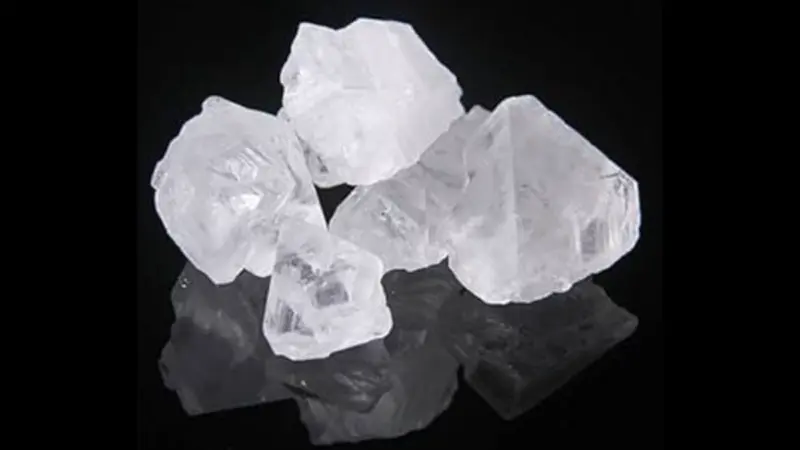

Did you know that alum is commonly known as 'fitkari'? Alum is a class of hydrated double sulphate salts. Alum is referred to as a double salt because it contains two different cations (like K+ and Al³+) that crystallise together.
We will learn more further in the article.
Let us look at how widely alum finds use in everyday life. Alum is known for its astringent, antiseptic, and antibacterial properties. It is widely used across cosmetics, skincare, haircare, hygiene, water treatment, and even the textile industry.
Alum has been known since ancient times. It was crucial for ancient dyeing, medicine, and water purification. Romans and Egyptians used it widely for water treatment to reduce cloudiness in the water. In India, alum is mentioned in Ayurvedic texts, namely Charak Samhita, Sushruta Samhita, and Ashtana Hridaya, with names such as sphaṭika kṣāra, phitkari or saurashtri.
Alum is an inorganic chemical compound that is generally made up of water molecules, aluminium, or other metals and sulphates. Alum can occur as minerals such as alunite and leucite. These alum crystals are available in the market.
Alum is industrially produced by combining aluminium sulphate and the sulphate monovalent cation like potassium sulphate in water followed by evaporation to allow the alum to crystallise out as a white solid. The process used to produce alum industrially involves precipitation from an aqueous solution.
There are different types of alum: potassium alum, sodium alum, ammonium alum, and chrome alum. We will learn in detail about the most commonly used potash alum in this article. Let us learn the chemical name (IUPAC) and formula for alum.
What is the chemical name and formula for alum (fitkari)?
The chemical name for the most common form of alum is potassium aluminium sulphate.
The chemical formula for alum, or potassium aluminium sulphate, is KAl(SO4) 2·12H2O
This contains potassium sulphate (K2SO4) and aluminium sulphate (AI2(SO4)3).
That is why alum is referred to as a double salt because it contains two different cations potassium and aluminium (like K+ and Al³+) that crystallise together.
Source: Britannica
Properties of Alum
Alum (potassium aluminium sulphate) is a chemical compound usually referred to as double sulphate of potassium and aluminium. It is commonly found as a dodecahydrate. It is the most important member of the class of compounds called alums, simply called alum.
Let us look at the physcial and chemical properties of alum below.
Physical properties of alum
Appearance: Coloursless or white, glassy
Odour: Odourless
Taste: Metallic
Density: 1.725 g/cm³
Melting point: 92 to 95 degrees Celsius
Boiling point: Decomposes at 200 degrees Celsius
Chemical properties of alum
Composition: Potassium Alum (most common)
Crystallisation: Crystallises in regular octahedra from neutral solutions, but can form cubic crystals in alkaline conditions
Solubility: Highly soluble in water, especially hot water
Acidity: Reacts as an acid (turns blue litmus red)
Antiseptic: Yes
Source: Wikipedia
Uses of alum
Alum (potassium aluminium sulphate) is widely used for water purification, astringent, deodrant, oral hygiene, preservative, and many other purposes. Have a look at the major uses of alum below:
- Aftershave cuts or minor bleeding
- Deodorant
- Oral hygeine
- Skincare
- Water purification
- Textile dyeing
- Leather tanning
- Metallurgy