
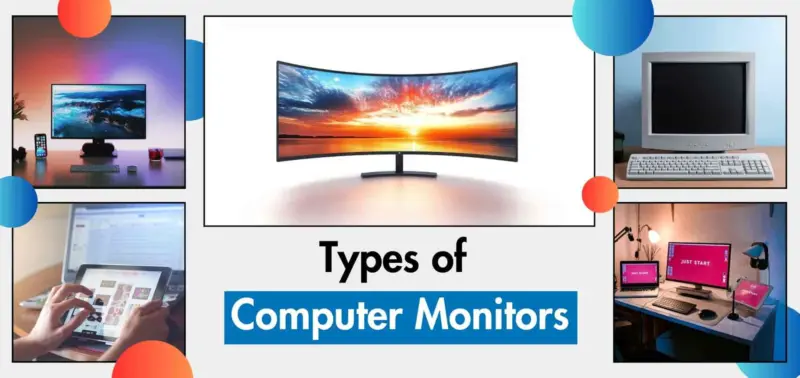

4 Common Types of Computer Monitors: A Comprehensive Guide to Display Technology: By Ishita Gupta
Modern display technology offers a diverse range of hardware tailored for specific digital tasks.
Choosing the correct types of computer monitors significantly impacts visual clarity, colour accuracy, and overall eye comfort.
While traditional cathode ray tube models are now obsolete, contemporary market options include liquid crystal displays, light-emitting diode screens, and organic LED panels.Each category features distinct specifications regarding refresh rates and resolution.
High-end gaming variants focus on motion smoothness, whereas professional IPS panels prioritise precise colour reproduction for graphic design.
Understanding these technical variations ensures that the selected hardware meets the requirements of the intended workspace or entertainment setup.
Primary Display Technologies
Selecting the most suitable hardware requires a basic understanding of modern display characteristics.
The following sections detail the evolution and technical benefits of various screen technologies.LED (Light Emitting Diode)These computer monitor types utilise light-emitting diodes to backlight a liquid crystal panel.
This method provides high brightness levels and better energy efficiency than older backlight styles.
Most modern offices and home setups rely on this technology for everyday tasks.OLED (Organic LED)Unlike standard backlit screens, these types of computer screens use organic compounds that light up individually.
Because each pixel can turn off completely, the display achieves perfect black levels and infinite contrast.
This technology is frequently found in high-end creative displays and premium media monitors.LCD (Liquid Crystal Display)Traditional liquid crystal units serve as the foundation for many flat-panel displays.
These screens use a layer of liquid crystals pressed between two sheets of polarising material to manage light.
While once using older bulb-based backlighting, the architecture remains a standard for affordable and reliable viewing.CRT (Cathode Ray Tube)As one of the earliest electronic display methods, these bulky units used a vacuum tube and electron guns to manufacture images.
Though largely replaced by thinner alternatives, they remain relevant in niche circles for their lack of input lag and native handling of various resolutions.
Common LCD Panel Types
Choosing a specific liquid crystal configuration determines how a screen manages light and colour.
The following details compare common types of monitor and their respective performance.Panel TypeKey StrengthBest forIPS (In-Plane Switching)Superior colour accuracy and wide viewing anglesGraphic design and professional creative workVA (Vertical Alignment)High contrast ratios and deep black levelsImmersive gaming and cinematic media viewingTN (Twisted Nematic)Rapid response times and high refresh ratesCompetitive gaming and entry-level office useAlso Read: Types of Computer Mouse: Simple Differences That Matter More Than Specs
Click to read more
www.justdial.com