

A Clear Guide to 4 Stages of Ovarian Cancer and What They Mean: By Aditya Migom Doley
A diagnosis like ovarian cancer rarely arrives with clarity.
It comes with scans, reports, and one word that shapes everything next: stage.
Understanding the stages of ovarian cancer helps make sense of what doctors are seeing and what comes next.
It's not just medical language.
It's a way to map how far the disease has moved and how treatment decisions are made.
Stages of Ovarian Cancer
Doctors classify ovarian cancer stages using a system that tracks how far the cancer has spread from the ovaries.
This framework, often based on the FIGO staging system, divides the disease into four main stages.
Each stage reflects tumour location, spread to nearby tissues, and involvement of distant organs.The stages of ovarian cancer are not just labels.
They guide treatment plans, from surgery to chemotherapy, and help estimate outcomes like the survival rate for ovarian cancer.
Early stages tend to be more contained, while later stages involve a wider spread across the abdomen or beyond.Understanding ovarian cancer early can make a noticeable difference in how the condition is treated and managed.
Stage I (Early Stage)
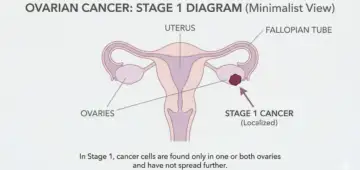
At Stage I, the cancer is limited to one or both ovaries.
It hasn't travelled beyond them, which is why it's often considered the most treatable phase within the stages of ovarian cancer.What Defines Stage ICancer is confined to the ovaries or the fallopian tubesNo spread to lymph nodes or distant organsSubtypes include IA, IB, and IC based on tumour specificsRecognising Early SignsSymptoms at this stage can be vague, which makes early detection tricky.
Common stage 1 ovarian cancer symptoms include mild bloating, pelvic discomfort, or feeling full quickly.
These signs often overlap with everyday digestive issues, so they're easy to ignore.Early symptoms can sometimes be confused with common conditions like an ovarian cyst, which is why proper evaluation becomes important.Treatment ApproachSurgery is usually the first step.
Doctors may remove one or both ovaries, depending on the case.
Chemotherapy may follow, especially in more complex cases within Stage I.PrognosisThis is where outcomes are strongest.
The survival rate for ovarian cancer is significantly higher when detected early, especially in Stage I cases.
Click to read more
www.justdial.com