




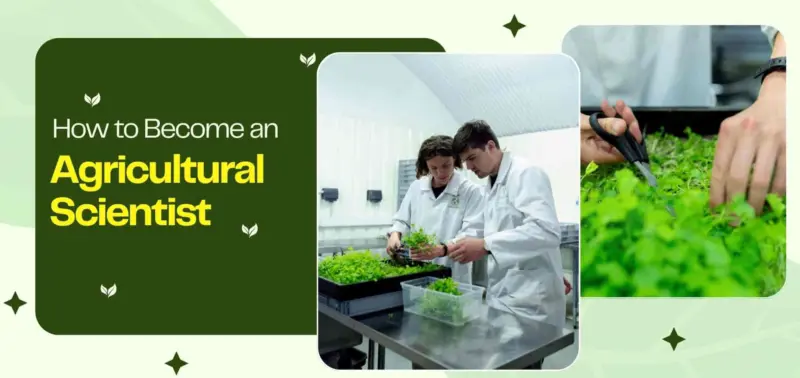

How to Become an Agricultural Scientist: Step-by-Step Career Guide: By Ritika Tyagi
Agriculture today is driven by innovation, sustainability, biotechnology, and scientific research rather than traditional farming practices alone.
As global concerns around food security, climate change, and crop productivity continue to rise, the demand for skilled professionals such as an Agricultural Scientist has increased significantly.
But what do agricultural scientist actually?Well, agricultural scientists help improve farming systems, develop disease-resistant crops, study soil health, and create sustainable agricultural solutions.
This career combines science, technology, and environmental awareness to solve real agricultural challenges.
So, for students interested in research, farming innovation, and sustainable development, becoming an Agri scientist can offer a rewarding and future-focused professional career with strong growth opportunities.
Best Courses to Become an Agricultural Scientist
To begin a career as an Agricultural Scientist, students must first choose the right educational path and build a strong foundation in agricultural sciences.Here are the related courses: BSc AgricultureBSc Agriculture is the most popular course for aspiring agricultural scientists.
This four-year programme covers both theoretical and practical agricultural sciences.Key SubjectsAgronomySoil sciencePlant breedingAgricultural biotechnologyCrop productionEntomologyEligibilityClass 12 with Physics, Chemistry, and Biology or MathematicsQualification in relevant agriculture entrance examsAgricultural EngineeringStudents interested in farm technology and mechanisation can pursue Agricultural Engineering, which focuses on irrigation systems, farm machinery, precision farming, and food processing technologies.MSc AgricultureAfter graduation, students can pursue MSc Agriculture to specialise in areas such as agronomy, horticulture, soil science, biotechnology, and agricultural microbiology.EligibilityBachelor's degree in agriculture or related fieldEntrance exam qualification where applicableAn MSc degree improves opportunities in research, teaching, and agritech industries.PhD in Agricultural ScienceStudents interested in advanced research and university-level teaching can pursue a PhD in Agricultural Science.Agriculture Entrance ExamsAdmissions to many reputed institutions are conducted through CUET UG, CUET PG, and other university-level agriculture entrance exams.
Students should prepare well in Biology, Chemistry, Physics, and agriculture-related subjects.

Top-Recommended Colleges
Choosing the right institution is important for practical exposure, research opportunities, and career development.
So, before you make a decision, here are the leading agricultural universities in India:Indian Agricultural Research Institute (IARI), DelhiPunjab Agricultural University, LudhianaTamil Nadu Agricultural University, CoimbatoreUniversity of Agricultural Sciences, BangaloreGovind Ballabh Pant University of Agriculture and TechnologyAcharya N G Ranga Agricultural UniversityBanaras Hindu University - Institute of Agricultural SciencesFactors to Consider While Choosing a CollegeStudents should evaluate:Research facilitiesLaboratory infrastructureIndustry exposureInternship opportunitiesPlacement supportExperienced facultyField training programmesThus, a strong research-oriented institution can significantly improve career opportunities in agricultural science.

Click to read more
www.justdial.com