




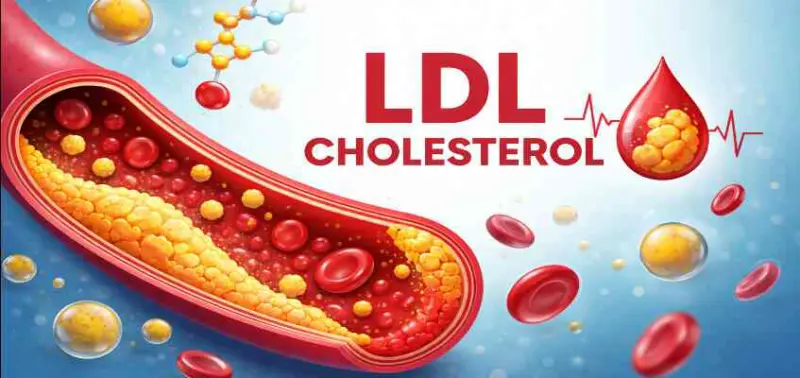

What Is LDL Cholesterol: Understanding Your Blood Test Results Clearly: By Shreya Doris Chattree
It is common for many people to get curious about what is LDL cholesterol, after they check their lipid profile report.
LDL is commonly labelled bad cholesterol, but the science behind it is more specific than that phrase suggests.
It is a type of particle that transports fat through the bloodstream.
Understanding what is LDL cholesterol in blood test reports can help you interpret cardiovascular risk accurately and make informed lifestyle or medical decisions.
What is LDL Cholesterol?
When asking what is LDL cholesterol, it helps to first understand cholesterol itself.
Cholesterol is a waxy, fat-like molecule produced mainly by the liver and partly obtained from food.
It plays a crucial role in the body, as it is needed to produce steroid hormones such as cortisol, testosterone and oestrogen to synthesise vitamin D in the skin when exposed to sunlight, and to maintain the structure and flexibility of cell membranes.
Without cholesterol, normal cellular function would not be possible.Because cholesterol is a lipid, it does not dissolve in water-based fluids such as blood.
To travel through the bloodstream, it must bind to specialised protein carriers called lipoproteins.
These particles form what we measure as blood cholesterol in routine lipid profiles.
LDL stands for low density lipoprotein, which transports cholesterol from the liver to tissues where it is required for repair, growth and hormone production.Problems arise when there is more LDL circulating than the body needs.
According to the British Heart Foundation, excess LDL can penetrate the inner lining of arteries.
There, it may undergo oxidation, which is a chemical reaction that triggers inflammation.
Immune cells attempt to remove the oxidised LDL, leading to the formation of fatty streaks and eventually plaque.
This gradual buildup is known as atherosclerosis.As plaques enlarge, they narrow the arterial lumen, which is the inner opening of the blood vessel, reducing blood flow.
If a plaque ruptures, it can form a clot that blocks circulation entirely, causing a heart attack or stroke.
This risk is why LDL is commonly labelled bad cholesterol.
LDL vs HDL
When you understand what is LDL cholesterol, it helps to compare with HDL, which stands for high-density lipoprotein.
LDL carries cholesterol to tissues, while HDL transports excess cholesterol back to the liver for removal.
The National Health Service explains that higher HDL levels are protective, whereas elevated LDL increases cardiovascular risk.LDL vs HDLFeatureLDLHDLFull FormLow density lipoproteinHigh density lipoproteinCommon NameBad cholesterolGood cholesterolMain FunctionDelivers cholesterol to cellsRemoves excess cholesterolEffect on ArteriesCan form plaque buildupHelps prevent plaqueRisk ImpactRaises heart disease riskLowers heart disease riskMonitoring both through routine cholesterol tests gives a clearer picture of heart health.
Click to read more
www.justdial.com