
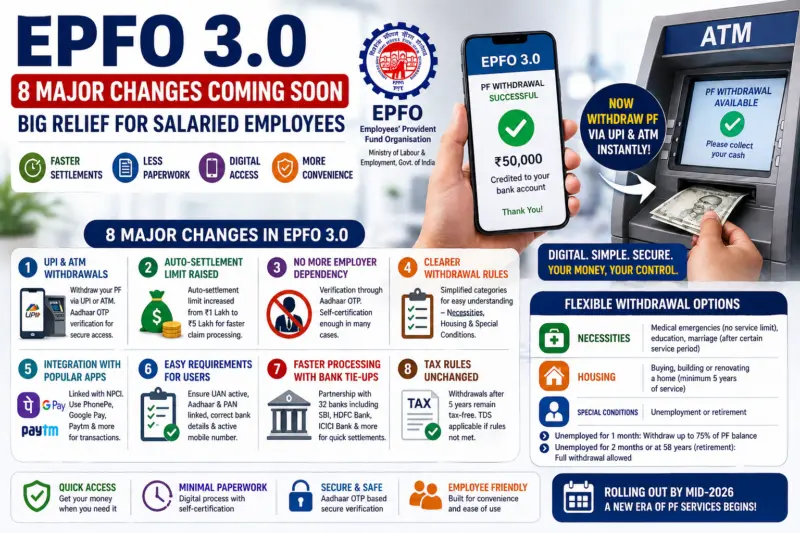

A major overhaul is on the horizon for salaried employees as the Employees' Provident Fund Organisation prepares to introduce its upgraded system, widely known as EPFO 3.0. Expected to roll out by mid-2026, this new framework aims to simplify provident fund access by making the entire process quicker, paperless, and user-friendly.
These upcoming reforms are designed to eliminate delays, reduce dependency on employers, and bring PF services in line with modern digital banking systems.
UPI and ATM-Based Withdrawals to Simplify Access
One of the most transformative features of the new system is the introduction of UPI and ATM-based withdrawals. Employees will soon be able to access their PF savings just like withdrawing money from a bank account.
Instead of submitting physical forms or visiting offices, funds can be transferred directly to your bank account using Aadhaar-based OTP authentication. This change is expected to make withdrawals significantly faster and more convenient.
Auto-Settlement Limit Increased to ₹5 Lakh
To speed up claim processing, the auto-settlement limit has been raised from ₹1 lakh to ₹5 lakh. This means most withdrawal requests will be processed automatically without manual intervention.
As a result, employees can expect their claims to be settled within hours or by the next working day, providing quick financial relief during urgent situations.
Reduced Role of Employers in Verification
Earlier, employer approval was often a major cause of delay in PF withdrawals. Under EPFO 3.0, this dependency is being significantly reduced.
Verification will now largely happen through Aadhaar-based OTP, and in many cases, self-certification will be sufficient. This ensures that employees have direct control over their savings without unnecessary delays.
Simplified Withdrawal Categories
To make the system easier to understand, withdrawal rules have been reorganised into clear categories:
- Essential needs: Medical emergencies (no minimum service requirement), education, and marriage
- Housing: Buying, constructing, or renovating a home (generally requires at least 5 years of service)
- Special situations: Unemployment and retirement
This structured approach helps users quickly determine eligibility and the applicable rules.
Flexible Withdrawal Rules for Emergencies
The updated system also introduces more flexibility:
- Up to 75% withdrawal allowed after one month of unemployment
- Full withdrawal permitted after two months of unemployment or at retirement (58 years)
These changes are aimed at providing timely financial support during difficult periods.
Integration with Digital Payment Platforms
EPFO 3.0 is being integrated with the National Payments Corporation of India (NPCI), enabling seamless transactions through popular apps.
Platforms like PhonePe, Google Pay, and Paytm are expected to support PF withdrawals, making the process as simple as everyday digital payments.
Key Requirements to Use the New System
To benefit from these features, employees must ensure:
- Active UAN (Universal Account Number)
- Aadhaar and PAN linked with the account
- Correct bank account details
- Active mobile number for OTP verification
Meeting these requirements ensures smooth and hassle-free transactions.
Faster Processing Through Bank Partnerships
EPFO has partnered with several major banks, including State Bank of India, HDFC Bank, and ICICI Bank.
These collaborations will improve verification processes and significantly reduce delays in fund transfers.
No Changes in Taxation Rules
While the system is becoming more efficient, tax rules remain unchanged:
- Withdrawals after 5 years of continuous service are tax-free
- Withdrawals above ₹50,000 before 5 years may attract TDS
- Higher TDS may apply if PAN is not linked
Keeping your documents updated is essential to avoid unnecessary deductions.
Final Takeaway
EPFO 3.0 marks a major step toward modernising provident fund services in India. With digital withdrawals, faster settlements, and reduced paperwork, the new system promises greater convenience and transparency.
For millions of salaried employees, this upgrade means quicker access to their own savings—without the delays and complications of the past.
Disclaimer: This article is for informational purposes only. Features, rules, and timelines related to EPFO 3.0 may change as per official updates. Readers are advised to verify details with official EPFO sources before making decisions.