
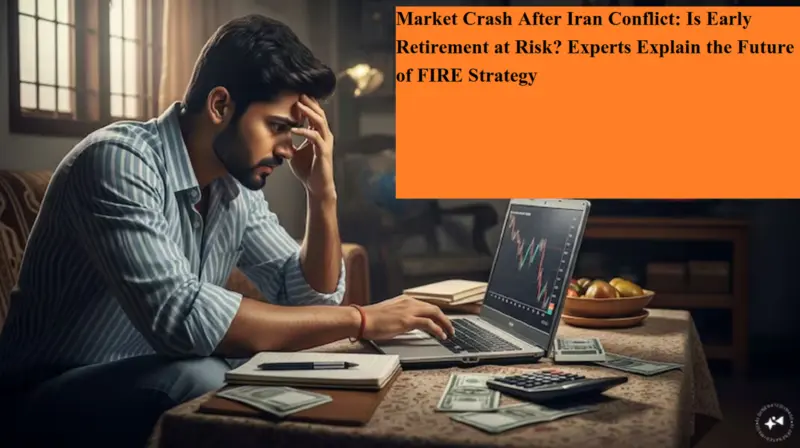

The recent market downturn triggered by escalating tensions in the Middle East has raised serious concerns among investors. The impact of the Iran-Israel conflict is now being felt across global and Indian financial markets, leading to volatility, declining returns, and rising uncertainty.
This sudden shift has sparked a crucial question—will dreams of early retirement now be delayed or even derailed? For many salaried individuals following the popular FIRE strategy (Financial Independence, Retire Early), the current situation has forced a rethink.
What Is the FIRE Strategy?
The FIRE strategy is a financial planning approach where individuals aim to accumulate enough wealth at an early age to retire well before the traditional retirement timeline.
This strategy typically involves:
- High savings rates
- Controlled spending
- Aggressive investments in equities and high-growth assets
The idea is to build a large enough corpus that generates passive income, allowing financial independence without relying on a regular salary.
Market Volatility Is Challenging Early Retirement Goals
With markets under pressure due to geopolitical tensions, returns across several sectors have weakened. In some cases, investors are even facing negative returns.
This directly impacts long-term wealth creation—an essential pillar of the FIRE strategy. When returns slow down, the time required to achieve financial independence increases, making early retirement harder to achieve.
Additionally, rising inflation and economic uncertainty are further complicating the situation. Higher living costs mean individuals now need a larger retirement corpus than previously estimated.
Experts Say FIRE Is Evolving, Not Ending
Despite the current challenges, experts believe the FIRE strategy is not disappearing—it is simply evolving.
Investors are no longer chasing high returns blindly. Instead, the focus is shifting toward:
- Financial stability
- Consistent cash flow
- Better liquidity
This marks a transition from aggressive investing to a more balanced and sustainable financial approach.
Shift Away From High-Risk Investments
According to industry experts, current market conditions have encouraged investors to reconsider their risk appetite. Instead of heavily investing in volatile assets, many are now opting for diversified portfolios that include safer instruments.
The emphasis is gradually moving from 'timing the market' to 'time in the market,' along with building a resilient financial system that can withstand economic shocks.
Cash Flow Management Becomes a Key Challenge
For salaried individuals, managing monthly cash flow has become increasingly difficult. Factors such as:
- Rising inflation
- Higher EMIs
- Changing tax structures
are reducing the amount of disposable income available for investments.
This has a direct impact on FIRE goals, as lower savings mean slower wealth accumulation.
Experts suggest that individuals should now focus more on:
- Building emergency funds
- Maintaining liquidity
- Managing expenses efficiently
Role of Short-Term Credit Tools
With unpredictable expenses becoming more common, short-term credit options—such as UPI-based credit—are gaining popularity. These tools help individuals meet urgent financial needs without breaking long-term investments like mutual funds or fixed deposits.
Such options act as a temporary financial cushion, helping maintain overall financial stability.
A More Practical Approach to Early Retirement
The current market environment is pushing investors to adopt a more realistic and flexible approach to early retirement planning.
Instead of aggressive targets, people are now:
- Extending their retirement timelines
- Creating multiple income streams
- Focusing on financial security over speed
This shift ensures that financial independence remains achievable, even if it takes longer.
The market decline linked to the Iran-Israel conflict has undoubtedly disrupted investor sentiment. However, it has also encouraged a healthier, more balanced approach to financial planning.
While early retirement dreams may face delays, they are far from impossible. By adapting strategies, diversifying investments, and focusing on long-term stability, investors can still work toward achieving financial independence in a changing economic landscape.
Disclaimer: Investment decisions should always be made after consulting a certified financial advisor. Market conditions are subject to change and involve risks.