
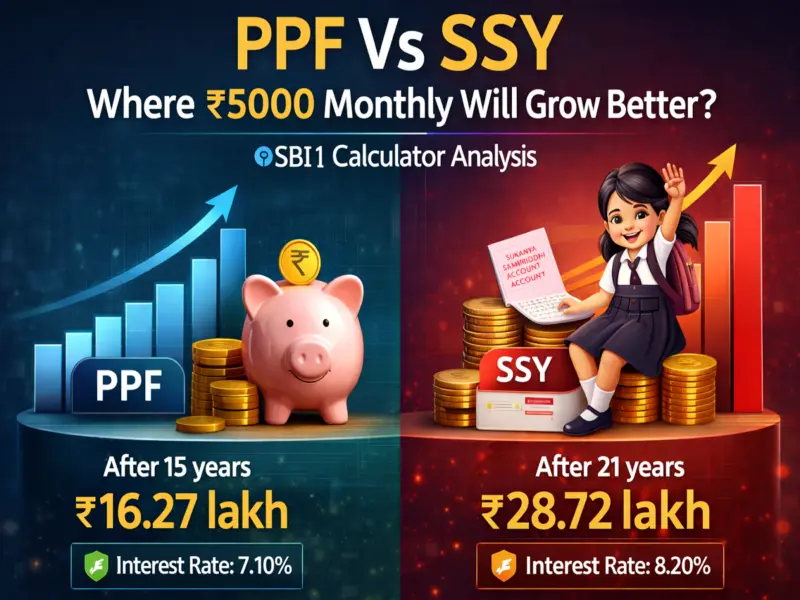

PPF vs SSY Investment 2026: If you are planning long-term savings, two government-backed schemes—Public Provident Fund (PPF) and Sukanya Samriddhi Yojana (SSY)—are among the most popular choices.
But if you invest ₹5,000 every month, which scheme will help you build a bigger fund? Let's break it down using real calculations.
Interest Rates Remain Unchanged for Q1 FY 2026-27
The government has kept interest rates unchanged for small savings schemes for the April-June 2026 quarter. This means:
- PPF Interest Rate: 7.10% per annum
- SSY Interest Rate: 8.20% per annum
These rates continue from the previous quarter, as confirmed by the Finance Ministry.
Investment Scenario: ₹5,000 Per Month
If you invest ₹5,000 every month:
- Annual investment = ₹60,000
- Total investment in 15 years = ₹9,00,000
Now let's compare how much wealth each scheme can generate.
PPF Calculation: Steady Growth Over 15 Years
Under the Public Provident Fund:
- Investment Duration: 15 years
- Total Investment: ₹9,00,000
- Interest Rate: 7.10%
- Maturity Amount: ₹16,27,284
- Interest Earned: ₹7,27,284
PPF offers stable and tax-free returns, making it a preferred choice for conservative investors. Additionally, after 15 years, the account can be extended in blocks of 5 years for continued growth.
SSY Calculation: Higher Returns Over Longer Period
Under the Sukanya Samriddhi Yojana:
- Investment Duration: 15 years
- Maturity Period: 21 years
- Total Investment: ₹9,00,000
- Interest Rate: 8.20%
- Maturity Amount: ₹28,72,848
- Interest Earned: ₹19,72,848
In SSY, even after you stop investing after 15 years, the money continues to earn interest for another 6 years, significantly boosting the final corpus.
Key Difference Between PPF and SSY
| Feature | PPF | SSY |
|---|---|---|
| Interest Rate | 7.10% | 8.20% |
| Maturity Period | 15 years | 21 years |
| Investment Duration | 15 years | 15 years |
| Returns | Moderate | Higher |
| Tax Benefit | Yes | Yes |
| Eligibility | Anyone | Only for girl child |
Which Scheme Builds a Bigger Fund?
Based on the above calculations:
- PPF: ₹16.27 lakh after 15 years
- SSY: ₹28.72 lakh after 21 years
Clearly, SSY generates a significantly larger corpus due to:
- Higher interest rate
- Longer compounding period
However, SSY is limited to parents or guardians investing for a girl child, whereas PPF is open to all individuals.
Which One Should You Choose?
Your choice depends on your financial goals:
- Choose PPF if:
- You want flexibility
- You're planning retirement savings
- You prefer a shorter lock-in
- Choose SSY if:
- You are saving for a girl child's future
- You want higher long-term returns
- You can stay invested for 21 years
Final Takeaway
Both PPF and SSY are excellent long-term investment options backed by the government. While PPF offers flexibility and stability, SSY stands out for delivering higher returns over a longer period.
If eligible, SSY can help you build a significantly larger fund with the same monthly investment, making it a powerful tool for future financial planning.