




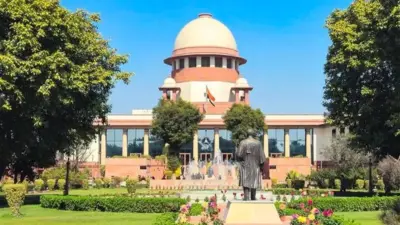

The Supreme Court's landmark judgment upholding the legality of the Election Commission's Special Intensive Revision (SIR) of voter lists marks a watershed moment in Indian electoral governance.
By dismissing a batch of petitions that challenged the SIR processes initiated across various states, a three-judge bench comprising Chief Justice Surya Kant, Justice Joymalya Bagchi, and Justice Vipul M. Pancholi has effectively cleared the dense fog of anxiety surrounding citizenship verification and electoral rolls. The ruling firmly establishes that the Election Commission (EC) possesses the explicit authority to conduct such intensive purges, successfully putting an end to prolonged legal and political disputes.
A crucial nuance of the apex court's ruling lies in the strict demarcation it draws between voter eligibility and national citizenship. The bench clarified that while the EC holds the power to verify an individual's citizenship status, this authority is strictly functional-limited entirely to determining whether a person qualifies to be on the electoral roll. If genuine discrepancies or suspicions arise, the EC is well within its rights to exclude or legally remove a name from the list. Crucially, the court underscored that being dropped from a voter list does not strip an individual of their Indian citizenship. While it results in the temporary loss of the right to participate in the electoral process, it does not alter their legal status as a citizen. Sovereign citizenship determination remains the exclusive domain of the Central Government, and the EC's role is merely administrative. The judicial endorsement of the SIR process hinges on sheer practical necessity. The Supreme Court found the EC's justifications entirely satisfactory, noting that intensive voter list revisions had been neglected in many regions for over four decades. In states like Bihar, the last comprehensive revision dates back to 2003. Over these intervening decades, profound demographic shifts-driven by rapid urbanisation, mass migrations, the death of registered voters, the coming-of-age of new voters, and the proliferation of duplicate entries-have severely compromised the accuracy of the rolls. Backed by Section 21(3) of the Representation of the People Act and Article 324 of the Constitution, the SIR is a necessary mechanism to realise the constitutional mandate of ensuring free, fair, and transparent elections. The court rightly rejected the argument that prior inclusion in a voter list grants permanent immunity against future verification, emphasising that a static list cannot serve a dynamic population. This verdict delivers a significant political setback to a broad coalition of opposition parties and civil rights groups-including the Congress, the Muslim League, the Trinamool Congress, the RJD, the Samajwadi Party, and the Association for Democratic Reforms (ADR)-who had approached the court fearing mass disenfranchisement, particularly in states like Kerala. To ensure institutional checks and balances, the Supreme Court has directed the EC to forward the data of all individuals removed during the Bihar revision to the Central Government within four weeks. By streamlining this process, the judgment successfully bridges the gap between state security concerns and democratic rights. Ultimately, the ruling serves as a vital corrective, reassuring the public that maintaining a clean, contemporary voter list is not an instrument of politically targeted exclusion, but an essential prerequisite for a robust democracy.