

Although the fundamental principles of law remain constant, their design and framework must evolve to keep pace with changing times. One of the most significant British contributions to India was the systematic organization of the administrative hierarchy and the establishment of a professional structure.
The British designed this framework primarily to ensure the efficiency of their colonial rule. At that time, even minor matters required written permission from higher authorities. As foreigners, it was essential for the British to ensure that the upper echelons of government were fully informed of every movement at the lower levels. During that era, writing was the only available means of communication; today, however, these methods have undergone a revolutionary transformation.
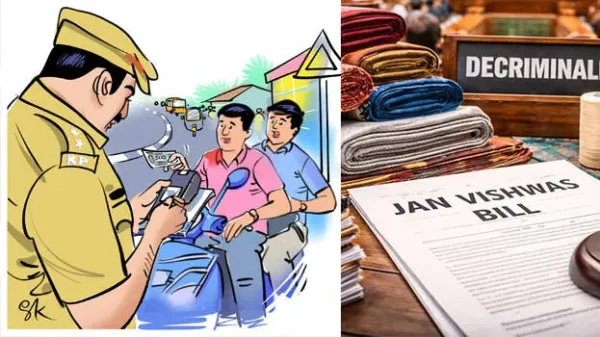
Despite these advancements, the legacy of British administrative methods persists. In fact, the term "red tape" originated from these very practices. While citizens elect representatives to modernize laws and ensure the administration remains smooth, agile, and transparent, any attempt to reform existing legislation is often met with stiff resistance. This opposition reflects a fundamental human reluctance to embrace change. Nevertheless, when reforms introduced by the government are clearly conducive to public welfare, they must be accepted. A prime example is the Jan Vishwas (Amendment) Act, which was passed by Parliament to de-clog the system by decriminalizing or relaxing 784 provisions across 79 different laws.
Under this amendment, imprisonment will no longer be imposed for minor offenses, including those governed by the Motor Vehicles Act. Historically, the number of vehicles on the road-and the resulting legal cases-was minimal. Today, the reality is starkly different: thousands of traffic violations are filed daily. Because these are still processed through the cumbersome written procedures of outdated laws, they create significant hardships for both law-abiding citizens and the judiciary. Currently, over 50 million (five crore) cases are pending in Indian courts. Union Minister Piyush Goyal clarified that this bill was introduced specifically to facilitate the speedy disposal of these matters, aiming to alleviate the burden on the courts and strip away obsolete regulations.
While the Act eases many restrictions, it maintains strict accountability: if a minor offense is repeated, the penalties will escalate. Significant practical changes have also been introduced; for instance, whereas a driving license renewal delayed by a single day was previously an offense, licenses now remain valid for a 30-day grace period after expiry. Similarly, unauthorized occupancy of a reserved train berth will no longer result in a criminal case, but rather a civil penalty of up to Rs 1,000.
Overall, criminal charges have been eliminated in 317 types of cases, replaced entirely by fines, and imprisonment has been removed as a penalty in 29 specific sections. Furthermore, for 63 types of offenses, first-time offenders will receive only a warning. In essence, the Jan Vishwas (Amendment) Act is a landmark step toward streamlining administrative procedures and drastically reducing the overwhelming backlog in the judicial system.