

Table of Contents
ToggleCricket is a very different sport in comparison to other sports played all across the globe. It is not like football or hockey where your main aim is to score a goal to win the game. It is neither like basketball where you need to score points by putting the ball in the basket. Cricket is a way more complicated game and has a lot of technicalities attached. Cricket has 3 different forms with different time periods: T20s (20 overs), ODIs (50 overs) and Test Cricket (5 Days). All the formats use different types of cricket balls. All these types of balls have different impact on how the game is played, provided the overall conditions are helpful. Let us have a look at the different types of cricket balls used all across- from gully cricket to international cricket.
List of all Types of Balls in Cricket
S.N | Level | Types | Classifications |
1 | Balls for GULLY CRICKET | Sponge Ball | |
Plastic Ball | |||
Rubber Ball | |||
Tennis Ball | |||
2 | Training Level | Synthetic Cricket Balls | |
Hockey Ball | |||
Cork Ball | |||
3 | International Level | Red Leather Balls | Kookaburra |
Dukes | |||
White Leather Ball | SG | ||
Pink Leather Ball |
Also Read | All Cricket Fielding Positions Names and Explanation
Types of cricket balls for Gully Cricket
Cricket Ball Name List: Sponge Ball (smiley)
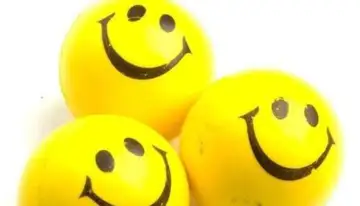 Smiley balls are the safest options for kids of age 3-5 (credits: indiamart.com)
The sponge ball or the smiley ball is the safest option to buy for parents who have children who are around 3-5 years old. It is the lightest and the softest ball to play with. Although its main purpose is not cricket, the smiley ball can be used to play underarm cricket at home as it won’t break any kind of expensive showpieces in your residence. However, it cannot be used while you play cricket outdoors as it has a tendency to swing in the air and move in any direction, which wouldn't be under your control. It should be used in the initial days of any child so that they understand how to bat without the fear of getting hurt. The smiley ball mostly ranges from ₹20-60/piece.
Cricket Ball Name List: Plastic Ball
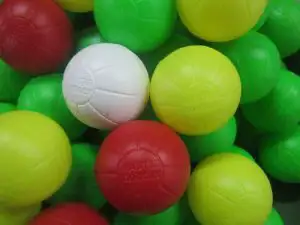 Plastic balls can be used to play indoors
It is the most basic form of cricket ball used to play gully cricket. It might not actually be a cricket ball, can be any sort of plastic in a circular shape. Children can use plastic balls at home too. The quality of the plastic depends on the makers as well as its use of it. These range from ₹6/piece to ₹120/piece depending on the quality of plastic, use and the manufacturing company.
Cricket Ball Name List: Rubber Ball
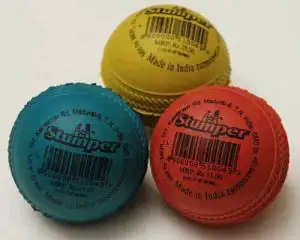 Stumper is the leading producer of quality rubber balls in India (credits: shoppercrux.com)
These types of cricket balls are neither extremely heavy nor extremely light. It is the most suitable ball to use while you want to play cricket along with your friends in your society or locality. The rubber balls in India have a sort of a seam in the middle, similar to the leather ball used in international/professional cricket. However, this seam has no role in swinging the ball.
Also Read: Triple Century in Test Cricket: Know The Players Who Touched Milestone
The rubber ball doesn't last longer than 10 days or more. 'Stumper' is one of the most popular manufacturing company of rubber balls in India. It uses high quality rubber for their balls and hence are comparatively higher in price. Any usual rubber ball in general store costs around ₹15-20/piece. Whereas the Stumper rubber ball costs around ₹50-70/piece.
Cricket Ball Name List: Tennis Ball
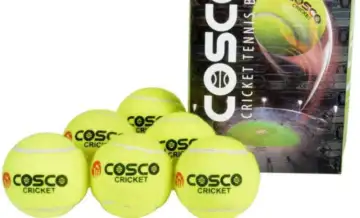 Cosco tennis balls are used in every competitive gully cricket match in Maidaans or playgrounds (credits: flipkart.com)
Whenever people gather around to play at any playground or maidaan on holidays, they use the hard Cosco ball as it is more durable. It is heavier than the usual rubber ball, however it doesn't have any seam in the middle. Cosco is the leading manufacturer of cricket tennis balls in India. Other competitors are Vixen, Nivea, Khanna etc. These balls are prominently available in two colours: Red and Light Green. The hard tennis balls mostly range from ₹60-90/piece depending on the manufacturing company.
People also use soft tennis balls while playing cricket. People use these types of cricket ball to replace rubber balls. The soft tennis ball is light and you can use it to play gully cricket in you locality. The cost of the soft tennis ball ranges from ₹25-50/piece.
Types of Cricket balls at raining level
Synthetic Cricket Balls
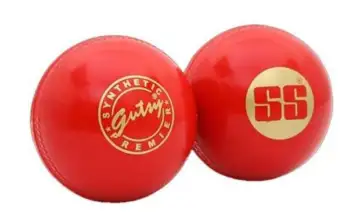 Hard synthetic ball manufactured by SS (credits: sportshopy.com)
Professional cricket training institutes use synthetic balls to train beginners. It has a proper seam made of a synthetic material. It resembles like a proper leather ball. However it is way more lighter than the actual ball used at the international level of cricket. Amateur cricketers use this to train for catching and fielding. The soft synthetic ball costs around ₹120-250 per piece, depending on the manufacturing company and product quality.
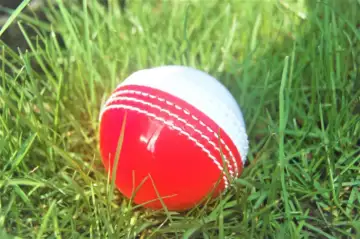 Beginners use soft synthetic balls to learn fielding and catching
Beginners use the hard synthetic ball in the nets on cement pitches. The synthetic ball comes quicker than usual after pitching. However, it is not much helpful for the bowlers as it does not seam, swing or spin much. Batsmen use these types of cricket balls to improve stroke making against the fast bowlers. These balls are perfect for training. Companies like SS Cricket manufacture 'Gutsy' synthetic balls which cost around ₹250-500 per piece.
Hockey Ball
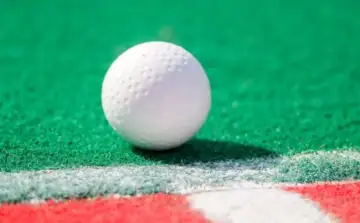 Hockey ball is used in hanging balls to improve front foot and back foot defence (credits: sportsdynamix.com)
A lot of training institutes use hockey balls in the nets. The coaches bowl underarm balls to the batsmen to improve their stroke-making. A lot of them use hanging hockey balls to increase the strokes on a newly bought bat.
Also Read | Top 10 Players With Most Test Centuries In Cricket
Cork Ball
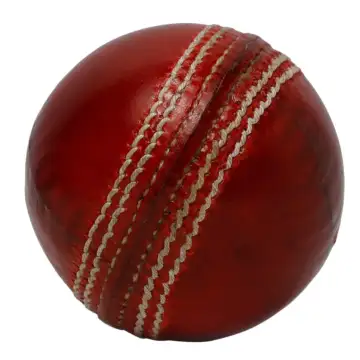 Image Source: Decathlon
A cork ball is used in training nets at every cricket coaching in our country. The cork ball looks exactly like a leather ball used in international cricket. But it is entirely made of cork, both from inside and outside. Unlike a leather ball which swings in the air, cork ball doesn't offer much to the bowlers. Players use this ball only for the purpose of training as it favours the batsmen. It is hence used at junior level at concrete and mat pitches. These do not last for more than 50 overs. Any cork ball costs about ₹350-550 per piece depending on the manufacturers.
Types of cricket balls in International level
Red Leather Balls
1. Kookaburra
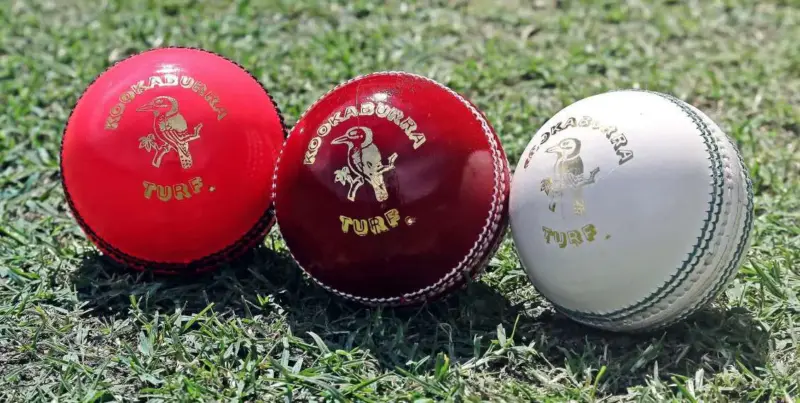
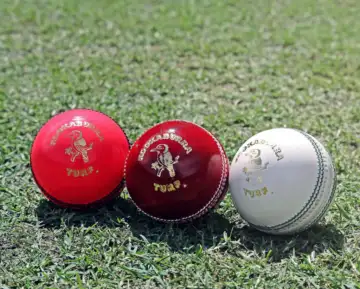 Kookaburra manufactures all 3 types of cricket balls used in international cricket (kookaburra.com)
Every limited overs international match uses the Kookaburra leather ball. Kookaburra is manufactured in Australia and the red one is used Test matches in Australia, New Zealand, Zimbabwe, Sri Lanka, South Africa and Pakistan. The Red Kookaburra weighs about 156 grams with a 4-piece construction. These balls are mostly machine-made. The Kookaburra ball has a seam effective only till 20-25 overs because after that it becomes old and doesn't swing. It doesn't offer much to the spinners as they don't get a good grip to turn the ball effectively.
2. Dukes
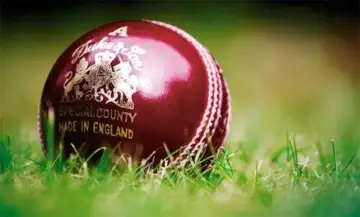 England manufactures Dukes ball (credits: dukescricket.co.uk)
England manufactures Dukes cricket ball. Test matches in England and West Indies use Dukes at home. It is the most bowler-friendly ball as it swings till 50 overs. Its seam remains intact for a very long time and hence it favours the seam bowlers even when the ball is rather old. However, this ball doesn’t benefit the spinners as it is used in seam friendly conditions. The Dukes ball ranges from £10-100 (₹850-8500).
Also Read | Complete List of ODI Double Centuries in Cricket
3. SG
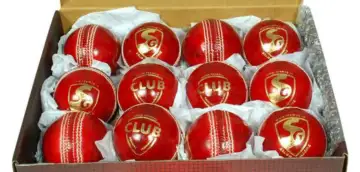 India uses SG cricket ball in all its home Test matches (credits: sportsuncle.com)
The only country that uses SG cricket ball in tests is India. This red ball doesn't retain its shine for a very long time. Hence, it doesn't favour the seamers as the ball swings only for the first 10 overs. However, the seam of the ball is intact and doesn't deteriorate.
Therefore, it is more spinner-friendly as spinners get a good grip to turn the ball effectively. Also, India uses turning wickets which has helped players like Ravichandran Ashwin to be so successful with the red SG ball. But it even is helpful for the fast bowlers in the later half as it helps them to reverse swing effectively. This ball costs around ₹650-2000 in India.
White Leather Ball
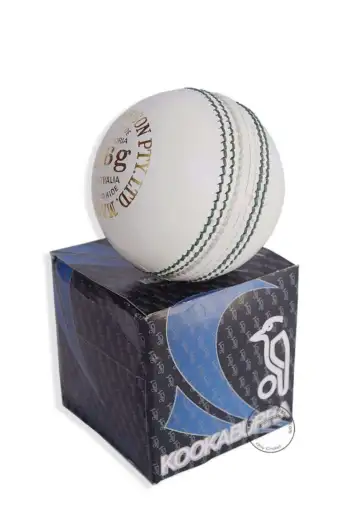 Credits Kookaburra
Kerry Packer, the guy behind the idea of the revolutionary World Series Cricket, introduced white ball for the first time in 1977. World Series Cricket was the first-ever cricket league and it also introduced colored jerseys for the first time in cricket.
This was also the first time that a cricket match was played under floodlights. Hence, the red ball wouldn’t have been effective as it would camouflage with the colored jerseys and also wouldn’t be visible in the dark sky.
1992 was the first time that white ball was used in a World Cup in Australia and New Zealand. The white Kookaburra ball swings a lot in the first 20 overs. But in the later half, its seam and shine deteriorates and hence it isn’t effective for the seamers.
Pink Leather Ball
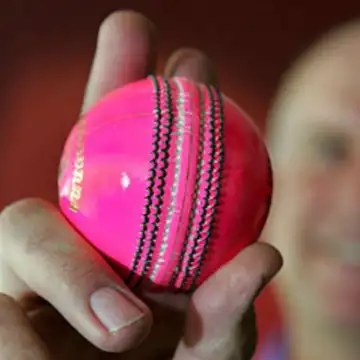 Credits Kookaburra
Kookaburra also manufactured the first pink ball used in the first-ever Day-Night Test match when Australia clashed with New Zealand at Adelaide in 2015. The neon pink ball was manufactured as the normal red ball wasn't visible in the night sky under floodlights. Also, the white ball would have camouflaged with the white Test jerseys. Hence, pink was picked as it was clearly visible in the dark blue sky at night, under the floodlights. The Kookaburra ball is almost 7 times expensive than the SG ball used in Test matches in India. The original ball used in T20s and ODIs costs around ₹10,000-12,000 in India.
FAQs
1. Q: What are the different types of cricket balls used in gully cricket?
A: The cricket ball name list for gully cricket includes Sponge Ball, Plastic Ball, Rubber Ball, and Tennis Ball. These types of cricket balls are used for casual games and are softer and lighter than professional cricket balls.
2. Q: What types of cricket balls are used for training purposes?
A: Synthetic Cricket Balls, Hockey Ball, and Cork Ball are used for training purposes. These types of cricket balls are designed to help players improve their skills and techniques.
3. Q: What are the different types of leather cricket balls used in international cricket?
A: The cricket ball name list for international cricket includes Red Leather Balls, specifically Kookaburra, Dukes, and SG. These types of cricket balls are used in Test matches and limited-overs internationals.
4. Q: What is the difference between white and pink leather cricket balls?
A: White leather cricket balls are used in limited-overs internationals, while pink leather cricket balls are used in Day-Night Test matches. The pink ball was introduced to make the ball more visible under floodlights.
5. Q: What factors determine the choice of cricket ball used in a match?
A: The choice of cricket ball depends on the level of play, the surface, and the lighting conditions. Different types of cricket balls are designed to suit specific conditions and requirements.
Also read | Top 10 Best Wicket Keeping Gloves