




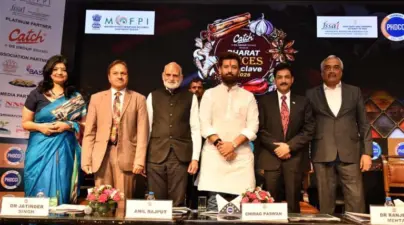

21 April 2026, New Delhi: The PHD Chamber of Commerce and Industry (PHDCCI), in association with Catch, organised the Bharat Spices Conclave 2026 - Roadmap for Doubling India's Spice Economy at PHD House, New Delhi.
Addressing the gathering as Chief Guest, Chirag Paswan, Union Minister for Food Processing Industries, Government of India, said spices have historically played a significant role in India's trade legacy and continue to hold untapped potential beyond traditional culinary use. He said India must now move from a volume-driven model to a value-driven ecosystem through food processing, innovation and stronger global market integration.
He said the Government is committed to improving ease of doing business through reforms and policy support, and invited industry stakeholders to share recommendations for the sector's growth. Highlighting key initiatives, he said 100% foreign direct investment in food processing and schemes such as PMFME are aimed at strengthening the value chain and promoting entrepreneurship.
The minister also stressed the need for stronger quality standards, stating that consistent quality is essential for building trust in international markets and reducing export rejections. He pointed to emerging opportunities in nutraceuticals, wellness products and value-added spice segments, and called for greater investment in research, innovation and technology. He added that the spice sector would play an important role in achieving the vision of Viksit Bharat 2047 and positioning India as a global food basket.
Anil Rajput, Chair, Food Processing Committee, PHDCCI, said India produces more than 60 of the world's 109 recognised spices and exports to over 200 countries. He said spices should be repositioned as high-value products and strategic assets capable of driving farmer incomes, MSME growth and Brand India globally.
He identified key priorities for the sector, including stronger farmer integration into value chains, promotion of innovation and research and development, sustainability through residue-free and organic production, and deeper public-private collaboration. He added that rising global demand for health, wellness and natural products presents a major opportunity for Indian spices, particularly in nutraceutical and functional food segments.
J D Desai, Co-Chair, Food Processing Committee, PHDCCI, said the Bharat Spices Conclave is contributing to the mission of connecting India's heritage with an innovative and future-oriented food processing industry. He said a focus on innovation, sustainability and capacity building for farming communities and MSMEs would help ensure Indian spices become globally associated with excellence. He added that the conclave is helping strengthen the spice sector as a pillar of India's global economic identity.
Dr. Ranjeet Mehta, CEO and Secretary General, PHDCCI, said India has strong fundamentals in scale, heritage and production, but the next phase of growth must focus on building global brands, improving quality systems and creating a stronger international narrative for Indian spices. He said the conclave aims to align industry, government and stakeholders around a shared vision of making India a global leader in the spice economy.
The session was moderated by Dr. Jatinder Singh, Deputy Secretary General, PHDCCI, who said such platforms are important for fostering meaningful dialogue between government and industry. He said the discussions would help guide future engagement and contribute to shaping a progressive roadmap for India's spice sector.
Global Agriculture is an independent international media platform covering agri-business, policy, technology, and sustainability. For editorial collaborations, thought leadership, and strategic communications, write to [email protected]
21 April 2026, Lisbon: The New Holland Academy by IEFP has officially started in Évora, with a first intake of 14
The International Crops Research Institute for the Semi-Arid Tropics (ICRISAT), in partnership with the International Food Policy Research Institute (IFPRI), launched
10 April 2026, Belgium: The Gates Foundation has awarded a $7 million grant to Rainbow Crops to support the development of crop varieties that can