
23 April 2026, Mumbai: The Good Rice Alliance (TGRA) has announced a long-term offtake agreement with Amazon for carbon credits linked to high-integrity methane emission reductions from rice cultivation across India.
The partnership marks a major step in scaling climate-smart rice farming while improving livelihoods for thousands of smallholder farmers. TGRA is an entity owned by three global companies: Bayer, GenZero, and Shell.
Conventional rice cultivation, which relies on continuously flooded paddy fields, is responsible for an estimated 8-10% of global methane emissions. This makes rice farming the second-largest source of agricultural methane emissions worldwide after livestock. India, which has the world's largest rice cultivation area and supports more than 100 million livelihoods through rice farming, is also the world's third-largest methane emitter.
Under the agreement, Amazon will serve as the primary buyer for the project's initial crediting phase, with a commitment covering more than 685,000 metric tons of CO2 equivalent carbon credits. The deal highlights growing corporate demand for measurable, science-backed climate solutions with real-world agricultural impact.
TGRA's program works with smallholder rice farmers to reduce methane emissions through improved water-management practices such as Alternate Wetting and Drying (AWD) and Direct Seeded Rice (DSR). These methods reduce the prolonged flooding that drives methane generation in rice fields. Since methane has a global warming potential more than 27 times greater than carbon dioxide over the long term, rapid methane reductions are considered critical for slowing climate change during this decade.
The alliance currently operates across multiple Indian states and works directly with more than 13,000 smallholder farmers across 35,000 hectares of farmland. Farmers participating in the initiative receive agronomic training, on-ground field support, and financial incentives to encourage long-term adoption of sustainable practices. The program is designed not only to cut emissions, but also to improve yields, lower input costs, and strengthen resilience to climate stress.
Suhas Joshi, Director on Board of TGRA and Carbon Initiative Lead at Bayer South Asia, said the agreement reflects rising demand for rigorously measured methane mitigation credits. He emphasized that the program's core focus is to deliver real and verifiable climate outcomes while ensuring that smallholder farmers remain central to the value created.
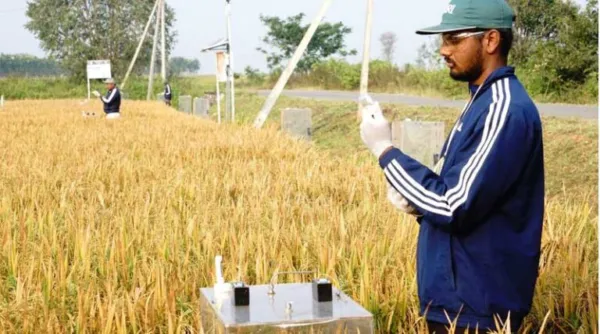
A key feature of the program is its science-led measurement, reporting, and verification (MRV) framework. Emission reductions are quantified through direct, field-based methane measurements carried out in collaboration with the International Rice Research Institute (IRRI). These measurements are supported by digital monitoring tools and third-party verification under Verra's Verified Carbon Standard (VCS) using the VM0051 methodology for improved rice management.
TGRA is also preparing for future use of a biogeochemical model for emissions quantification, subject to calibration and validation. This is expected to further enhance the scientific rigor and scalability of the initiative over time.
Michelle Jolly, Director of Sustainability Solutions and Services at Amazon, said methane is a super pollutant requiring immediate action, and agriculture presents one of the most important opportunities for emissions reduction. She noted that the agreement demonstrates Amazon's commitment to high-quality carbon credits backed by auditable field measurements, documented practice change, remote sensing validation, and biogeochemical modeling. According to her, the program offers measurable emissions reductions at scale while helping farmers build more water-efficient operations.
The initiative's implementation relies heavily on direct field engagement. TGRA supports all participating farmers through multiple in-person visits by field officers during each growing season. These visits include hands-on technical guidance and geo-tagged, time-stamped photographic documentation of improved farming practices. Field data is then cross-validated with independent satellite-based soil moisture and water-management records, creating a strong audit trail for every carbon credit generated.
Beyond methane reduction, TGRA's improved irrigation practices can reduce irrigation water use by up to 30%. Unlike many climate projects that estimate water savings through proxy indicators or models, TGRA says it follows a measurement-first approach that allows defensible water stewardship outcomes alongside verified methane reductions.
Joshi added that methane reduction in rice cultivation represents one of the fastest opportunities to slow near-term global warming, and partnerships with companies such as Amazon can help scale proven, science-based solutions that generate both climate and farmer benefits.
TGRA, a company owned by Bayer, builds on a multi-year feasibility study and pilot program developed by Bayer, GenZero, and Shell Nature-Based Solutions, which laid the technical, scientific, and operational foundation for large-scale rice methane mitigation. Continued participation of GenZero and Shell in the long-term program remains subject to regulatory approvals.
The initiative has also received an ex-ante A rating from BeZero Carbon, making it the highest-rated rice project currently listed on BeZero's platform. TGRA said it also plans to pursue additional integrity labels and certifications as they become available.
The Good Rice Alliance is a large-scale climate and sustainable agriculture initiative working with rice farmers across India to reduce methane emissions from irrigated rice cultivation. By supporting improved water-management practices, the alliance aims to deliver measurable climate benefits, water savings, and stronger farm economics through a science-led, field-based MRV system.
Global Agriculture is an independent international media platform covering agri-business, policy, technology, and sustainability. For editorial collaborations, thought leadership, and strategic communications, write to [email protected]
New Digitrac range now spans five models in the 45-55 HP segment, including a 4WD option 22 April 2026, Lucknow: Escorts
24 April 2026, Philippines: The International Rice Research Institute (IRRI), in collaboration with partners around the world, recently held its two-day
10 April 2026, Belgium: The Gates Foundation has awarded a $7 million grant to Rainbow Crops to support the development of crop varieties that can