
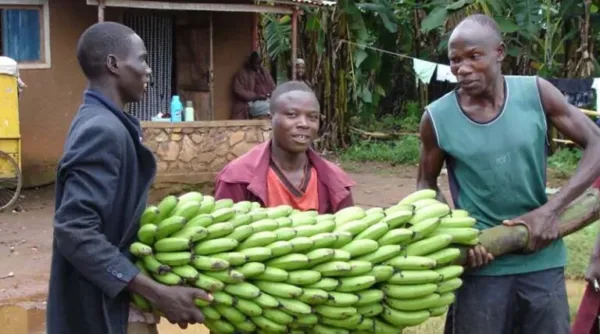

16 April 2026, Tanzania: In Tanzania, nearly half of banana farmers in Kagera have adopted improved varieties introduced through a partnership led by ENABEL and KU Leuven, with CGIAR playing a crucial role in their selection and dissemination, helping secure food and livelihoods for over 125,000 people in the region.
In Tanzania, nearly half of banana farmers in Kagera have adopted improved varieties introduced through a partnership led by ENABEL and KU Leuven, with CGIAR playing a crucial role in their selection and dissemination, helping secure food and livelihoods for over 125,000 people in the region.
Bananas are more than a crop in Kagera, a region in northwestern Tanzania; they are a cornerstone of daily life, culture, and income. For generations, farming families have depended on them for food security and livelihoods.
But this lifeline came under serious threat.
In the late 20th century, devastating diseases such as Fusarium wilt and black leaf streak, alongside pests like weevils and nematodes, began to spread across the region. Yields declined sharply, and the rich diversity of the region's traditional East African Highland Bananas (EAHBs) started to disappear. What followed was an agricultural crisis that put entire communities at risk.
Farmers fought back using the knowledge and resources they had. They introduced banana varieties from other regions of Tanzania and neighboring countries. Yet these efforts brought limited success; without a clear understanding of how pests and diseases spread, the problem persisted.
Working closely with national and international partners, CGIAR helped introduce improved banana hybrids - known as superior banana varieties (SBVs) - developed by the Fundación Hondureña de Investigación Agrícola (FHIA) in Honduras and the International Institute of Tropical Agriculture (IITA) in Nigeria.
From 1997, in partnership with the Government of Tanzania and with funding from the Belgian Agency for International Cooperation (Enabel), the initiative aimed not only to distribute the new varieties, but also to establish community nurseries, conduct on-farm trials, and train thousands of farmers.
It also empowered farmers to share plantlets and knowledge with one another, creating a ripple effect of adoption across the region. Farmer-to-farmer dissemination was critical to accelerating adoption.
Other initiatives, such as the Sustainable Improvement of Banana Cropping Systems Programme, further expanded these efforts, ultimately leading to the distribution of millions of plantlets to farmers.
An impact study by IITA reveals the scale of the transformation. By 2024, nearly 48% of banana farmers in Kagera had adopted these improved varieties, leading to 15% increase in productivity, reduced crop losses from pests and diseases and more farmers producing surplus for markets.
For households, this translates directly into better nutrition. Daily caloric intake among adopting families increased by 27%, reflecting improved food availability and diversity.
The impact extends beyond the farm.
As production increased, so did economic opportunities across the banana value chain. Traders expanded into larger and more distant markets, while processors began favoring the improved varieties for cooking and dessert, and better processing qualities. The region's economy benefited from an estimated 119,000 additional tons of banana production annually, contributing nearly $7 million per year.
Women, who play a central role in banana production, have also seen meaningful gains. Increased income and market participation have strengthened their role in household decision-making and economic empowerment.
Overall, the adoption of improved varieties has led to a significant reduction in food insecurity, with an estimated 125,602 people - over 20,000 households - moving out of food insecurity.
Crucially, farmers themselves have shaped the success of this story. Their preferences - high yields, strong resistance to pests and diseases, adaptability to poor soils, and suitability for cooking, brewing, and markets - are now guiding the next generation of banana breeding.
Building on these decades of partnership, TARI and IITA recently released the "TARIBAN" hybrids, improved Matooke varieties specifically bred for the traits farmers value most: pest resistance, large bunches, and excellent cooking quality.
"Three SBVs are in the process of official registration by the Tanzania Official Seed Certification Institute (TOSCI) to ensure legal protection, facilitate their incorporation into the formal seed system, and support the maintenance of seed quality and availability, while guaranteeing farmers have access to clean, high-quality planting materials certified by TOSCI", explains Dr. Mpoki Shimwela, senior banana breeder at Tanzania Agricultural Research Institute (TARI).
This transformation, from crisis to recovery, shows what is possible when science, partnerships, and farmer-led dissemination come together. The innovations developed over decades are now embedded in local systems, ensuring that banana farming in Kagera is not only restored, but also a renewed source of prosperity and a more secure future.
Global Agriculture is an independent international media platform covering agri-business, policy, technology, and sustainability. For editorial collaborations, thought leadership, and strategic communications, write to [email protected]
Three-year FIRST® partnership connects students in communities across the country to hands-on robotics experience and pathways to careers in agriculture,
22 April 2026, Kenya: At CIMMYT's Kiboko research station in Kenya's arid and semi-arid lands, a quiet but significant transformation is
10 April 2026, Belgium: The Gates Foundation has awarded a $7 million grant to Rainbow Crops to support the development of crop varieties that can