




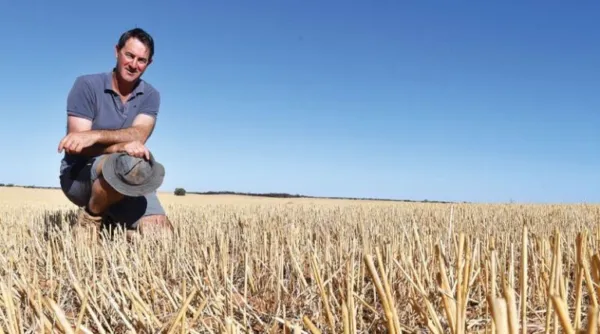

04 May 2026, AU: Ongoing collaboration between growers, advisers and researchers is proving to be key in improving sandy soil productivity in the short and long term.
For CSIRO Principal Research Scientist Dr Therese McBeath, her work is most effective when scientists, agronomists and growers work together. It's why, midway through the national GRDC Sandy Soils II investment, she convened a forum of growers and agronomists from regions where the research is taking place.
Held in Adelaide in February, the forum brought together more than 60 stakeholders to assess outcomes from the first part the project and plot a pathway forward.
For researchers, the opportunity to "pause halfway" to hear from growers and their advisers provided an invaluable insight into the relevance and efficacy of the research, says Dr McBeath, who leads the project.
As remedying sandy soils is a varied and complex issue, consulting broadly also helped to "find common ground" and focus priorities to deliver impact.
"It was a good chance to engage and work out whether we were on the right track or needing to adjust our plans," she says.
For growers, the forum provided an opportunity to hear firsthand from the research team about the latest findings and to share their experiences.
The 2 Sandy Soils investments aim to increase productivity in sandy landscapes.
Ultimately, Dr McBeath hopes the project will support the production of detailed tillage maps for application at the paddock scale, enabling precise amelioration matched with particular constraints.
The first Sandy Soils project ended in 2023 after 6 years. Among its achievements, it:
- tested and refined a range of amelioration techniques including deep ripping, deep ripping with inclusion and spading
- demonstrated significant biomass and yield increases and greater water use efficiency by correctly identifying and treating soil constraints.
It also produced a range of support tools including technical manuals, fact sheets and the Sandbox interactive web app for identifying constraints and treatment options.
These materials provide practical guidelines around the 6 stages of soil amelioration developed in the project:
Sandy Soils II builds on the initial findings and targets research to address knowledge gaps identified by the reference groups in 3 programs:
- Where to start and stop - looking at where, when and how to ameliorate constraints
- Feeding and maintaining the new yield potential
- Post-amelioration management - including the management of new constraints that might emerge such as increasing soil acidity.
For grain grower Mick Pole, a Victorian Mallee reference group member and forum participant, these are critical questions.
His sandy soils at Walpeup include non-wetting deep sand, hard pan (to 250 to 350 mm) and sand over clay (sandy loams).
Over the past 7 to 8 years, his amelioration strategy has included deep ripping the hard pan where appropriate, delivering an immediate "bang for buck" in yield gains.
"We're building confidence every year and all the indications are that there is a very clear response on certain soil types as long as you implement it in the right crop sequence and the right season."
But Mick has found that feeding this new potential with higher inputs has contributed to an increase in soil acidity, with pH levels falling from 6 or 7 to as low as 4 in some areas.
It's becoming clearer that acidity has increased along with no-till, intensive cropping and high fertiliser use in our low-rainfall environment, so we're a bit of a victim of our own success.
"We're starting to bring in lime, and our soils are high-performing when we get it right, so we need to learn to adjust accordingly without overdoing it," he says.
Along with post-amelioration management, Mick also welcomes the spatial component of the research to help refine where, when and how to improve his sandy soils. He says he has taken a cautious approach over the past couple of years to ensure he gets his amelioration strategy right and doesn't inadvertently cause a negative response in his soils.
Research showing where amelioration hasn't had its intended impact is equally as useful as showing where it has, he says. "There is money to be made but also money to be saved in this game, so I'm waiting for the outcomes of the latest research trials before we launch into investing in machinery that may or may not fix our problem."
For Mick, much of this research is particularly pertinent. Involved in the Sandy Soils project from the beginning, he has hosted several trials into liming rates and the impacts of ripping at various sites across his 6,000 ha property.
Although hosting trials takes time and effort, Mick says the "power and knowledge" the Sandy Soils research is bringing to the region makes it worthwhile. Plus, he gets a unique, hands-on insight into the specifics of his own farm.
"I'm all about trying it out," he says. "I don't get so much out of going to someone else's farm and asking, 'will that work on my farm?' But if I see it on my soil type, in my conditions, I can fully understand the picture."
Ultimately, he hopes the research at his site and others will feed into the development of technology that will enable growers to start and stop amelioration and liming with precision for optimal productivity and ongoing soil health.
"I would like to be able to stick a variable-rate map in the spreader to put out the lime, and have a similar map for the multi-tool - or whatever other machine we're using - to ameliorate the soil precisely where it's needed," he says.
Mick says attending the forum was an opportunity to help shape the research in line with growers' needs on the ground, while meeting and learning from the researchers and peers facing similar challenges.
"You're mingling with others and you get that verification about what you're doing and confidence that you're on the right pathway," he says.
Many of the forum participants, including Mick, were from 4 reference groups representing regions with sandy soils in South Australia and Victoria.
Established before any trials were put in the ground, these groups made up of growers, advisers and researchers help guide and review the research across some 23 trial sites.
Led by research agronomists Dr Melissa Fraser (SA Mallee), Michael Moodie (Victorian Mallee), Sam Trengove (SA Mid North) and Brett Masters (Eyre Peninsula), the groups meet individually twice a year with the project team to help plan the research and review results.
Dr McBeath explains that the groups were established on the back of an initial 2016 "roadshow" with growers whose feedback set the direction of both the Sandy Soils I and II projects.
"When we started the Sandy Soils investment, we stood in paddocks with interested growers and asked what their key constraints were, what they had tried and what they thought would and wouldn't work," she says.
Dr McBeath says this collaborative approach ensures the research is aligned with growers' needs. And as a researcher, it gives her insight, ideas and purpose.
"We're trying to develop a more productive system together to deliver impact on farm," she says. "And to generate that impact the growers and their advisers need to be at the centre of what we do."
The Sandy Soils II forum was convened by project lead Dr Therese McBeath (CSIRO) and facilitated by project partner Dr Melissa Fraser from Soil Function Consulting and Felicity Turner from Turner Agri.
Dr Fraser also spoke as research agronomist and regional reference group lead, representing the SA Mallee along with Michael Moodie (Victorian Mallee), Sam Trengove (SA Mid North) and Brett Masters (Eyre Peninsula).
Wayne Parker, a Senior Research Scientist with the Department of Primary Industries and Regional Development (DPIRD) in Western Australia, also provided insights from the GRDC-DPIRD Soil, Water and Nutrition (SWAN) investment.
There were updates from CSIRO project associates Dr Kenton Porker (feeding the new yield potential) and Dr Stirling Roberton (when to start and stop), and a machinery update from Dr Chris Saunders from Adelaide University. A panel of growers from SA and Victoria also shared their experiences.
To reach a wider audience, the team is planning a range of events including workshops and masterclasses throughout 2026 and 2027.
Events will be tailored to subregional issues and will cover a range of stages through the amelioration process, Dr McBeath says. There will be introductory classes for those starting out, and workshops on precision ag for those refining strategies around when, where and how to ameliorate based on what has been working or what hasn't.
"Whether you're just beginning or looking for one more layer or one more piece of information to add value, we're wanting to give people something they can take away and implement on their own property," Dr McBeath says.
Global Agriculture is an independent international media platform covering agri-business, policy, technology, and sustainability. For editorial collaborations, thought leadership, and strategic communications, write to [email protected]
06 May 2026, Basildon: CNH (NYSE: CNH) has announced that three models from its Case IH, New Holland, and STEYR® brands, have
06 May 2026, Switzerland: New evidence and expert discussions highlight how climate change and rice production systems are converging to influence
29 April 2026, New Delhi: The National Bank for Agriculture and Rural Development (NABARD) has acquired equity stake in 24×7 Moneyworks