




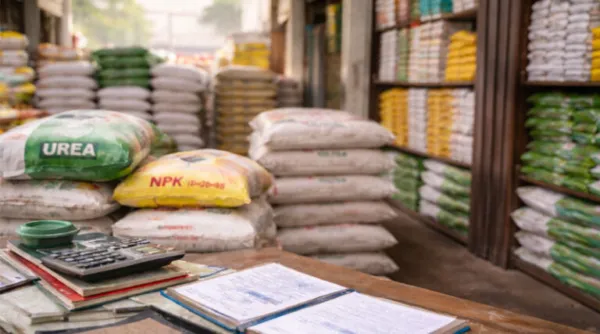

14 March 2026, Ujjain: A recent directive issued by National Fertilizers Limited (NFL) to sharply increase security deposits for fertilizer dealers in Madhya Pradesh has triggered strong opposition from the dealer community across the state.
According to dealers, the revised policy raises the required security deposit in some cases by nearly ten times, a move they describe as impractical and contrary to normal business practices.
Fertilizer dealers argue that the decision comes at a time when the global fertilizer market is already facing uncertainty. Rising geopolitical tensions in West Asia, particularly the ongoing conflict between Iran and Israel have created volatility in fertilizer supply chains and international prices. Dealers say that imposing a sudden and steep increase in security deposits under such conditions places an additional financial burden on the distribution network.
Members of the dealer community stressed that fertilizer distributors act as a critical link between companies and farmers. However, they argue that the new requirement effectively creates a financial barrier for many small and medium-scale dealers who are already operating under tight margins.
"Dealers form the bridge between fertilizer companies and farmers, but this decision appears to place a financial wall on that bridge," said Krishna Dubey, a fertilizer dealer from Indore.
According to Dubey, agricultural input traders are already dealing with multiple pressures including bank loans and interest liabilities, fluctuating business volumes due to weather variability, and delayed repayment of credit extended to farmers. Under such circumstances, the expectation that dealers immediately deposit significantly higher security amounts overlooks the financial realities faced by the retail distribution network.
Dealers have urged NFL to reconsider the decision and engage with stakeholders before implementing such policies. They argue that any major financial requirement should be assessed against ground-level market conditions and the operational challenges faced by agri-input retailers.
Industry participants also warn that measures affecting dealer liquidity could have downstream implications for fertilizer availability in rural markets. If dealers are forced to divert large amounts of working capital toward security deposits, it may reduce their capacity to maintain adequate fertilizer stocks during critical cropping seasons.
The issue has sparked discussions within the agricultural input trade community in Madhya Pradesh, with dealers hoping that the company will review the directive and arrive at a more practical solution that balances corporate safeguards with the operational realities of the fertilizer distribution system.
Global Agriculture is an independent international media platform covering agri-business, policy, technology, and sustainability. For editorial collaborations, thought leadership, and strategic communications, write to [email protected]
18 March 2026, Texas: As the U.S. cattle herd falls to a 75-year low and beef prices climb to record highs,
18 March 2026, Ethiopia: Agriculture is Ethiopia's dominant economic sector, contributing 31.8% to national GDP and growing at an annual rate of 6.9%. Yet
18 December 2025, Abidjan: The Board of Directors of the African Development Bank Group (https://AfDB.org) meeting in Abidjan today approved a €102.12